Friday, 21 September 2012

“It is absurd, malicious and ultimately laughable” – Aviation Minister reacts to Arik’s allegation


24 hours after Arik Air, announced that they were suspending local flights, they came out to point accusing fingers in the direction of the Aviation Minister. The allegation, was that Mrs Stella Oduah, had demanded 5% equity from the airline. And when they refused to grant her the request, she set in motion the scheme to run them down.
But in a press release received by DailyPost this evening, the Minister has come out to deny all the allegations categorically, stating that there is no atom of truth in them.

Full release:
ARIK AIRLINES’ CONFLICT OF INTEREST ALLEGATION LAUGHABLE, DIVERSIONARY
The attention of the Honourable Minister of Aviation, Princess Stella Adaeze Oduah, OON, has been drawn to a fabrication credited to the Management of Arik Airlines, to the effect that the Minister demanded a 5 percent equity holding in the airline. The story alleged a Ministry of Aviation hostility against Arik on account of the so-called equity demand that it claimed to have turned down!
The first impulse is to totally ignore this groundless falsehood. Except that it will send the wrong signals to the general public. Therefore, the sole intent of this release is to put the records straight.
The 5 percent equity story is without any foundation whatsoever. It is absurd, malicious and ultimately laughable. The Honorable Minister of Aviation could not have contemplated acquiring a stake in any airline, let alone Arik Air that is groaning from a crippling N85.4 billion debt overhang.
The time is ripe for Arik Air to change its business module that ‘thrives’ on unprecedented accumulation of debts and liabilities. The futile attempt to impugn the integrity of the Aviation Minister by inferring a conflict of interest against her is at best diversionary. It should be obvious to the management of Arik Air that blackmail is not a panacea for a floundering enterprise.
The Honourable Minister of Aviation has directed her lawyers to seek legal redress for this malicious allegation by Arik Air.
Joe Obi
SA (Media) to the Aviation Minister.
DailyPost

Harness Resources For Dev Of Edos - Apostle Okundaye


BENIN CITY – The need to harness the knowledge, wisdom and resources of Edo people for the benefit of all the citizen has been canvassed by the President of Edos in Diaspora for good governance in Nigeria Most Senior Apostle Edobor Okundaye.

Apostle Okundaye stated this in his message at the inaugural meeting of Edo State Chapter of Edos in Diaspora for Good Governance in Nigeria held in Benin City recently.

The president in his message delivered by the international liaison officer Mr. Eddy Ogunbor said Edos in Diaspora for Good Governance in Nigeria is a platform where indigenes of Edo State abroad can channel their support, ideas and grievances.

He said this can only be achieved through active collaboration and cooperation of all Edo people at home and abroad, irrespective of political inclination.

Apostle Okundaye pointed out that there is need to revolutionize the way the affairs of governance in Edo State is being run, hence the need for all Edos at home and abroad to come together to chart a common course.

The Chairman and convener of Edo State Chapter of Edos in Diaspora for Good Governance in Nigeria Chief Johnson Usen, the Osa of Benin Kingdom and retired Commissioner of Police while welcoming members said the vision of the group is to strive for good governance at all levels in Edo State in particular and Nigeria in general irrespective of the government of the day.

Chief Usen explained that it is aimed at ensuring that the dividends of democracy get to all citizens in the state, adding that the respect for human right should be seen as the norm rather than as a privilege.

The chairman enumerated the aims and objectives of the group to include, the promotion of social, educational, economic and cultural welfare of Edo people, to defend the territorial boundaries of the state in collaboration with relevant government ministries, department and parastatals, to promote and coordinate the activities of Edos at home and abroad for the general welfare and progress of Edo people, to organize and pursue initiative that support good governance in Edo State, among others.

Chief Usen said the group will also encourage and promote the principles and practice of good governance in Edo State, which will lead to equitable creation and distribution of wealth, in order to eliminate poverty among the people.
  Visit our website today for ur registartion free of charge. 
http://www.edggn.org/

Nigerian Observer


President Goodluck Jonathan is suffering from bad conscience - Prof. Wole Soyinka

print this page
Save web page to PDF free with www.web2pdfconvert.com
send email
Nobel laureate, Professor Wole Soyinka, has blasted President Goodluck Jonathan over his recent comment that the January mass protest against fuel price hike in Lagos was stage managed, accusing the president of suffering from bad conscience. The world class scholar in a statement entitled "NOT AGAIN, JONATHAN!!!", and obtained by our team today said Jonathan's comment shows" he is lamentably alienated from the true pulse of the nation."The full text of Soyinka's statement reads in full:
"The most generous response that can be given to President Jonathan's recent statement on the people's fuel subsidy protest is that he is suffering from a bad conscience.  The worst  – which I fear is closer to the truth – is that he is lamentably alienated from the true pulse of the nation, thanks perhaps to the poor, eager-to-please quality of his analysts, those who are supposed to provide him an accurate feel of the public mood. Since I have had the opportunity to contest this perception of the protest with him directly, it is clear what kind of interpretative diet he prefers. The nation needs all the luck it can get.
The president sent in the army and shock Police squads to forcibly seize and occupy grounds from a demonstrating public, a violation of the people's rights as entrenched in the constitution, a right – as it happens – that has been further consolidated by a pronouncement of the courts of law.  This should be seen as a grave danger to democracy, and a warning. Both the participants, and those who – myself included – even though unable to be present, lent both vocal and moral support to the demonstration, have been maligned and insulted by such reductionist reasoning. The culture of public protest appears to be alien territory to President Jonathan, which is somewhat surprising, considering the fact that he has not only lived in this nation as a citizen but served in various political offices. He has lived through the terror reign of Sanni Abacha whose ruthless misuse of the military and the secret service did not prevent demonstrations against perceived injustice and truncation of people's rights.
Jonathan's pronouncements truly boggle the mind. What is this obsession with bottled water, comedians and musical artists? Must demonstrators drink water from the gutter? Is protest no longer viable when sympathizers cater to their needs, supply decent water and food rations?  And since when have entertainers been deemed a sign of unseriousness in a protest rally. Static or moving, demonstrators boost their morale in any way they can, including dancing and even mini-carnivals. Sit-down occupation and hunger strikes are also legitimate public weaponry against unacceptable state conduct and policies. It may interest the president to know that during the SNG protest march on the legislative houses, a march, not for any individual, but for the sanctity of the constitutional rules of succession, discussions were on for the acquisition of Mobile Toilets for the next stage, in case the protests attained the momentum of continuous encampment. Presumably Jonathan would have preferred to march into office over a field of human waste.
What is especially ominous in Jonathan's distortive re-visit of that campaign is his attitude of self-commendation, from which one deduces a clear intent to repeat the same action if the people choose to exercise their right of assembly in the future.   It sounds warning of a state of mind infected by one of his predecessors who was never weaned of his military antecedents, a predisposition to intolerance of dissent that was expressed in mindless muscularity and contempt of judicial decisions.  We should not wait for a tragedy to happen before we serve notice that democracy is incompatible with the arbitrary deployment of armed forces against a people gathered or marching peacefully in freedom, articulating their grievances with or without accompaniment of songs, clowns, water sachets or bottled water. The reaction of the public to attempts at military intimidation is always unpredictable – government at the centre should know its limitations, act responsibly, and refrain from incursions that override even the expressed wishes of state governors, and the rights of a people rendered fractious by decades of misgovernment.
Let there be no further attempts at revisionism. The Nigerian people's right to gather and protest remains inviolate.  Gani Fawehinmi
Park – and any place of choice for a people's assembly – is a people's space. It should never again be invested by menace and attempted coercion.
- Wole Soyinka

President Jonathan's Economic Advisers Owing Nigeria N1.3 Trillion; CBN Bars Banks From Doing Business With 419 Deadbeat Companies And Individuals


Members of Jonathan's Economic management team
By SaharaReporters, New York
An explosive Central Bank of Nigeria (CBN) circular published today by a local Nigerian newspaper lists some of President Goodluck Jonathan's economic advisers among the country’s worst deadbeat debtors.
Some of the worst offenders are household names: Mr. Femi Otedola, Alhaji Sayyu Dantata, Sir Johnson Arumemi-Ikhide, Prof. Bart Nnaji, Mrs Elizabeth Ebi and Dr. Wale Babalakin.
And businesses too: Zenon, Arik, MRS, Aero Contractors, Capital Oil and Gas, to list just five.
But now local banks are barred from extending even one more kobo of credit to them until they clear all debts.
The big debtors are also among the nation’s richest companies and individuals, and their extensive uncollateralized loans from Nigerian banks to the tune of billions of dollars led to the collapse of the banking sector.
Several of the debtors were also involved in the petroleum subsidy scam that bled the Nigerian economy of some $6.5 billion.
Instead of prosecuting the predatory lenders and borrowers the Jonathan government pushed the problem aside by setting up a bogus body known as the Asset Management Corporation of Nigeria (AMCON) to absorb the debts and enable the debtor roam free and engage in more economic crimes.
They apparently roamed far and wide, all 113 companies and 419 directors/shareholders.  419 is the actual number given by the CBN.  
The document circular obtained by Thisday, dated last Monday, September 17, showed that the disdain by these rich individuals and companies for their debts has grown so much that the CBN decided to bar banks in the country from extending further credit to them.
“It has become necessary to stop debtors who failed to repay their loans to banks and had these loans subsequently transferred to AMCON, from further enjoying credit facilities from Deposit Money Banks (DMBs) until they fully repay agreed outstandings to AMCON,” said the circular, which was signed by CBN’s Director of Banking Supervision, Mrs. A. O. Martins.
According to ThisDay:
•    The circular, which was accompanied by a detailed list of the blacklisted debtors, showed that worst hit by the directive are Zenon Petroleum, owned by Otedola, which was indebted to banks to the tune of N192.4 billion; MRS Holdings Limited, which belongs to Dantata  – N119.98 billion; Seawolf Limited – N98.32 billion; Arik Air Limited, belonging to Arumemi-Ikhide  – N85.481 billion; NITEL Plc/M-Tel  – N71.547 billion; and Capital Oil and Gas Limited, which belongs to Ifeanyi Ubah – N48.014 billion.
•    Others include Falcon Securities, whose Managing Director, Mr. Peter Ololo, was arraigned alongside several bank executives in 2009 by the Economic and Financial Crimes Commission (EFCC) – N162.9 billion; Rockson Engineering Limited, owned by Arumemi-Ikhide – N60.475 billion; BGL Securities – N6.44 billion; Rahamaniyya Oil & Gas Limited – N46.38 billion; Bi-Courtney Limited – N20.214 billion; and Geometrics Engineering, owned by Nnaji – N19.76 billion.
•    The restriction also applies to: Aero Contractors Company, owned by the family of Olorogun Michael Ibru - N32.579 billion; Tinapa Business Resort – N18.509 billion; Nestoil Limited, belonging to oil and gas entrepreneur, Ernest Azudialu – N13.506 billion; Dorman Long Engineering – N9.667 billion; Ascott Offshore Nig. Ltd, belonging to former banker, Henry Imasekha and the Berkley Group – N64.728 billion; Gitto Constuzioni – N11.838 billion; and Dansa Foods – N14.880 billion, whose directors, Sani and Abdul Dangote, are the brothers of business mogul, Alhaji Aliko Dangote.
Furthermore, the banks have also been directed not to grant further credit to two States: Cross River and Zamfara, because of the failure of the Tinapa Business Resort and the Zamfara Accountant General to pay back loans collected.
The Central Bank warned that any bank that flouts the guidelines would be made to make an immediate provision of 100 per cent of total principal and interest outstanding in the account of the customer and related parties, in addition to whatever regulatory penalties the CBN may decide to impose, ThisDay said. 

Annan: Why we should grade countries on their elections


By Kofi Annan, Special to CNN
Mexicans casting their ballots on July 1 to vote for the country's next president.
STORY HIGHLIGHTS
  • Kofi Annan: Democracy is a universal value and aspiration, unbound by region or culture
  • Annan: For democracy to fulfill its potential, we must have fair and credible elections
  • He says threats to democracies -- both old and new -- must be overcome
  • Annan: We can grade countries on their elections and sound off alarms on electoral malpractice
Editor's note: Kofi Annan is the chair of the Global Commission on Elections, Democracy and Security. From 1997 to 2006, he served as the seventh Secretary-General of the United Nations.
(CNN) -- Democracy is a universal value and aspiration, unbound by region, ethnicity, culture or religion. In the last two decades, it has spread across the world in unprecedented ways.
Elections are fundamental to the ethos and principles of democracy. They provide citizens with a say in the decisions that affect them and governments with a legitimate authority to govern. When elections are credible, free and fair, they can help promote democracy, human rights and security.
But when elections are fraudulent, as we have seen in a number of countries, they can trigger political instability and even violence. This means that for democracy to fulfill its potential as a means of peacefully resolving social and political conflict, the integrity of elections is crucial.
Kofi Annan
Kofi Annan
Threats to electoral integrity are not limited to poor, divided or war-torn countries. They can be found in every democracy. Many of the countries that embraced democracy in the last 20 years now struggle to entrench democratic governance. In some long-standing democracies, citizen trust and confidence in democratic institutions have dropped precipitously.
Global recession and rising inequality are putting pressure on older democracies to show that they are relevant to their citizens' concerns. The infusion of money in politics, for example, threatens to hollow out democracy.
And recent events in the Middle East and North Africa demonstrate that revolutionary transitions hold both opportunities and dangerous pitfalls.
In response to these concerns, a group of former political leaders and leading figures have come together to create the report, "Deepening Democracy," which stresses the crucial importance of integrity in elections in advancing democracy, security and development.
Elections with integrity by themselves will not build citizen trust in democracy. But they can be an important step in achieving the goal. Our report identifies five challenges for countries to overcome.
First, the need to strengthen the rule of law so that elections and the rights of voters and candidates can be protected.
Second, professional and independent national bodies should manage elections so that they are credible and the results are legitimate. I saw for myself in Kenya the catastrophic impact of the failure of the country's electoral commission to deliver these goals in the 2007 disputed presidential contest, when 1,300 people were killed and over 600,000 displaced in waves of unprecedented post-election violence. We must prevent this kind of tragedy from ever repeating.
Third, greater efforts are needed to build the institutions, processes and behaviors that are vital for genuine multi-party competition and division of power. They would bestow legitimacy on the winner, provide security for the losers, and end the "winner-takes-all" politics that discourages democratic practice.
Fourth, the integrity of elections requires political equality. The barriers that prevent voting and wider participation in political life must be removed. Too often, women, young people, minorities and other marginalized groups are not given a full opportunity to exercise their democratic rights.
Finally, unregulated money in politics undermines voters' faith in elections and confidence in democracy. Vote buying and bribery of candidates, including by organized crime, have to be prevented in both aspiring and mature democracies. And we must tackle the explosive growth in campaign expenditures that is damaging confidence in electoral equality by strengthening fears that wealth buys political influence.
These are all, of course, political challenges. But politicians cannot resolve them alone. Civil society and the media play their roles and have responsibilities as well.
In addition, international funding ought to support democratic reform and electoral integrity rather than, as happened too often in the past, prop up authoritarian regimes. This entails increased efforts to prevent abuse throughout the political and electoral cycle and not just around a particular ballot.
Our report provides a strategy on a global level. Governments need to regulate political donations and spending, and require full transparency and disclosure of donations with penalties for non-compliance. Organizations that manage elections in each country must come together to create international standards of professionalism, independence and competence against which they agree to be measured.
A new transnational organization should be created to grade countries on their elections and to sound the alarm about electoral malpractice. The international community can then agree clearly on "red lines" of extreme electoral abuse, which would trigger condemnation and, if necessary, sanction.
Such a program for delivering elections with integrity -- with its emphasis on inclusion, transparency and accountability -- can promote better governance, greater security and human development.

Thursday, 20 September 2012

Chukwumerije May Lead Impeachment Move Against Jonathan


Some prominent senators have warned that President Jonathan will be at the risk of impeachment if he continues to ignore resolutions passed by the National Assembly. Senator Uche Chukwumerije (PDP, Abia), apparently worried over the executive’s impunity, said: “The Ahmad Lawan report is the highest moral ground of the Seventh Senate so far.
It was that report that convinced everybody, the public, that the hope for this country lies with the Senate; that there’s still one body that’s concerned with the nation which lies far above sectionalism.
Chuwkumerije offered to lead the motion on the president’s impeachment if nothing is done to curb rising corruption in Nigeria, which he blamed on non-implementation of the National Assembly’s resolution prescribing punishment for indicted public officeholders.
He said, “The BPE report shows uninhibited siphoning of public funds through all sorts of subtleties into private pockets and private companies. We must pass a resolution calling on the attention of Mr. President to the main body of that report.
“As of two weeks ago, with Lawan and others I started collecting signatures that, if we could collect two-thirds or so, we are going to get it here -- a motion that gives marching order to Mr. President to do something about this report, or else…
“We are getting to that stage in this country. We cannot continue like this with the impunity in which they continue looting public funds and nobody is saying anything. When it comes to the stage of threatening impeachment, Uche Chukwumerije will do it and move a motion.
“The pattern in this country all along has been one siphoning of country funds through all sorts of legal subtleties to private pockets and private companies.
“And for the first time, there was a bold report that exposed the rot and we called for a reversal of this pattern...unfortunately, it is business as usual. It is, therefore, in the interest of this Senate that, in addition to what we are doing on this Act as we are doing now, we must pass a resolution calling the attention of Mr President to the main body of that report.”
The outburst was sequel to a bill for an act to amend the Public Enterprise (Privatization and Commercialization) yesterday, which was sponsored by Senator Ifeanyi Okowa. They all chorused that they were vexed by the constant non-implementations of its resolutions, adding that the actions amounted to bad governance.
Consequently, the Senate demanded that President Jonathan should implement its resolution on the probe of the Bureau of Public Enterprises, BPE, by immediately sacking the director-general, Ms. Bolanle Onagoruwa, who was indicted for gross misconduct in the sale of government enterprises.
Deputy Senate president Ike Ekweremadu, who presided over the bill, urged President Jonathan to ignore claims by the minister of information, Mr. Labaran Maku, that National Assembly’s resolutions are mere advisory tools which can be implemented or ignored by the federal government without any consequences. Said he: “I do not think we need the minister of information -- indeed any minister -- to remind us that our resolutions are not binding, just as we do not need to remind him that he was not elected. So we know that our resolutions are not binding, but the decisions we take in this Senate, especially regarding the resolutions, are all well thought-out.
“They are borne out of patriotism, they are well researched and it is the amalgamation of the views of very responsible Nigerians. And, to that extent, it is very persuasive and anybody who is ignoring the resolutions of this Senate is doing it at the expense of good governance and we cannot encourage such a thing.
“We believe that this is an opportunity for Mr. President to go and look for the resolutions of the Senate regarding the BPE investigation. If there are very fat buttocks that are sitting on it, I think he should use his executive powers and push them out and get the report out and begin to implement them for the overall interest of this country.”
The chairman of the ad-hoc committee that conducted investigation into sale of government enterprises by the BPE, Senator Ahmed Lawan, in his contribution, urged Jonathan to implement all the recommendations.
He urged the president to ignore comments from Maku, adding that Senate resolutions are on critical issues which are meant to move the nation forward.
According to him, “It is time that the BPE resolution of the Senate that had been passed to Mr. President for his action is considered forthwith. Mr. President must ignore people like Labaran Maku who will always tell Nigerians, unfortunately, that the resolutions we passed are only advisory and have no weight and do not matter.
“While it is true that the resolutions of the National Assembly are advisory, members of the National Assembly passed a resolution that is so important, so critical to making Nigeria work; therefore I urge Mr. President to now take immediate action on the BPE resolution passed by this Senate.”
Leading the debate on the bill, Senator Okowa noted that the amendment would enhance security of public enterprises by allocating 5 per cent shareholdings to staff and host community of any privatised government enterprise.
He said: “The amendment provides for not less than 5 per cent of shares to be offered to Nigerians, to be reserved for the host communities of the public enterprises to be privatised, and also proposed not less than 5 per cent of such shares for sale to be reserved for the staff of the public enterprise.
“The import of this amendment is to enhance the security of the public enterprise as both the staff of the enterprise and the host community will buy into the process of the privatisation and would, as co-owners, protect such enterprise post-privatisation.”
Senators were in support of the bill. Many of them that spoke maintained that allocating 5 per cent share to the host community and staff of a privatised public enterprise would enhance the survival of the enterprise and boost the economy.
Senator James Manager, PDP, Delta, speaking in support of the bill said 5 per cent shares would give the host communities and staff a sense of belonging.
German hospital dispels first lady’s death rumour
Contrary to rumours that First lady Patience Jonathan had passed away yesterday in German Hospital where she is receiving medical attention, a reliable source confirmed to LEADERSHIP that  she is alive but in a critical condition.
The first lady has been in Horst Schmidt Klinik for over four weeks where she underwent a major operation to remove some poisonous substances from her intestines, following ruptured appendix.
Leadership
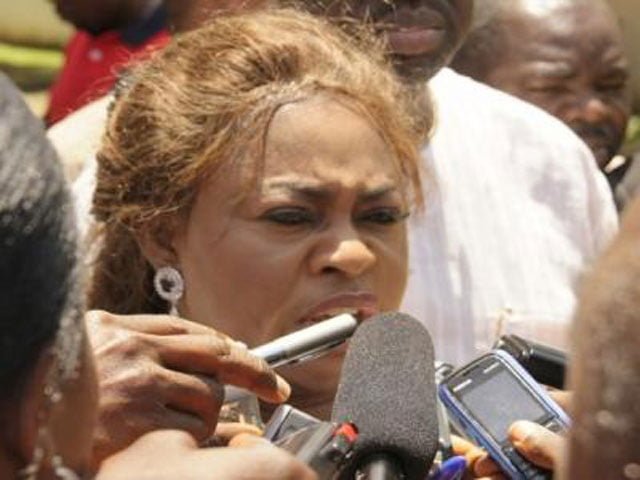
Shuttered Arik Air Accuses Aviation Minister Of Demanding 5% Share


Minister of Aviation, Stella Oduah
By SaharaReporters, New York
Officials at Arik Air, whose domestic flight operations across Nigeria were grounded earlier today, have claimed that the carrier was forced out of business for refusing to part with 5% of its corporate shares as Aviation Minister, Stella Oduah, demanded.
Today, the beleaguered airline circulated a text message accusing Ms. Oduah of vindictively fomenting crisis within the airline for denying her demand to receive a stake of 5% in Arik. The text message read, “Due to persistent hostility of the Ministry of Aviation, with a minister who is demanding a 5 percent equity in a business where she has no investment...and FAAN management, which has culminated in the use of FAAN staff to stop the airline operations and lock in checked-in passengers in Lagos this morning, Arik Air has suspended all domestic operations until further notice. This issue [borders] on personal interests and not payment of bills; since FAAN has been collecting.”
Speaking this evening to SaharaReporters, a senior official of Arik defended the airline’s account of the source of the company’s woes. “It is a pity that a minister can cause so many problems for an airline just because she did not have her way,” the official said.
Ms. Oduah is regarded as one of the closest ministers to President Goodluck Jonathan. In the 2011 general election, she served as treasurer for Mr. Jonathan’s campaign. The Arik source claimed that the minister pressured owners of the airline to hand her a 5% stake in the ownership of Arik, asserting that she was making the demand on behalf of President Jonathan.
The shady and crisis-prone airline is believed to be owned by interests who benefited massively from grand corruption during the administration of Governor Peter Odili of Rivers State and the tenure of former President Olusegun Obasanjo.
The source at Arik also accused the Aviation minister of instigating Arik workers to go on a strike that grounded the airline’s domestic operations today. The workers reportedly went on strike to pressure their employers to pay debts owed the Federal Aviation Authority of Nigeria (FAAN). “Is it not curious that workers at a private airline are going on strike to demand that their employer should pay debts owed to the federal government?” our source asked. He added, “That should tell you that something fishy is happening, and also who is behind the nonsense.”
Another source in the aviation industry said she agreed with Arik’s assertion that Ms. Oduah was behind the airline’s trouble. She told SaharaReporters that Ms. Oduah’s actions against Arik were related to the recent controversial decision to let Dana Airline resume flight operations after one of the airline’s planes crashed early June in a heavily populated area of Lagos, killing close to 170 people.
“We have received reports that minister received hundreds of millions of naira [in bribe] from Dana authorities to restore their license to operate,” said the source. She added that the Dana management was actually surprised by the urgency with which their airline’s license was restored. “You should bear in mind that Dana had not paid a quarter of the insurance payments to families of the casualties in the June 3rd crash of Dana Flight 992 in Lagos,” said our source, an aviation expert. She said it was eye-opening that the management of Dana issued a statement claiming that they had not bribed anyone to influence the restoration of their license.
The aviation source also recalled that the restoration of Dana's license coincided with a bizarre order by a federal high court judge effectively stopping a coroner inquest that was initiated by the Lagos State government at the prompting of Femi Falana, a human rights attorney.
The controversial court order arose from a suit filed in Lagos by a hitherto unknown group by the name of “Civil Aviation Round Table Initiative.” In a curious twist, the federal government took the same position as Dana in its response to the lawsuit. Shortly afterwards, the Jonathan administration restored Dana’s license as Ms. Oduah openly declared that the government had made a huge mistake in suspending the airline’s license in the first place.
Ms. Oduah is also believed to be the spirit behind a renewed effort by the federal government to create a national airline for Nigeria. The country has had a terrible record of maintaining a national carrier, with previous attempts hobbled by bureaucratic bottlenecks, financial mismanagement, and poor technical management.