Friday, 28 September 2012

Deputy governorship aspirants sell programmes in Ondo, Mimiko’s running mate shuns debate


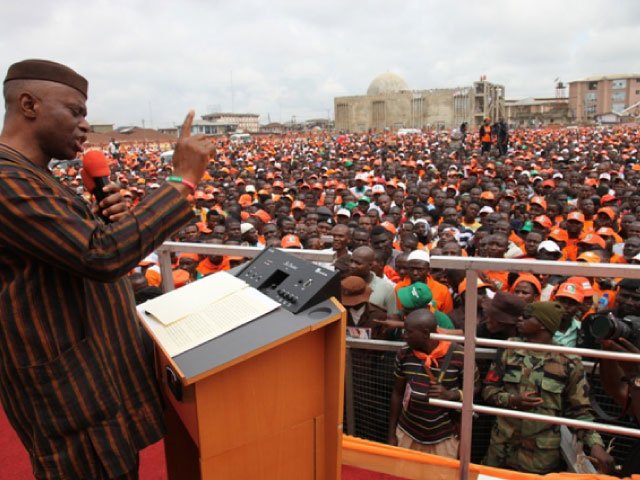
The debate for October 20 governorship election in Ondo state entered its second lap yesterday with six deputy governorship candidates highlighting the programmes of their various political parties.
The debate which was organized by Nigeria Elections Debate Group(NEDG) was attended by the Deputy candidates of the People’s Democratic Party (PDP) Saka Lawal, Moses Losha of People for Democratic Change (PDC), Alonge Ahmed of the PPA, Babatunde Bidemi , Change Advocacy Party (CAP) and Cornelius Adefila of the National Solidarity Democratic Party( NSDP) as well as Paul Akintelure of the Action Congress of Nigeria (ACN). Meanwhile, the Labour Party (LP) deputy governorship candidate Alhaji Ali Olanusi shunned the event.
According to the ACN candidate, Dr. Paul Akintelure the present government had abandoned its people for too long and the people must be delivered from visionless administration.
He assured that people in rural communities that they would benefit from ACN government that is people- oriented.
The Medical practitioner said the citizenry would taste real dividends of democracy in contrast to the ongoing situation in the state where people are living in abject poverty.
Akintelure who cited examples of other ACN controlled neighboring states like Osun, Ekiti, Oyo, Ogun, Lagos and Edo states said the citizenry in the sunshine state would start enjoying the benefits of progressive government with effect from February 13, 2013.
The PDP candidate, Saka Lawal said he would bring positive change to governance. This policy programme, he said would bring the much-expected economic rebirth for the people of Ondo state if elected.
He said that the PDP government would provide quality jobs through economic policies that will be targeted at the youth of the state, while all the moribund industries all over the state would be resuscitated.
On education, Lawal said rather than promoting the idea of mega schools that actually meant to siphon the state resources, the PDP government will improve on various infrastructures put in place by Agagu’s administration between 2003 and 2009.
The candidates of PPA, PDC, and CAP were not left out in dishing out their agenda for the State particularly on employment generation, adequate security, qualitative education, as well as solid infrastructures.
The Akeredolu Campaign organization (ACO) has described the refusal of LP deputy governorship candidate, Alhaji Ali Olanusi to show up at the debate as not only a sign of contempt for the people of the State but showed that the ruling Party has nothing to show for the three years of governance in the State.
A statement by its spokesman, Idowu Ajanaku said the debate had the ACN Deputy Governorship Candidate, Paul Akintelure, PDP Saka Lawal, PPA, ACPN and others afforded the parties’ flag bearers to expatiate on their vision and programmes for the people of Ondo State.
It was said that “Indeed, Dr. Akintelure came tops, but with the absence of Olanusi, LP was robbed of the golden opportunity to roll out its achievements and convince the people of Ondo State on why they should vote for the party”

DailyPost

CBN Moves to eradicate E-Payment Fraud


The Central Bank of Nigeria (CBN) has issued out a communiqué to banks as well as other financial institutions to put all hands on deck to combat cybercrimes as well as electronic payment fraud, to sanitize the financial system.
CBN, made this call through Director, Financial Policy and Regulation Department, Mr. Chris Chukwu, at the September version of the Nigeria Electronic Fraud Forum (NEFF) in Lagos.
Represented by Mr. Sebastine Barde, Chukwu said, “A common problem associated with e-payments platforms is their use by cyber criminals who take advantage of inadequate controls in the payment platforms.”
“We noted that Automated Teller Machines were introduced in 1993 without adequate guidelines and embedded security controls. The machines were using magnetic strife cards, which were susceptible to cloning hence the myriad complaints of illegal withdrawals from customers’ accounts by cyber criminals.”
He stated that before 2011 complaints were very alarming but following the migration of Euro Master Visa card last year, even though complaints have reduced now considerably; “we intend to leave no stones unturned.”
However, with the migration of in February 2011, such complaints have dropped substantially in 2012.”
“E-payments are consequently globally favoured and rapidly pursued by nations because they are efficient, convenient, cost effective, transparent, secured, fast, and accurate, reduce corruption by minimizing interaction of government’s officials with contractors and leaving trails, provide better visibility into an entity’s spending, afford ability to leverage financial incentives on transactions, as well as advanced fraud protection.” He said.
“It is therefore no exaggeration to say that e-transactions have comparative advantages over cash-based transactions. The cost of currency management is usually a high figure in the accounts of any central bank of a cash-based economy.”
According to Chukwu, e-payments were designed to automate, integrate, and simplify the payment process.
BusinessNews

Sanusi Breaks Silence on N5000 Note Suspension, Calls for CBN Autonomy


CBN Governor, Lamido Sanusi; and Deputy Governor, Tunde Lemo
“Do not temper with CBN autonomy,” This was contained in a in a message issued out yesterday to the National Assembly by the CBN boss, Governor Sanusi Lamido Sanusi and former Information Minister, Frank Nweke (Jr) .
Speaking at the 2012 Annual Public Lecture organised by the law firm of J-K Gadzama & Partners LLP, Mallam Lamido Sanusi, said if politicians are allowed agile control of the CBN, it would not efficiently accomplish its regulatory directive.

“Politicians and even the executive think short term. The CBN thinks long term. If you allow politicians to control the CBN, we will not achieve anything. Politicians will never allow us to manage inflation, interest rate simply because they want to win election.”

As the Chairman of the event, Sanusi was represented by Alhaji Suleiman Barau, the CBN Deputy Governor, Corporate Services, Alhaji Suleiman Barau.

The lecture was titled “Nigeria in the Year 2012: The Vision of a Cashless Economy,” and was presented by Nweke.

Reacting to former Chairman, Senate Committee on Banking, Senator Nkechi Nwogwu’s comments that some CBN guiding principles must be subjected to legislative authorization, first, arguing that while CBN should have total autonomy in its regulatory tasks, some of its guidelines, such as the then anticipated introduction of the N5000 banknote should be subjected to legislative examination.

“I don’t think the Senate has ever said the independence of the CBN should be curtailed. We never said so. The intervention of the CBN in distressed banks and the like is within its purview,” She said

“But there’s no agency that is an Island. We are saying that there are some of its projects, which need democratic review. Certain monetary policies must be brought before the legislature for a review. That is what we are concerned about. We are not at loggerheads with CBN at all. All we’re saying is that they should consider the opinions of Nigerians.”

Senator Nwogwu, also moved against the banknote policy, saying it says the opposite to the ‘cash-less’ plan “because in my handbag I can carry N20million.” Although Sanusi, had a different view of that, while defending the initiative through constructive arguments he later presented.
BusinessNews

Oil Majors Grumble as Nigeria Seeks 73% Share of Offshore Oil Profits


Petroleum Minister, Diezani Alison-Madueke
Africa’s top oil producer, Nigeria, will seek a bigger share of profits from oil produced offshore when a new industry bill is passed into law, Petroleum Minister Diezani Alison-Madueke said.
The Petroleum Industry Bill, which was sent to Parliament in July, proposes to boost the government’s share to 73 percent from 61 percent, Alison-Madueke said in a statement e-mailed today from the capital, Abuja.
“The proposed increase of government take to about 73 percent is not only competitive but considerate when we look at the scale of other entities around the world,” she said, citing Norway, Indonesia and Angola as examples. Previous terms introduced in 1993 were based on an oil price of $20 a barrel, and are no longer realistic because “crude prices have been on the upward swing,” she said.
The bill, which seeks to reform the way the West African nation’s oil is regulated and funded, was initially introduced to Parliament more than three years ago. Lawmakers were unable to pass it before the end of the last legislative session in May 2011.
Energy companies including Royal Dutch Shell Plc (RDSA), Chevron Corp. (CVX), Exxon Mobil Corp. (XOM), Total SA (FP) and Eni SpA (ENI) said in a joint presentation to lawmakers in 2009 that the proposed tax increases would make exploration “uneconomical.” They pump more than 90 percent of the country’s oil through ventures with state-owned Nigerian National Petroleum Corp. The latest draft of the bill will make Nigerian deepwater oil fields unprofitable if it becomes law, Lagos-based Vanguard newspaper reported Shell Nigeria country Chairman Mutiu Sunmonu as saying on Sept. 24.
Under the terms proposed in the draft bill, royalty and tax would be calculated on the basis of production instead of using terrain and investment as currently done, according to the Petroleum Ministry statement. Lower taxes will be charged for the production of condensate from bigger oil fields and for companies that operate in “ultra-deep water,” the ministry said.
“Royalty by production, as outlined in the bill, is designed to capture the output of a company as opposed to its location, while creating a fair balance between small and big operators,” Alison-Madueke said.
 BusinessNews

Nigerian Cocoa Output May Rise 20% in 2012-13 Season


Cocoa Pods
Cocoa output from Nigeria, the world’s fourth-biggest producer, may rise by as much as 20 percent in the season that starts on Oct. 1, as new farms begin production, an industry group said.
Cocoa trees planted four to five years ago in western, eastern and midwestern regions of Nigeria will begin to bear fruits in the 2012-13 season and raise the country’s output to at least 300,000 metric tons from 250,000 tons last year, Robo Adhuze, spokesman for the Cocoa Association of Nigeria, said by phone today in Akure in the southwestern state of Ondo.
“In the past five years, Nigeria has done so much to raise output, and what we are seeing now is the result of that,” Adhuze said. The government encouraged farmers to expand their farms, replace old trees and also taught them good practices, he said. Last year, eight new varieties of cocoa, with shorter maturity periods and higher yields per hectare, were introduced, he said.
Ondo state, the biggest producer, is expected to increase output to 90,000 tons from less than 77,000 tons last year, Adhuze said, adding production should also rise in Cross River and Edo.
Nigeria ranks behind the Ivory Coast, Ghana and Indonesia in cocoa production, according to the International Cocoa Organization. Shipments of the beans represent the second- biggest foreign exchange earner for Nigeria, Africa’s leading oil producer, according to government figures.
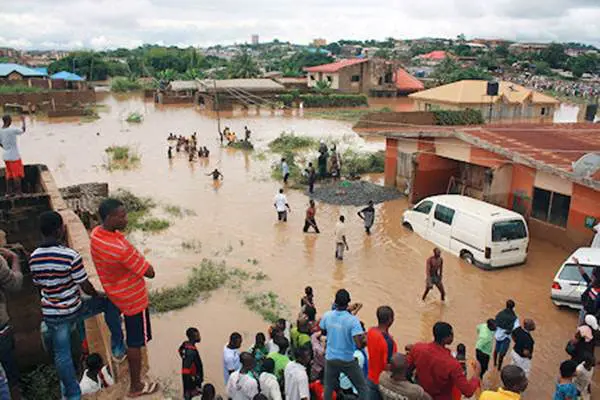
Flooding in parts of Nigeria including Kogi, Edo and Cross River states is causing “anxiety” among the farmers, Adhuze said. “It means that output of cocoa from these states could be affected,” he said.
Flooding worsened after gates on hydro electric dams on the country’s biggest river, the Niger, were opened to prevent them from collapsing under pressure from “high-intensity rains,” Anthony Anuforo, director-general of the Nigerian Meteorological Agency, said yesterday in the capital Abuja.
Nigeria’s cocoa year is divided into two harvests with the main one beginning in October and ending in January, while the smaller crop usually begins in March and ends in June.
 BusinessNews

“Nothing can break Nigeria” – Governor Aliyu


Against all odds, chairman of the Northern Governor’s Forum, NGF, and Governor of Niger State, Dr. Babangida Aliyu believes that Nigeria will remain indivisible and united despite the constant security challenges in the country. Stressing on the continuous unity of the country, Aliyu had asserted that nothing can break Nigeria.
.
The governor called on the Federal Government to be more tactful while addressing security problems of the country, saying that it will be better to address security challenges early enough before they get out of hands.
Aliyu said this yesterday in Lagos at a forum organized by the Obafemi Awolowo Institute of Government and Public Policy in commemoration of Nigeria’s 52 independence.
Speaking on the topic: The Search For National Security In Nigeria; Challenges and Prospects, Aliyu urged the government to be more systematic and professional in addressing security related matters.
Governor Aliyu said: “We should be more sophisticated in managing our security challenges and avoid handling the issues in reactionary ways of adopting impulsive measures and strategies that fail to address the fundamental problems on a sustainable basis. We have national security challenges, it does not mean that Nigeria is on the brink of collapse, as being insinuated in some quarters.”
Boko Haram has waged a bloody fight against Nigeria’s central government and has been blamed for killing more than 680 people this year alone.
DailyPost

NEMA warning: Over a million Nigerians will die if Nyos Dam collapses


Over a million Nigerians are likely to die if the Nyos Dam in Cameroon should collapse the National Emergency Management Agency (NEMA) has warned.
The agency made this known at the presentation of a manual to prevent such an occurrence. The manual, which was endorsed on Thursday at a ceremony in Abuja by stakeholders, aims to put measures in place to mitigate flood waters from the lake from affecting the people of Benue State.
The agency said the manual, titled Lake Nyos Disaster Response Manual, was produced to “proactively prepare for the disaster that may arise from the possible collapse’’ of the Lake Nyos Dam in Western Cameroon.
Director-General of NEMA, Alhaji Muhammed Sidi, said Lake Nyos was close to Nigeria and that a 2005 UNDP report had predicted that the dam was at “a point of potential collapse’’.
Sidi, who was represented by NEMA’s Director of Administration, Dr. Zanna Muhammad, said the report predicted that the collapse might be caused by gradual erosion from rain, wind and lake waters, or as a result of violent volcanic eruption.
The representative of the DG explained that the report mentioned the possibility of the breakdown of the dam within 10 years, adding that the eventual failure of the dam would result in the discharge of about 55 million cu. metres of water which would result in flooding downstream.
“It is estimated that between Cameroon border and River Benue, 50 settlements, including Katsina-Ala, Kashimbilla, Waya, Manga, Gamovo, Andie, Terwegh and over 15,000 hectares of land will be flooded.
“Also, over one million people and 20,000 heads of cattle and other livestock will be affected and could perish,” he said.
He also said that financial losses had been estimated to be in billions of naira, comprising of crops, residential and commercial structures, utilities and infrastructure, including roads and bridges and other services.
KILLER WIND
Meanwhile, the Nigerian Meteorological Agency (NIMET) has warned Nigerians to take precautions against violent winds that may occur during the dry season, due to the effects of climate change.
The Director-General of NIMET, Dr Anthony Anuforom, gave the warning in Abuja on Thursday.
He said, “We are transiting now from rainy to dry season; the kinds of things we may experience are violent winds. Therefore, we advise people to avoid staying under trees.
“The reason why we alert people is for them to know ahead of time and take necessary precautions.
“We have no ability to protect natural disasters but the ability to observe what the weather is and inform the people early.”
Anuforom further noted that if forecasts by the agency were strictly adhered to it could help save the situation, adding that any emergency situation could only surprise people unexpectedly if there were no early warnings.
“If adequate disaster risk measures are taken, the number of deaths will decrease because people would have known what to expect,’’ Anuforom said.
 DailyPost