Saturday, 29 September 2012

One week, one trouble: Arik flight held by passengers for alleged overbooking


by Akan Ido
Arik Air is at it again with reports coming from an online news source indicating its flight out of Lagos to Benin was allegedly overbooked by sixteen passengers.
The passengers who were affected reportedly complained bitterly about the inconvenience and insinuated a deliberate attempt on the part of the Arik management to extort them.
The flight which, according to sources was scheduled to leave Lagos at 6:30am was delayed on the tarmac till noon with no definite time of leaving Lagos.
Reports say the sixteen passengers who were affected in the booking discrepancy have refused to disembark from the aircraft causing some form of confusion among the flight crew and other passengers.
The aircraft curiously named John Paul II is purportedly involved in the delay. No passenger has agreed to disembark and the pilots have refused to fly.
It is not clear how the booking anomaly came about but observers say it is a common practice of the airline to book more passengers than necessary in other to make undue profits.
Let’s see how this one plays out.
YNaija

£30,000 a year addiction to London: How Nigerians are becoming big spenders

by  Susannah Butter
Visitors from the West African country are the UK’s fourth biggest foreign spenders, parting with an average of £500 in each luxury shop they visit — four times what UK shoppers typically spend.
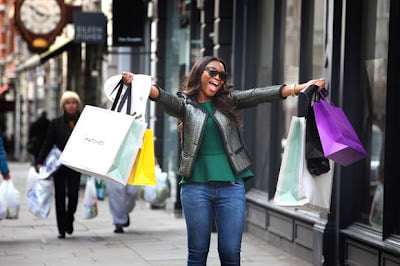
Every year, Simi Osomo makes six trips to London from Nigeria. The 25-year-old spends about two weeks here and every day she goes shopping. Today she’s at the boutique shop Matches Townhouse in Marylebone with a personal shopper. “When it comes to shopping and Nigerians, I can tell you it’s just what we have to do,” she tells me while admiring the patterned dresses.
For Nigerians, London is a shopping mecca. Visitors from the West African country are the UK’s fourth biggest foreign spenders, parting with an average of £500 in each luxury shop they visit — four times what UK shoppers typically spend. When I ask Osomo how much a two-week shopping trip in London costs she makes a bashful face. “Ooh, should I really be saying this? It depends, but most times about £5,000.”
Osomo is wearing a green top from Zara that’s “the colour of the Nigerian flag”, blue skinny jeans and new Christian Louboutin shoes. Later today she’s going to buy an iPhone 5 for her sister.
“You can get lots of things in Lagos but they are cheaper here and you get to take a holiday and relax a bit. It’s only six hours away.” The number of Nigerian visitors to the UK increased by more than 50 per cent to 142,000 a year between 1991 and 2011, according to the Office for National Statistics. Nigeria is projected to become Africa’s biggest economy by next year and the world’s fifth most populous country by 2050, and London is cashing in.
Debenhams’ Oxford Street branch has put up signs in Hausa, one of the official Nigerian languages, and said customers from this part of West Africa are its biggest overseas spenders. Yet Osomo says it’s not just rich Nigerians who come over. “Middle-class people can afford to come and spend £600 on shopping in a week here. What I like about the UK is that it doesn’t discriminate. As long as you’re able to prove you have an income, accommodation in London and a return ticket, the authorities are more than willing to give you a visa. It’s closer than America and the customer service here is phenomenal.”
Back home in Lagos, the technology market has been flooded with fake products from China, which means more people are coming to London for electronic goods and are even taking items back to sell. “No one wants to spend more than 100,000 naira (£390) and find out it is fake, so they prefer to come over for a holiday and buy something they know is real and has a guarantee in case something goes wrong.”
Marks & Spencer is one of Osomo’s favourite shops. “I love their fajitas. You can’t get them in Nigeria. I also buy soy sauce and Thai green curry paste, which is good because it lasts for a long time. Oh, and Crunchy Nut cereal, Skittles, Maltesers and tea. There’s nothing like a British cuppa. I get Lipton, PG and green tea.” She likes the variety of London. “I love Zara, H&M, Topshop. But if I want something more high end, there’s Sloane Street.”
More than £3 billion a year is spent on high-end goods in London, according to the London Luxury Quarter Report, and it predicts this will rise to £4.5 billion by 2020, with new shops including Burberry’s flagship fuelling the trend. Luxury concierge services are also popular. Osomo is a client of Quintessentially, which organises shopping trips and parties for her and has an office in Lagos.
Although summer is the height of the shopping season, Osomo likes to come back for the January sales too. Her mother, a lawyer, and father, a businessman, often join her. She has just finished a law degree and is about to start a job in fashion journalism, which she hopes will give her enough holidays for trips to London. But flights can get booked up quickly.
“You don’t want to get the Lagos to London flight in July. It’s packed with parents and their kids making noise.” Return flights at high season start at about £369.
But what about getting her haul of shopping back from London to Lagos? That, says Osomo, is costly. “All I pack when I come over is one pair of jeans and three tops. I bring two big suitcases but I always have to get another one and pay for excess baggage. I never learn.” British Airways has increased its excess baggage charge on flights from London to Lagos from £40 to £97 per suitcase in the past year. “They must have realised we always put an extra bag in and thought they’d try to make money out of it,” says Osomo.
Fashion-wise, she still picks up the odd item in Nigeria. Six months ago Zara opened an outlet store in Lagos, and Mango has been there for about a year. “Zara is affordable because it’s an outlet but what I find is that things are a bit last season. Nigeria’s hot all the time so there are always maxi dresses and swimwear but the colours are boring and we lack variety. Customer service is not great and some shops can get really crowded, which is challenging.” There is a burgeoning online shopping industry in Nigeria too. Currently, ASOS is the only shop that ships to Lagos free of charge and everyone Osomo’s age uses it.
“Nigeria is a fun place, I’d encourage people to go. Shopping is evolving. In five years I think a lot of stores will come to Nigeria because there is a gap in the market. Ten years ago I never thought Zara would come to Nigeria. I believe in the next five years we will catch up. But I still love London and won’t stop coming here.”
YNaija.com

“He owes us 4-months’ pay” – Air Nigeria staff take Jimoh Ibrahim to court

by Stanley Azuakola

Let’s face it: Nobody expected Jimoh Ibrahim’s words communicating his sack of all Air Nigeria staff and closing down the airline as the final word on the matter. Certainly there was more to come.
As promised, workers of the grounded airline have dragged the chairman, Jimoh Ibrahim and the chief executive officer, Kinfe Kanssaye to the National Industrial Court  in Lagos. They are challenging the illegal and wrongful termination of their employments, non-payment of salaries and non remittance of their 7.5 per cent pension scheme contributions.
(Read: Top 10 craziest quotes by Jimoh Ibrahim)
The workers’ suit was filed by their solicitors; Muhmad Adesina ESQ, and Ogunsany & Ogunsany.
According to the lawyers, the grouses of the workers against Jimoh Ibrahim and Kinfe Kanssaye include the following:
1. The unilateral and compulsory retirement of workers on September 5, 2012 did not follow due process as contained in the employment handbook as the news was only communicated to them through the media. They argued that the workers did not withdraw their respective services to Air Nigeria Development Limited as they did not write any letter to the company.
2. Prior to the termination of their appointments, the airline owed workers arrears of salaries; from May to August, 2012 and that some were paid for the month of May only, while others were not.
3. Prior to the alleged wrongful termination of their appointments, workers had contributed 7.5 per cent of their salaries to the Pension Contributory Scheme, while the company contributed 7.5 per cent. However, even though the company had been deducting this amount from the salaries of the workers, the company was not remitting same to the pension scheme as agreed upon by employer and employees.
4. The workers also claimed that the money deducted from their salaries under the Pay As You Earn(PAYE) up till the moment of their wrongful dismissal, could not be accounted for, as there were no evidence of payments to the appropriates authority.
YNaija.com

Edo lawmaker shot

 by James Azania

A member of the Edo State House of Assembly representing Etsako West I, Rasaq Momoh, was on Thursday night shot by yet-to-be identified gunmen in the state capital, Benin.
Momoh, who is the House Committee Chairman on Finance, was reportedly shot on Akenzua Road, around 9.30 pm while on a visit.
The lawmaker was taken to the University of Benin Teaching Hospital, where he is currently being treated.
Speaker of the House, Mr. Uyi Igbe, and state Commissioner of Police, Olayinka Balogun, confirmed the shooting in different telephone interviews.
Igbe said he was informed about the incident and that the lawmaker was in a stable condition.
Balogun, however, said he was yet to get the full details of the incident.
The lawmaker, who reportedly drove himself, was said to be without his orderly and was accosted by one of the gunmen, who ordered him to lie on the ground.
Momoh was said to have refused the order and was consequently shot in the abdomen, after which his assailants fled the scene.
The Punch

Canadian High Commission Denied Nigerian Islamic Leader Adegbite Visa For Regular Medical Treatment Before His Death


Dr. Lateef Adegbite during his last interview
By SaharaReporters, New York
SaharaReporters has learned that yesterday’s death of the prominent Islamic Cleric and senior legal practitioner, Dr. Abdulateef Adegbite, may have been a consequence of unexpected interruptions to his routine medical checkups, a key one of which arose from a new Canadian policy under which he was denied a visa to travel to that country two months ago.
Although family sources say they do not want to trade blames over the cause of the late cleric’s death, some medical accounts show that his health grew critical after he was denied an important travel opportunity by the Canadian High Commission.  At the time, his health grew so bad that rumors began to fly that he had died, but they were dispelled by his wife, Hajiya Modinat Adegbite, who told Saharareporters that Alhaji Adegbite was only ill at home but was still alive.
The Canadian High Commission reportedly denied all visa applications, citing new a directive to thoroughly screen applicants regardless of their status.
That development affected Dr. Adegbite's plan for treatment in Canada, and may have contributed to the deterioration of his health for close to two months before he was eventually flown to London for the treatment he needed. Alhaji Adegbite, 79, was battling symptoms of old age and had been taking care of himself through such trips until his experience with the Canadian High Commission two months ago.
The Secretary to the Late Chief Adegbite at his Law Chambers in Lagos, partly identified as Mr. Yusuf, said all efforts were made to ensure Dr. Abdulateef’s record and status were immediately verified to enable him proceed to Canada when his health grew worse, but that the High Commission did not yield.
“His friends and associates tried all that they could to enable him clear the visa for his treatment in Canada, but all proved abortive” said Mr. Yusuf.
He further described the circumstances in which Dr. Adegbite’s children finally made the decision to fly him to London for his treatment, noting that in the one and half months that his family was actively trying to obtain the Canadian visa and his being taken to London, Dr. Adegbite was receiving medical attention at the Lagos University Teaching Hospital [LUTH].
A member of his legal chambers in Lagos said before Dr. Adegbite’s July attempt to fly into Canada, he had been visiting that country twice a year, one for his sabbatical rest and the other for medical treatment. Dr. Adegbite’s last return from Canada was on 18th March, 2012 and he celebrated his 79th birthday one week later, on 26th March, 2012.
One of the cleric’s more memorable recent activities was his well-publicised advice to the United States to exercise caution in designating the violent Islamic sect in Nigeria, Boko Haram, a terrorist group.
Dr. Adegbite clarified his position later in an interview with Citizen Journalist, Segun O’Law in Lagos, saying that he wanted the United States Government to give the Nigerian government more time to deal effectively with the militants, and that the government was already making progress.  He warned that a precipitous decision might result in Nigerians being stereotyped abroad as members of the sect.  O'Law said he observed at the time that Alhaji Adegbite was struggling with his health during the interview.
A former Attorney General of Western Nigeria, Dr. Adegbite was Seriki Musulumi and Baba Adinni of Egbaland. He helped found many Islamic societies and associations, including the Muslim Students’ Society of Nigeria (MSSN) in 1954, and was the first President of the Association. He was also a member of several national, international, professional and business organisations.
Until his death, was the Secretary General, Nigeria Supreme Council for Islamic Affairs. He was also the Principal Partner of Lateef Adegbite and Company, a law firm with major focus on Commercial Law Practice.
Late Adegbite is survived by his wife, Hajiyat Modinat Simisola Adegbite, children, grandchildren and great grandchildren.  He was buried today at his family home  in Abeokuta, Ogun State, according to Islamic rites.
 

JTF arrests Immigration Officer who is member of Boko Haram


The positive runs by the security agencies on Boko Haram group and other terrorist groups seem to be yielding more fruits as more gains culminating in the arrest of plants of the groups in some paramilitary agencies have been arrested by the Joint Task force.
Among those arrested yesterday was an immigration officer, Ahmed Grema Mohammed whose confessions led to the arrest of others who have been carrying attacks on government officials across some States of the north.
According to the Spokesman of the JTF, Lt. Colonel Sagir Musa, those already apprehended are some security personnel who have been carrying out attacks in Borno and Yobe which he said was a major breakthrough in their efforts at flushing out insiders in the security forces collaborating with the deadly groups.
A statement by Musa said that those arrested have confessed to being active members of the Boko Haram sect who joined the sect well before the 2009 crisis and received a lot of training in and outside the country.
He said that Grema also confessed to have been trained alongside 15 other members of the sect on weapon handling, assassinations and special operations in Niger Republic. Musa said Grema who was arrested over a month ago at a checkpoint on his way to Maiduguri while impersonating as a Nigeria Army lieutenant.
He further said during the trip Grema had planned killing a former special adviser to the immediate governor of Borno state. He also disclosed that Grema had equally confessed to the killings of some senior civil servants, security agencies and politicians in Damaturu and Damboa, Borno State who spoke against the activities of the sect including the slain former chairman of Damboa LGA, Alhaji Lawal Kawu.
Grema was also among those that led attacks on Yobe Police Command, Damaturu Prison, some primary schools, among others.
 DailyPost

Nigerians are UK’s 4th biggest foreign spenders – Report


Every year, Simi Osomo (pictured above) makes six trips to London from Nigeria. The 25-year-old spends about two weeks here and every day she goes shopping. Today she’s at the boutique shop Matches Townhouse in Marylebone with a personal shopper. “When it comes to shopping and Nigerians, I can tell you it’s just what we have to do,” she tells me while admiring the patterned dresses.
For Nigerians, London is a shopping mecca. Visitors from the West African country are the UK’s fourth biggest foreign spenders, parting with an average of £500 in each luxury shop they visit — four times what UK shoppers typically spend. When I ask Osomo how much a two-week shopping trip in London costs she makes a bashful face. “Ooh, should I really be saying this? It depends, but most times about £5,000.”
Osomo is wearing a green top from Zara that’s “the colour of the Nigerian flag”, blue skinny jeans and new Christian Louboutin shoes. Later today she’s going to buy an iPhone 5 for her sister.
“You can get lots of things in Lagos but they are cheaper here and you get to take a holiday and relax a bit. It’s only six hours away.” The number of Nigerian visitors to the UK increased by more than 50 per cent to 142,000 a year between 1991 and 2011, according to the Office for National Statistics. Nigeria is projected to become Africa’s biggest economy by next year and the world’s fifth most populous country by 2050, and London is cashing in.
Debenhams’ Oxford Street branch has put up signs in Hausa, one of the official Nigerian languages, and said customers from this part of West Africa are its biggest overseas spenders. Yet Osomo says it’s not just rich Nigerians who come over. “Middle-class people can afford to come and spend £600 on shopping in a week here. What I like about the UK is that it doesn’t discriminate. As long as you’re able to prove you have an income, accommodation in London and a return ticket, the authorities are more than willing to give you a visa. It’s closer than America and the customer service here is phenomenal.”
Back home in Lagos, the technology market has been flooded with fake products from China, which means more people are coming to London for electronic goods and are even taking items back to sell. “No one wants to spend more than 100,000 naira (£390) and find out it is fake, so they prefer to come over for a holiday and buy something they know is real and has a guarantee in case something goes wrong.”
Marks & Spencer is one of Osomo’s favourite shops. “I love their fajitas. You can’t get them in Nigeria. I also buy soy sauce and Thai green curry paste, which is good because it lasts for a long time. Oh, and Crunchy Nut cereal, Skittles, Maltesers and tea. There’s nothing like a British cuppa. I get Lipton, PG and green tea.” She likes the variety of London. “I love Zara, H&M, Topshop. But if I want something more high end, there’s Sloane Street.”
More than £3 billion a year is spent on high-end goods in London, according to the London Luxury Quarter Report, and it predicts this will rise to £4.5 billion by 2020, with new shops including Burberry’s flagship fuelling the trend. Luxury concierge services are also popular. Osomo is a client of Quintessentially, which organises shopping trips and parties for her and has an office in Lagos.
Although summer is the height of the shopping season, Osomo likes to come back for the January sales too. Her mother, a lawyer, and father, a businessman, often join her. She has just finished a law degree and is about to start a job in fashion journalism, which she hopes will give her enough holidays for trips to London. But flights can get booked up quickly.
“You don’t want to get the Lagos to London flight in July. It’s packed with parents and their kids making noise.” Return flights at high season start at about £369.
But what about getting her haul of shopping back from London to Lagos? That, says Osomo, is costly. “All I pack when I come over is one pair of jeans and three tops. I bring two big suitcases but I always have to get another one and pay for excess baggage. I never learn.” British Airways has increased its excess baggage charge on flights from London to Lagos from £40 to £97 per suitcase in the past year. “They must have realised we always put an extra bag in and thought they’d try to make money out of it,” says Osomo.
Fashion-wise, she still picks up the odd item in Nigeria. Six months ago Zara opened an outlet store in Lagos, and Mango has been there for about a year. “Zara is affordable because it’s an outlet but what I find is that things are a bit last season. Nigeria’s hot all the time so there are always maxi dresses and swimwear but the colours are boring and we lack variety. Customer service is not great and some shops can get really crowded, which is challenging.” There is a burgeoning online shopping industry in Nigeria too. Currently, ASOS is the only shop that ships to Lagos free of charge and everyone Osomo’s age uses it.
“Nigeria is a fun place, I’d encourage people to go. Shopping is evolving. In five years I think a lot of stores will come to Nigeria because there is a gap in the market. Ten years ago I never thought Zara would come to Nigeria. I believe in the next five years we will catch up. But I still love London and won’t stop coming here.”
 DailyPost