Friday, 15 February 2013

94 Eagles Vs Present Eagles: Any Comparison Now?


Not many people spared coach Stephen Okechukwu Keshi when he likened his boys to that of 1994 squad before the 2013 Africa Cup of Nations hosted by South Africa. He was roundly vilified for daring to compared his ‘amateur’ team with the all-conquering 1994 set.
Keshi had on Monday, January 14 in a chat with Supersport.com at the team’s camp in Faro, Portugal said that, “many Nigerians don’t know how good this team is. I see great potentials in them and they can go places,” adding that “in Emenike I see a player who can be like Rashidi Yekini and Godfrey Obaobona will grow in his position”.
2013 Eagles Squad Shortly after Keshi’s comment went viral, it was received with knocks from some people including his former team mates. One of those that disagreed with him is Peter Rufai. Rufai who manned the posts both at the 1994 Cup of Nations and the FIFA World Cup said, “our ’94 squad was poles apart.”
He said although the present Eagles could boast of some talented footballers, “they still cannot be compared with the team of our time.”
Rufai recalled: “Remember, 1994 was not our first Nations Cup as some of us had been in the national team since Libya ’82. We were in Cote d’Ivoire ’84, Egypt ’86, Maroc ’88, Algiers ’90 and Senegal ’92 before Tunisia ’94. You can see the difference. The present crop of players have to be there for some time to be compared to our team.”
Apart from experience, which Rufai said comes with time, the former goalkeeper said, “during our time, we played a lot of matches, our league was good and the competition for shirts in the national team was stiffer. We went through a lot to get to the national team.”
He noted that the Eagles preparing for the Nations Cup in South Africa were an upcoming team that need encouragement and could not be compared with 1994 set.
1994 Eagles Squad Note that the ’94 squad won the Nations Cup in Tunisia(Nigeria’s second after 1980) and also qualified the nation for her first World Cup in USA’94.
The 1994 Super Eagles squad paraded the likes of Skipper Stephen Keshi, Sunday Oliseh, George Finidi, Emmanuel Amunike, Austin Jay Jay Okocha, Dan Amokachi, Austin Eguavoen, Peter Rufai, Uche Okechukwu, Uche Okafor(late), Rashidi Yekini(late), Emeka Ezeugo, Aloy Agu, Ben Iroha, Chidi Nwanu, Oliha Thompson, Samson Siasia, Mutiu Adepoju, Victor Ikpeba, Efan Ekoku and Mike Emenalo among others.
The present Eagles squad include the likes of Vincent Enyeama, Austin Ejide, Elderson Echiejile, Juwon Oshaniwa, Joseph Yobo, Efe Ambrose, Kenneth Omeruo, Godfrey Oboabona, Mikel Obi, Nosa Igiebor, Ogenyi Onazi, Fegor Ogude, Ahmed Musa, Emmanuel Emenike, Brown Ideye, Victor Moses, Ikechukwu Uche, Ejike Uzoenyi, and Sunday Mba, among others.
Note: Keshi was quoted as saying when he described his team as work-in-progress that what took the ’94 squad, which he was a part of, five years to achieve took his boys only five weeks to do.
In view of this, do you think Keshi has been vindicated? Can the present Eagles in any way be compared with that of 1994 squad based on their recent performance?
Naij.com

Okupe Absolves Jonathan Of Yoruba Marginalization, Blames ACN


GEJ
Following allegations of marginalization and neglect of the South-West levelled against the Jonathan administration by Yoruba elders operating under the aegis of the Yoruba Unity Forum (YUF), Wednesday in Ibadan, the Senior Special Assistant to the President on public affairs, Dr Doyin Okupe has blamed the leadership of the Action Congress of Nigeria (ACN) for the marginalization of Yoruba people; not President Jonathan.
According to him, “the issue of marginalisation of the South-West was a political misadventure and political accident, brought about by the Yoruba themselves. If you would recollect, the Yoruba were supposed to produce the Speaker of the House of Representatives, which is the number four position in Nigeria.”
“But due to the political mishandling of the leadership of the Yoruba and also the sabotage of the Yoruba people by the Yoruba leadership. I am talking about the people in the ACN now. The Yoruba people in the ACN conspired against the Yoruba people and allowed the position to be taken away. That is the beginning of marginalisation.”
“You see, when people sit down to share what is not enough and you don’t have anybody to speak for you, there is a problem” he explained.
InformationNigeria

No Country For Petty Thieves By Chido Onumah


Chido Onumah
Nigerians are outraged, justifiably so, at the shenanigans of the country’s judiciary which led to the ridiculously light sentence and eventual freedom last month of a man who pled guilty of robbing the country’s police pension scheme of billions of naira.
The facts of the case speak for themselves. John Yakubu Yusuf, a former assistant director in the federal civil service, and six others are implicated in the theft of N32.8bn ($218ml) of police pension fund. They go on trial on a 20-count charge. Under a plea bargain agreement with prosecutors, Mr. Yusuf pleads guilty to three charges, including the 19th and 20th offences relating specifically to him (betraying trust and fraudulently converting N2bn ($13ml) of police pension funds to private use).
The maximum penalty for each offence is two years. Justice Abubakar Talba of the Federal High Court, Abuja, finds Yusuf guilty on three counts and orders that the sentences should run concurrently. He gives Yusuf an option of N250,000 ($1,700) fine on each of the three counts. In addition to the fine, Mr. Yusuf is ordered to forfeit to the State, 32 property, in Abuja and Gombe, and the sum of N325 ($2.1ml) in restitution.
In his plea for leniency, Yusuf’s lawyer, Theodore Bala Maiyakim, claimed his client had a serious heart condition. “He has saved the time of my Lord and being a first offender, with no previous record of conviction, I urge the court to temper justice with mercy and sentence him with least possible terms,” Maiyakim said. Another version of this tale noted that Maiyakim had “urged the court to be lenient on his client as he has ailing aged parents and responsibility to pay the school fees of his children”.
There are conflicting reports about what transpired and the exact amount involved in this criminal enterprise. According to the International Centre for Investigative Reporting, “The prosecution and defence lawyers actually had an agreement on specific outcomes of the case which included a custodial sentence which was breached by the judge. Although no formal agreement was written or signed by any of the parties, the two sides agreed with the judge that first, the accused person would declare and forfeit all assets he acquired with proceeds of the funds he stole. Secondly, the parties agreed that he would be given custodial sentence with no option of fine”.
It is really difficult to know how much Yusuf and his daredevil gang stole. We may never know how high up this fraud goes; the very senior government officials, ministers, maybe, senators and reps, bank managers and sundry other perfidious criminals involved in what clearly is a well-coordinated plot.  What is not hard to see is the effect of their bare-faced thievery. We can see it in the “untimely death” of many police pensioners; the families that have been ruined and impoverished; the thousand, perhaps millions of children who couldn’t go to school because the person responsible for paying their school fees is dead or has been denied his paltry income.
But all this is now academic. In a way, the Yusuf saga has become a byword for all that is wrong with our laws, criminal justice system, notion of crime and punishment and national psyche. Our mind-set is that when you steal public fund, you are stealing from nobody in particular; you are merely getting your share of the proverbial national cake. After all, those before you did the same and nothing happened. We have a warped sense of nationhood and hardly realize, or couldn’t care less, if our actions bring the country to her knees. The refrain is that everyone has a price. So, when you steal, you have to steal enough to bribe or pacify everyone, including judges, prosecutors and journalists.
Since the Yusuf judgement, the media (mainstream and social) have been awash with examples of how the country’s broken legal system has succeeded in shortchanging the masses. We have been reminded of the six-month imprisonment of Tafa Balogun, a former Inspector General of Police, for corruption and money laundering; the two-year imprisonment of ex-governor Diepreye Alamieyeseigha of Bayelsa State for corruption and money laundering; James Ibori, former governor of Delta State, who appeared before Justice Marcel Awokulehin on 147 charges, was set free, only for the governor to be found guilty and sentenced to 13 years in prison in Britain; the  six-month imprisonment (or golden handshake) given to rogue banker, Cecelia Ibru, for defrauding her bank to the tune of $1bn; the six-month imprisonment with an option of N3.5ml ($23,000) fine for ex-governor of Edo State, Lucky Igbinedion, for corruption; and the 30-month imprisonment of Bode George, former Chairman of the Nigerian Ports Authority, and national vice-chairman, southwest zone, of the People’s Democratic Party for contract fraud. The examples are endless.
The Tafa Balogun case is, indeed, instructive considering it involves the head of a law enforcement agency. How is it possible for the chief law enforcement officer of the country to steal so much money? I shall return to this. I raised this question in my book, Time to Reclaim Nigeria, where I documented Tafa Balogun’s exploit as a criminal mastermind.
Mr. Balogun became IGP in March 2002, and oversaw security during the April 2003 national elections. By the time Tafa Balogun was convicted in late 2005, he had over N5 billion ($33 million) of money meant for the police in his private accounts. With more than ten property around the world worth over N3 billion ($20 million) — property he acquired as a police officer — you won’t be wrong to think that Mr. Balogun was an estate agent.
The former IGP was forced to resign in January 2005 after allegations of bribery, corruption and dalliance with corrupt politicians and criminal elements became public. In April 2005, Mr. Balogun was put on trial on 70 charges and found guilty of embezzling about N20 billion ($133 million) of police fund.
After a plea deal, he was sentenced to six months in prison, part of which he spent at the Abuja National Hospital.
We can juxtapose these sweet deal convictions with the (in)justice for ordinary citizens. About the same time that Yusuf was walking home a freeman with proceeds of his crime, someone was being sentenced to three years in prison, without an option of fine, for stealing a cell phone. In Abeokuta, Ogun State, a magistrate court headed by Idowu Olayinka sentenced 49-year-old Mustapha Adesina to two years in prison for stealing vegetables valued at N5,000 ($33) with an option of N10,000 fine ($66).
In Asaba, Delta State, a young man, Emmanuel Michael, was sentenced to five years in prison with hard labour by a Chief Magistrate Court for stealing gold earrings worth N25,000 ($166). In sentencing Michael, Presiding Chief Magistrate, Sylvester Ehikwe, stated: “He does not deserve mercy as burglary is next to armed robbery.” It was reported that Michael who had earlier pled guilty to the two-count charge preferred against him wept in the dock, saying, “I was hungry”. There is the gut-wrenching story of a woman in Suleja prison in Niger State who has been awaiting trial for over two years, and is forced to live in prison with her six children, for stealing a goat.
It seems our prisons are meant for and are full of petty thieves while high profile criminals strut around and wine and dine in the presidency. What happens if our goat-stealing mother is later found not guilty? How much did it cost the government to prosecute John Yakubu Yusuf?  I am not a learned fellow so I have left the legalese of these matters, particularly the cases involving Justices Abubakar Talba and Sylvester Ehikwe, to legal minds.
For me, the fundamental issue is the question I raised earlier:  What kind of system makes it possible for public officers to steal so much of our collective wealth with impunity? The only answer I can come up with is that it is a system that lacks leadership; one in which the leadership would commit hara-kiri rather than let the public know what it is worth.
When you have a functional government and the man in charge not only gives a damn about fighting corruption but leads by example, then the tribe of John Yakubu Yusuf would be the exception rather than the rule.
Saharareporters


Court to rule on demolition of Wayas’ house

 by John Chuks Azu
An Abuja High Court is to determine a motion by former President of the Senate Dr Joseph Wayas challenging the recent demolition of his Abuja home on February 26.
 In a motion on notice filed through his counsel Haroun Eze Esq., the Wayas averred that his property Plot 1843 Asokoro Cadastral Zone AO4 was on January 28 demolished by the Federal Capital Territory Administration (FCTA).
 He is also asking Justice J.Y. Tukur to restrain the FCTA from demarcating and re-allocating the plot because that will “deprive him the permanent ownership of same.”
DailyTrust

Baba Suwe drug saga: NDLEA appeals N25 million court judgment


The Court of Appeal in Lagos is to hear arguments today on the appeal by the National Drug Law Enforcement Agency against the judgment ordering it to pay N25m as damages to Yoruba actor, Babatunde Omidina, aka Baba Suwe in 2011 for keeping him in custody beyond the legal time limit on the suspicion of drug ingestion.
The agency was also ordered to apologise to Baba Suwe publicly on “conspicuous pages of two national daily newspapers” but the NDLEA insisted in its appeal that keeping the actor in custody between October 12 and 21, 2011 on the suspicion that the drug was ingested did not violate his rights.
According to reports, the hearing has come more than one year after the NDLEA filed its notice of appeal against the judgment delivered by a Lagos High Court, Ikeja on November 24, 2011.
The Punch reports:
The NDLEA, in its five-ground notice of appeal, urged the appellate court to set aside the judgment on, among other grounds, that the award of N25m in favour of Baba Suwe was arbitrary and that the court wrongly assumed jurisdiction to entertain the suit.
Both Director of Prosecutions and Legal Services of the anti-drug agency, Mr. Femi Oloruntoba, and Baba Suwe’s counsel, Mr. Bamidele Aturu, confirmed on Thursday that the appellate court had invited them to argue the appeal today (Friday).
The trial judge, Justice Yetunde Idowu, had in her judgment on November 24, 2011, ordered the agency to pay N25m to the actor But Contrary to the judgment, The agency insisted that “there was an order of the Federal High Court on October 21, 2011 for a further detention of the applicant for 15 days.
“The detention of the applicant for the nine days has been legitimised by the order,” the notice of appeal read in part.
It also contested Idowu’s decision on the grounds that she “misdirected herself on the facts when she held that the detention of the applicant.’
“The applicant could not be said to have been detained for nine days with regard to the circumstances of this case.
“In the alternative, if there was any unlawful detention (which is not conceded), it was for only four days. That is from October 17 to 20, 2011.”
NDLEA said, “Drugs and poisons are items under the Exclusive Legislative List in the 1999 Constitution and also subject to exclusive jurisdiction of the FHC by virtue of Section 251 of the 1999 Constitution.
The judge on March 2, 2012 granted a partial stay of execution of the judgment by ordering the NDLEA to pay the money to the Chief Registrar of the court who would in turn pay it into an interest-yielding account.
Baba Suwe was arrested by operatives of the NDLEA at the Murtala Muhammed International Airport on October 12, 2011 and detained for 23 days without evidence that he ingested any banned substance.
TalkOfNaija

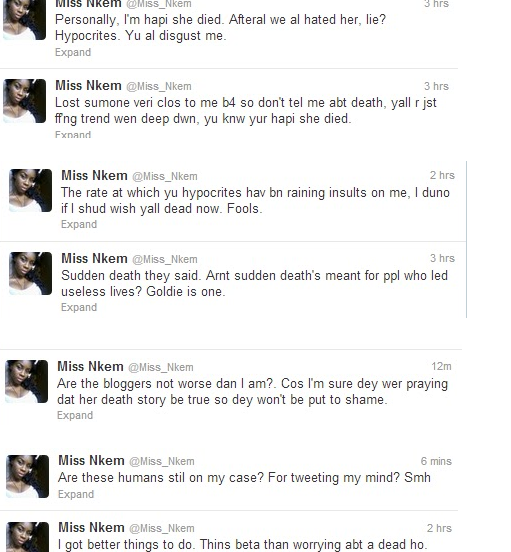
I Am Happy She Died – A fan reacts to Goldie’s Death

By

thechick
Instead of adhering with the “mourn with those who mourn” biblical principle, a Nigerian chick with the twitter handle @Miss_Nkem took to twitter a few hours ago to declare her hatred for the late singer, Goldie.
She made the declaration with so much anger and inhumanity.
When people like this act foolishly, one starts to wonder if there’s still any hope for the human race.
miss nkem's tweets
Meanwhile so many fans and friends have sent in their condolence message through their different twitter handles…see some of them below:
use oneuse two
 DailyPost

More Naira Rain As Delta Governor Hosts Victorious Super Eagles… Names Asaba Stadium after Keshi


PIX-11There appears to be no end in sight to the various rewards awaiting the victorious Super Eagles for emerging champions at the just concluded African Cup of Nations in South Africa as state governments, Multi-national companies, individuals and sponsors are falling over themselves to host the team
Delta State governor, Emmanuel Uduaghan, while hosting the chief coach of the Super Eagles, Stephen Keshi – an indigene of the state, along with members of the technical crew and home based players who paid him a courtesy call in Asaba, the state capital, congratulated the team for winning the championship.
He also commended the Keshi for his resilience and patience in giving his best even when people doubted the ability of the team to deliver.
Dr Uduaghan announced that the state government has allocated a plot of land to the team coach Stephen Keshi and promised to put up a befitting structure for him. Also, Mr. Uduaghan named the Asaba stadium after Keshi.
Not done yet, Keshi was also given N8 million cash reward. His assistants; Dan Amokachi, Sylavnus Okpalla, and Ike Shorunmu got N4m each while each player got N 2.5m cash.
Members of the team who were old and present players of Warri Wolves FC got N5million. The beneficiaries are Sunday Mba, Chigozie Agbim, Azuibike Egweke, and Brown Ideye.
InformationNigeria