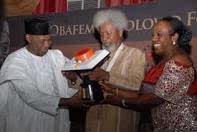
The Full Text Of A Lecture Delivered By Nobel Laureate And Winner Of
The Obafemi Awolowo Prize For Leadership, Professor Wole Soyinka, On
Wednesday 6 March, 2013
Today’s event may yet make a Christian out of me – since, from my
admittedly imperfect recollection of the Christian bible – somewhere, it
is written: to him who hath, even more shall be given. Despite the
numerous explications I have encountered from childhood regarding that
problematic passage, I have never been at ease with its implicit
inequity. Today however, I am setting aside all such objections. I was a
beneficiary of the liberal educational policy – at tertiary level – of
the man whose memory we are here to honour, and now, today, I find
myself recipient of yet another largesse, an inestimable honour at the
hands – albeit posthumously – of that same sage. As a small return
therefore, in tribute to some of those qualities which, in varying
degrees, many of us admired in him, such as the principle of
forthrightness, I intend to be blunt. When you live in an environment of
the progressive insemination of fear as an agency of faith, it is no
time for palliatives of speech and timorous euphemisms. As the poet
Langston Hughes, a product of generations of intolerance, observes in
one of his poems:
“There is no lavender word for ‘lynch’.
In this nation, the morbidity count for religious intolerance has
surpassed the level of the intolerable. The triumphalism that first
annunciates, then celebrates the brutal decimation of our own kind and
thus, the diminution of our common humanity, is the veritable face of
obscenity.
What is on fire today is not only within the mind, but the very
nation space in which we all draw breath. Look left and right, check
morning and night and you stumble on new minted issues that drain your
vitality and compress the mind’s scope of functioning. Every individual,
even infants, must have their own pertinent instances that illustrate
our very topic. Let us make our entry point with a recent mild, but
provocative event – admittedly on the lower rungs of the ladder of
intolerance – nonetheless potent with assisted access to the very apex
of discontent. It offers a most providential setting for the main body
of this address.
At issue, very often, is the very banality, or the banalisation of
Power: Illustrating that constant in social life was, conveniently, the
decision of some civil servants to prevent school pupils from taking a
general, universal examination because they were dressed in the moslem
hijab. What, may I ask, does the choice of a hijab have to do with
invigilating or sitting a public school examination? How does it
compromise, or detract from the integrity of the tests?
There are differences and distinctions. It is not as if we are
speaking of a private or public school, established on secular or
religious principles and thus, requirements. When you are a club member,
you observe the rules of the club. As I have persistently espoused –
including in my recent publication – Harmattan Haze on an African Spring
- all institutions have the right to set their own rules – as long as
these do not violate constitutional rights – including dress codes and
accessories that are symbolic of the school’s founding principles,
philosophy or ideology. The West African Examinations Council exercise
however – known as WAEC – is a general, all-comer, all-purpose arena for
the testing of aptitude, knowledge and application, one that should be
devoid of religious , national, or sectarian considerations at any
level. Wherever its venue happens to be, that venue is neutral grounds.
Why then should an examiner object to a choice of habiliments that do
not disrupt the process of that educational test? This is what creates
turmoil – the misappropriation of the designated province of Authority
through the territorial rapacity and distortions of Power. It is crude,
dictatorial, and avoidable.
As a student of such excesses, it has become routine for parallels to
spring immediately to mind – and from multiple directions. The first
contender was an occurrence in the United Kingdom some years ago, where
two medical practitioners, trained with public funds, and sworn to the
Hippocratic oath, refused to treat moslem women in their clinics unless
they presented themselves appropriately – in the hijab. Need one really
say more? Alas, there is indeed so much more to say.
Our late sage, Obafemi Awolowo, would surely have been baffled by
such encroachments on human volition, wondering at the arbitrary
limitations on entitlements to educational opportunities or – health.
We only need to make one particular extraction from his humanistic
vision, and we are instantly enlightened by its profound implications
for humanity. Awolowo, a staunch Christian and leader in a
predominantly Christian state, set up a Pilgrims’ Board in 1958 to
assist the moslem faithful in fulfilling one of the requirements of the
Seven Pillars of Islam. Such a policy, in my view, considered in all
possible ramifications, deserves to be nominated one of the Seven
Pillars of Nationhood. Translated in plain, practical terms, it
establishes the principle that Religion should be recognised as a right,
not a privilege, and that a citizen’s desire for spiritual fulfillment
deserves to be assisted – as a basis for both social understanding and
governance equity.
Now, that is the ideal. Is it however an absolute? When taken in the
context of a multi-religious nation, it asks questions of the
scaffolding that should uphold a nation – whether such state
intervention is truly harmless, or can become an entrapment for
unforeseen negative developments in the structuring of nation being.
Let us begin with the banal. For instance, that policy became a
springboard for demands for parity by islam’s main religious rival –
christianity. It is my view that some of those demands should have been
dismissed outright – certainly that of government assisted pilgrimages
to Jerusalem. Nothing in the Christian religion makes pilgrimage
mandatory to any destination in the world – so there is really no basis
for claims of parity.
All it has resulted in, predictably for us in this nation, has been
an encouragement to our affluent classes for extended tourist
destinations, this time under the guise of religious obligation. It was
only a matter of time before this class also felt that the act of
tourism was not enough. There had to be a title for the outlay on that
personal excursion, and thus came into usage the title of JP – no, not
Justice of the Peace but – Jerusalem Pilgrim. You style yourself
el-Hajj, I call myself JP. Of course, it all has to do with the
promiscuous environment of ostentation that had become the hallmark of
national life. Let me make it clear that I am speaking here of national
trends, not of exceptions. Even long before independence or the oil
boom, there were individuals who fulfilled their private spiritual
yearnings by finding their way to Jerusalem and other places of
christian pilgrimage without fanfare – among them, Chief Awolowo
himself.
What we witness today however is the evolution of a new religious
elitism that virtually looks down on those who have never stepped on the
Mount of Olives, known to moslems as the Noble Sanctuary.
It is a pity that traditional religions, such as the Orisa, did not
also demand their pound of flesh. The principle, after all, is what
counts, and what principle for nation building could be more
crucial than one of religious equity? For a substantial proportion of
citizens however, the principle of the separation of Religion and State
is even more primary, no less crucial to Nation being than that pillar
on which rests a nation’s accommodation of Religion – but strictly as a
private engagement with unseen forces, where and however they are held
to manifest themselves, and by whatever names they are known.
It would be absurd – I have to make this unambiguous, since there is
such a tendency to take words out of their context and twist them to
suit stubbornly held preconceptions – it would be even impious to lay
the blame for the nation’s current dilemma on the shoulders of any
leader who set the nation on a path of the harmonisation of religious
preferences through the inauguration of an enabling board for pilgrims.
More than even the practical aid, the gesture speaks volumes. It is to
our discredit that this visionary proceeding has been poorly repaid, and
in a measure that no one living even at that time could have foreseen.
Obafemi Awolowo evinced foresight beyond any other national leader, but
he never claimed to be a seer. He was, and remains till today, the
nation’s preeminent sage. And so, not even he could have foreseen that,
after over three decades of military dictatorial rule, and a civil war
that lasted over two years at a cost of over two million souls and years
of developmental retardation, a war – let this always be emphasized – a
war that was fought specifically for national cohesion – he could not
have foreseen that any state would unilaterally opt out of that
resulting conglomerate, and declare itself a theocratic state, to be
followed by eight others in a copycat relay of unilateralism –
unchallenged. However, if all this had indeed unraveled before his eyes,
and then he had learnt of a movement that had sprung up within that
nation’s borders, demanding that the President of the nation converts
before it ceased to blow up humanity in offices, on the streets, in
factories, in market-places and in places of worship, I believe that his
only surprise would have been that such a nation, supposedly filled
with students of history, was expressing so much surprise.
But do we even have to be students of history to anticipate, and be
pro-active against such developments? We have eyes to see and ears to
listen with. Millions are addicts of CNN, BBC, Al Jezeera, SABC and
other instruments that convey the march of history in contemporary,
real-life tempo. In any case, even before the advent of such instant
communication agencies, there are wisdoms that we imbibe with infant
gums. Here now is a morality tale that has stayed with me since
kindergarten school:
“A Bedouin on a journey through the desert camped down for the night,
his camel tethered to a peg outside the tent. A while later, the camel
pleaded: Master, the desert air is cold, can I just put my nose inside
the tent to warm it a little? The Bedouin considered it odd, but decided
to gratify his camel’s whim. Next, the camel, meek as ever, proposed
that his neck follow suit. Again, the Bedouin felt that he had nothing
to lose, just a little space, so he let in the neck. The head nosed its
way up and down the tent, sniffed the air and wiggled its ears. His
shoulders, the camel now pointed out to the owner, were not particularly
broad, indeed they would take up far less space than his hump, so could
he just intrude his shoulders a little further…..
The rest of the story is easily guessed. After the incursion of
shoulders, the front leg, then two, chest, hump and rump, the camel
began to grumble that the tent was getting cramped, and that even a
blind man could see that there was not enough room for both…… Still
vivid in my mind is the accompanying illustration – the astonished
Bedouin sailing through the air from a powerful kick of his camel’s hind
legs.
The lesson of that morality tale is unlikely to be missed, but just
in case, permit me to ask you to recall the role that religion has
played in the devices of history, the wars it has engendered, its
imperialism of both the physical and mental estates – from the moment
that this penetrative force of the ineffable was let loose on the world.
From sticking its mere nose in the secular tent, the proverbial camel
has moved to occupy centre stage – and in a most imperious manner, in
the lives and schemes of humanity. This intrusion has often taken place
in defiance and subversion of the real, the material, the palpable and
even the productive – by which I mean, the means to the reproduction and
enhancement of human existence. Never content with merely ministering
to the ineffable – the soul – from the fount of the Ultimate Ineffable –
godhead in whatever language – it moves to occupy the material space
and dictate – I repeat – dictate the fortunes, pace and survival
strategies of society.
Shall we turn yet again to another instance from the healing pursuit,
one to whose discoveries – both for preventive and – when that fails –
remedial application we all turn in time of need?
How recently was it that HIV-Aids cut its destructive swathe through
southern and Eastern parts the continent? A Christian bishop, who
presumably was in direct text or email correspondence with his deity,
had no doubt whatsoever about God’s position on the matter. And so, in a
region already half decimated by the disease, he mounted an aggressive
campaign, preaching that the condom is in fact an instrument of Satan
designed to infect its users with the very scourge it is meant to
prevent. AIDS, he claimed, was God’s punishment for the promiscuity of
modern society.
As the expression goes however, let us thank God for small mercies.
At least he did not pick up his AK47, summon his catechist or verger,
hijack an okada motor-cycle and proceed to mow down the anti-HIV
campaigners caught distributing condoms in his diocese. This was the
criminal recourse embraced by his self-declared islamic counterparts in
Northern Nigeria – how recently? We no longer remember. That horror has
been supplanted – is daily displaced by new, self-surmounting horrors.
Nine female health workers mown down in an orgy of hate, and commitment
to the will to dominate. One’s first response is primarily the shock,
next, recognition of the animalistic in man which makes one feel that an
apology is due to beasts. The mental conditioning between the two
aggressors is however identical. One condemns fellow humanity to the
possibilities of a slow, lingering death from HIV-Aids, the other
settles a one-sided score once for all – arrogant, homicidal and
unrepentant. Ground beneath both left and right theocratic heels is – my
and your humanity.
Let me, before we go any further, establish the context within which I
situate the manifestations of certain human phenomena – summed up in
two words: Power, and Freedom. That binary provocation will come up
again and again in this address. The first, Freedom, is a familiar
caller on the portals of humanity. It is easiest grasped in tandem with
the other – Power – and in a context that makes large claims, yet
narrows down the seizure of the phenomenon of history to a most
simplistic level. I readily admit that it does feel reductionist to
propose that we view the complex evolutionary processes of that organism
known as society through a straightforward, oppositional binary which,
to make matters worse, happens to be essentialist. Freedom, however
fervidly as it is pursued and valued as a humanistic defining goal, is
largely essentialist. It is not material in any sense of being
quantifiable or palpable. It has no dimensions, no taste, no texture, no
GNP, it is not cited on the Stock Exchange – yet it is so real that
millions have laid down their lives in its pursuit. Freedom is
humanity’s eternal quest.
‘The other end of my proposed binary opposition – Power – also
qualifies as being essentialist. To propose that this axial tension
summarises human history must therefore sound like seeking signposts
from the immaterial for an understanding of the material – the clearly
tangible convulsions that characterise our actual world. Usually I find
myself allied with those who decry such ‘undialectical’ references –
far too loose, vaporous, almost theological in approach – how, we may
ask, is this different from claiming that society is a product of the
struggle between good and evil? Or its ideological version - that
history is propelled through the ideological struggle – variously
translated as – between progressive and retrogressive forces. Or a much
favoured variant of that last, which lays claim to “scientific”
verification – that history does indeed advance through that same
process of binary oppositions within the class structure, but of an
ascending dialectical order. In short - that the polarised struggle
takes place between social classes, one supplanting the other, until
history culminates in the final showdown between approximations of the
middle class and the proletariat, and in a victory for the latter.
Finally however – the thesis continues – such a struggle concludes in an
elimination of that very process – an end of the serial binary contests
which throw up a predominant class, and thus eliminates classes
altogether. Humanity would have arrived at utopia, where all classes
have vanished and their inherent social contradictions no longer exist. I
have tried to be very fair-handed in that necessarily rapid excursion: I
hope I have succeeded. If there is disatisfaction, here is some
consolation.
I simply invite you to cast a prolonged overview to the north of this
very spot where we are gathered, making a detour towards that region
known as Somalia, then on to Egypt. Don’t stop at Egypt but proceed to
Syria. Leap across to the former Soviet Union – the mothering state of
satellites that finally jettisoned doctrinal tyranny and a long enduring
– and complicating – Personality Cult. Then decide if the reality of
our world today has not inflicted far greater demolition to that
theoretical – and utopian – end to the phenomenon of social conflicts.
By Personality Cult, I would like you to feel free to substitute, quite
accurately, the Cult of Power, as an end in itself, not merely as a
motivating factor but the craved end. I am speaking of the phenomenon of
Power as an Absolute, one that is so glibly understated and/ or simply
brushed aside, so as not to create untidy ends for a predictable grasp
of History’s unveiling.
I am however fortunate to have emerged from a culture that pays due
respect to the symbolic figure of the god Esu, who, as you know, makes
nonsense of the “well-laid plans of mice and men”. Or tidy, precision
calculations. Esu is the deity of the random factor, which perhaps
explains why I have been averse to the dominion of mathematics all the
way from school. I accord that discipline its place – it is awe
inspiring - but completely reject its application to non-mechanistic
functioning – such as the workings of the human entity – its psyche,
temperament, hormones, its irrationalities and inconsistencies. Thus I
remain unrepentant in my conviction that the motoring force of human
history – to which the very evolution of society is subject – is best
apprehended – indeed, most accurately understood – as the
non-measurable, non predictable, time-immune tension between two axial
ends of human striving – Power at one end, and Freedom at the other.
All human socio-political choices – including the economic – I find,
are grouped around these compelling drives. The neutrals are drawn,
sooner or later, into one polarity or the other through their sheer
magnetic – that is, compelling – fields of force, or else are flung off
from the centrifugal effect of the spinning axis. It does not matter
whether we are speaking of a society driven on secular or theocratic
ideologies; sooner or later the basic tendencies become clarified in
those two opposing allegiances. It is what accounts also for internal
splits, and counter splits within all social pulsations – so that even
when, for instance, an organised movement, or even a mere ideological
notion invades society and is embraced as a liberating force, it
invariably mutates into yet another agency of human repression, and the
struggle commences all over again. The two new polarities that have
sprung from what was once a unified – and from our point of view,
progressive – axial end begin to tear at each other’s throats. Barriers
go up, and the lettering reads: yes, we have come this far but – no
further! Or: this is the ONE direction we must now take, and all other
propositions are reactionary, ungodly, unrealistic, subversive etc. etc.
Voices raised in renewed opposition suddenly become secret agents,
dangerous revisionists, fifth columnists and all, who must be wiped out.
Liberation turns into Power and Dictation, confronting a new polar end
of which it was once a part - Freedom and Resistance. Nothing appears
to change, only the personnel, the tempo and intensity of struggle. To
be enslaved once is bad enough. To be enslaved the second time, third
and fourth, indeed a limitless number of times, provokes a level of
humiliation that leads to desperation.
Of the contributory binaries that have propelled, even through
costly, self-sacrificial routes, the course of human history, Religion
and Nation – the power of Faith, and the romance of Nation – appear
today to be the most resilient. That contrariness has come into the
open, and with such impact that some in positions of authority and
public responsibility feel compelled to seek out reasons, or simply
voice out frustrations as to why intended binding structures , such as
‘nation’ appear, to disintegrate before their eyes, thanks to the
encroachment of trans-border allegiance to that rapacious rival –
Religion. They begin to interrogate the composition of the elements
within that very crucible – nation – within which the ingredients of
existence are supposed to be mashed to provide a homogenous paste,
without particles, without granules, without impurities, in which all
the contributory characteristics have been subsumed.
Of course such a paste does not exist, and it is best to explore,
promote, and exploit differences but – creatively, productively, and
positively! For purposes of variety – the many in one. Of all the
ingredients that go into that crucible, the most obvious, the most
stubbornly resilient is the element we have identified as – Religion.
You can eliminate classes, you can eliminate inequalities – or at least
grind them down to levels of inconsequentiality. You can miscegenate
your population until even the colours blend or cease to matter – so
that you arrive at a level when you declare your nation colour blind, or
speak of a rainbow coalition, or whatever else. Brazil, for instance,
likes to boast that it has become a raceless society – often disputed,
but that the claim is made at all is most indicative of human
aspirations. You may eliminate gender inequality through social
policies, through progressive re-education and, in any case, except in
Aristophanes, and recently in a recent threat of a sex boycott from
Uganda, who can really conceive of a war between the genders. You can
diminish extreme nationalism and internal micro-nationalisms through
progressive governance policies and opportunities, and the strengthening
of international organs for conflict resolution. It can be achieved
through liberal educational policies that bring xenophobia to its knees.
In short, at one level or the other, the human identity appears
transformable, which implies that society itself, is. Only one
irreducible is left and that is, alas – Religion. That appears to be the
final bastion of resistance to the transformative end of the human
psyche at its most revealing, most contumacious, most subversive of any
vision of social oneness.
I must single out at least one example of those who have begun to
break the mould of silence and warn publicly against this apocalyptic
spectre called Religion. Normally it is a theme over which one would
expect the executive director of the apex financial system to remain
reticent. He has more than enough on his mind, such as closing down
rogue banks and pursuing their predatory managing directors, yet, out
came this recent indictment by the Chairman of the nation’s Central
Bank. It was a cri de Coeur, a cry uttered straight from the heart. In
summary, what he said was that he was not against spirituality, but that
he wished that Religion would vanish off the surface of that earthly
portion occupied by the nation It is a cry that echoed a lifelong
frustration that I have myself articulated on various fora and
discourses, the most recent being September last year in the conference
hall of the United Nations, at a gathering dedicated to promoting the
culture of peace. Permit me to repeat a paragraph from that address:
To such a degree has Religion fueled conflict, complicated politics,
retarded social development and impaired human relations across the
world, that one is often tempted to propose that Religion is innately an
enemy of Humanity, if not indeed of itself a crime against Humanity.
Certainly it cannot be denied that Religion has proved again and again a
spur, a motivator, and a justification for the commission of some of
the most horrifying crimes against humanity, despite its fervent
affirmations of peace. Let us however steer away from hyperbolic
propositions and simply settle for this moderating moral imperative:
that it is time that the world adopt a position that refuses to
countenance Religion as an acceptable justification for, excuse or
extenuation of – crimes against humanity.
I wish to repeat that last section:
“It is time that the world adopt a position that refuses to
countenance Religion as an acceptable justification for, excuse, or
extenuation of – crimes against humanity.
In the same vein as our young banking crusader however, I have been
at great pains not to throw the baby out with the bathwater. I recognise
the definition of man as an innately spiritual being, indeed, laud
those nations who accept the responsibility to protect a human essence
that demonstrates its ability to reach out to causes beyond man and
immerses his being in the potential of forces outside the provable
circuit of his minuscule being. Religion is a different kettle of fish
however, a kettle that is perhaps filled with that species known as the
electric eel.
Sleek, sinuous and inviting, it shocks when least expected. As
illustrated in the morality tale of the camel – Religion is never
content to occupy its own sphere of competence, which is ministering to
the irrational but psychologically therapeutic cravings of mankind.
Because of this propensity, it is stubbornly subversive of the secular
order of human intelligence that deduces, and builds upon the evidence
of the material world, on evidence that is palpable to human senses and
can be apprehended as a commonality of experiencing – with the freedom
to embrace or reject their insights.
Current events may appear to have provoked these reflections, but
they are not dependent on those events themselves. Even comparatively
stable societies, founded on democratic principles, continue till today
to question the place and the role of Religion in national life. The
only different between such a nation and ours is that, over yonder, it
is not being pursued as a life-and-death issue, but as a fundamental,
character forming principle of nation being. On this continent, it is a
life-and-death issue, and thus constitutes an immediacy that transcends
theorizing. It is actual. It demolishes humanity. It threatens to
incinerate – no, not even erode – but incinerate the very scaffoldings
that hold up the yet uncompleted structure that goes by the name of
nationhood. It is therefore imperative that we place emphasis where
emphasis is due and, while acknowledging contributory factors to the
nation’s current dilemma, dismiss escapist theories in which we can
comfortably bury our heads, taking refuge in propositions that all we
have to do is eliminate poverty, eliminate unemployment, eliminate class
distinctions, eliminate alienation, eliminate illiteracy to achieve
that smooth paste in which all granules are atomised and attain the
harmonious ideal. Yes indeed, this shopping list of contradictions must
form a background consciousness of what is desirable, but they only
provide us a cosseting picture of the totality. It is an understandable
tendency in human nature to concentrate on what seems performable: what
seems beyond immediate solution however had better be accorded
proportionate space and attention.
Nation and Religion, alas, are two ancient principalities seeking
privileged access to, and precedence to that same commodity – Power.
Their warring ground is – Humanity, and its innate pursuit of – Freedom.
The bedrock issue then, the constant that continues to narrate the
history of mankind is the contest between Power and Freedom, of which
Nation and Religion – when all else is eliminated – threaten to remain
‘the last duo standing’. It is within this struggle that the intractable
is lodged. Intractable because essentialist, yet it is within that
nexus that other abstractions, including societal virtues such as
tolerance – are to be found. It is the final battleground of nation
being and the winding down of human history.
Let us not underestimate the protean reach of Power – its exercise,
abuses and appropriation – apprehending it only in its formalised, and
often spectacular array: an ecstatic field of millions mesmerised by a
ranting Adolf Hitler; an Idi Amin methodically reducing a nation to fear
and obsequiousness; a Sanni Abacha and his sinister brigade of hitmen
and so on and on – yes indeed, these are the more notorious templates of
power: usually a Goliath of state versus David and his civilian
slingshot. We tend to fasten on the concept of Power only when a brutal
dictatorship is squatting on our faces and obstructing even the simple
instinct of breathing. However, Power, even in a democracy, can become
the foraging field of even marginal elements of society, such when a
Kalashnikov confronts us, cradled snugly in the crook of the arms of an
armed robber who has broken into the home in middle of the night –
sometimes a youth young enough to be one’s grandchild, points that agent
of subjugation in our faces and orders us to lie face down – or else!
Power is experienced by the victim of rape, helpless under the brutal
violation of her innermost being. Power is in evidence when a telephone
call is received from a family member, friend or colleague, who informs
you that they have been kidnapped and marched into the depths of the
forest, and you have to choose between raking up the ransom or mounting a
rescue operation – whichever choice we make – ransom or rescue – the
fact is that our choices are set for us outside our own volition, our
lives are interrupted and thus our freedom – snatched from us for an
unpredictable duration. Indeed, the very fear that is instilled in the
average citizen today at these very possibilities, fears which place a
crimp on our choice of movements, anxieties that dictate the choice of
life-styles, these are the many faces of the exercise of Power at its
crudest and physical.
There is even phantom power that is nonetheless palpable and
humiliating in its exercise and effect. Such is encountered when a
creature of mere circumstance, but with a will to dominate environment
in inverse proportion to demonstrable intellect and proven capabilities,
when such a being, devoid also of constitutional existence, exhibits an
unhealthy propensity towards appropriation of public funds to feed her
phantasmagorical projects, her illusions of power, delusions of grandeur
and allied obsessions. There is much more to be said in that vein, but
today is dedicated to addressing issues far more worthy of our attention
than a narcissistic streak, for which even a three-day resurrection is
not enough, but must aspire to a full week of days.
We shall take leave of that distraction – at least for now – with
this parting admonition: Aspire to be a Lady first, then a First lady.
There are manifestations that are more subtle, more insidious and
profound in their effects, though these may also be exercised
stridently. Of such manifestations, none is more humanly reductive and
more sinister than the exercise of power over the mind, reducing us to
merely glorified zombies, subject to the dictatorship of clerics of all
hues, an exercise that relegates the functions of the mind, the rational
quotient in our human make up, to the provenance of the absolutist
intermediation of another mortal. Such a mere mortal then proceeds to
attempt to control every action, every choice, from what we consume
internally to the external covering of our bodies, dictates our modes of
relating to one another, dictates our very sensibilities towards, and
derivations from environment, attributes what is palpably inimical to
our well-being to the will of unseen deities and, in sum – preaches the
theology of meek submission to whatever they, mortals like us, prescribe
– this power that saps the holistic apprehension of our human potential
and reduces it all to the private interpretations of textual theology –
this is the most insidious challenge to our full seizure of human
potentiality, exercised in freedom.
It is this Power to propose inferior status, penury and beggary as
divinely ordered conditions – even more than state neglect – that
constitutes the last frontier for social liberation. It is this Power
that releases its deadly toxin in the serial slaughter of nine female
health workers, and the detonation of home-made devices in the market
concourse of farmers and traders. It is this Power that so benumbs the
mind that we become addicted to remedial incantations that only lead us
into the escapist mode of ignoring the tyranny of the origination. This
origination, which grants advance absolution for no matter what
atrocity, is that of the painstaking, assiduous corrupters of malleable
minds, who would rather see a generation of polio-stricken youths on our
streets, than accept their presence in our midst as whole citizens of a
common wealth.
A truthful recognition of this bedrock of the eternal human assertion
– the choice between Power and Freedom, between Submission and
Liberation, inevitably decides the agencies that we decide upon for
confronting the violence that is unleashed in our midst. Yes indeed, we
do applaud such measures as the overhaul of those breeding grounds for
mind corruption, the religious schools where, from infancy, the
impressionable mind is taught that the material world is a chimera, and
that reality lies only beyond the present, in the hereafter, where
certificates of pleasure earned in self-denial in this world can be
cashed. Yes indeed, measures such as the establishment of supervised
schools is essential. Side by side also is the unpleasant but mandatory
responsibility of immobilizing those who threaten the very existence of
the inhabited world with their own agenda of eliminating its humanity –
unless it adopts its own warped reading of reality. However, even the
sometimes enforced duty of violence as legitimate resistance to violence
requires its own dual proceeding. We are after all, dealing with a
phenomenon of the genie that has escaped from the bottle or, to deploy
another metaphor, locking the door of the stable after the horse has
escaped. The hordes are out in the open, infecting new sensibilities,
not in the enclosures of the madrassas, but in scattered fields of
indoctrination, remote from state controls. So, bombing versus bombing?
All right, but with what material? I have yet to learn of a strategy –
for instance, of raining down enlightenment leaflets instead of bullets.
It is the minds that need most desperately to be bombed as part of
state strategy. The airwaves need to be bombarded with counter
indoctrination to what has already taken hold of the minds of these
addicts of the untenable. Listen to the following gleeful , obscene
declaration of a follower of al-Shabbab, broadcast only a few days ago:
We shall win, because we have nothing to lose. When any of us is
killed, we rejoice, since we know he has gone to join the ranks of the
martyrs, but when we kill the other side, they go into mourning.
That cast of mind has divided the world into teo geo-spiritual zones:
The School of Life, and the Ministry of Death. But it goes beyond this
apocalyptic effusion. What, in the profoundest sense, that individual
and thousands like him are saying to the world is this: I exercise power
over you. I am free, you are chained. You are chained because you cling
to life. I do what I like with you. Let us stop foisting our own
analysis over a freely conceded, and boastful declaration. That
individual does not say, I am hungry, I am marginalised, therefore I
kill. He tells you to your face: you have only one choice: Submit! I
want to take possession of your mind. So what shall your response be? In
what form? No, I shall not answer my own questions – at least, not
openly. What I do have a duty to publicly express is this: whatever
response you have, do not base it on the social condition you impose on
that speaker. Listen to what he has actually said, follow what he does
to actualise his proclaimed intent, not to your own sense of guilt or
that of the society you inhabit. Yes of course, clean up the fertile
ground in your own backyards on which such mental disposition has been
cultivated, offer social options that wither its easy recruitment
grounds. But first, in order to do this, you must ensure your survival,
and that requires a response that is sometimes unpalatable, since it
requires – to put it bluntly – neutralising such forces to keep them
from inflicting further harm on society, and with all the capabilities
you can muster. There is only one caveat: we must not become like they,
in our choice of methodologies. We must not offer dehumanisation for
dehumanisation.
Let us continue to stress this: nothing new is happening in this
nation, only the final suppuration of a boil that has been left to
fester, and the burden that it is happening during a period of greater
accessibility to both sophisticated and home-made technology of instant
and massive destruction. The child behind a AK47 has taken a quantum
leap in evolution from the guileless child that was merely bred in the
Nigerian madrassa, or the forest camp of a Joseph Kony, the Christian
warrior of Uganda. That new being has tasted power, and is massively
transformed beyond the pale of humanity. Call him a monster – such
expressions are accurate but unhelpfully emotional. He will be restored
only if he is fortunate to be captured alive – or escapes his captors.
But there are differences.
Go and study the recovery processes of the child soldiers of Liberia,
Sierra Leone and other warring fields – that early model of obedience,
now grown into an ageless killer – will be restored only through
time-tested rituals. In one model, he is taken back to the village where
he has committed atrocities, put through a process of reclamation that
takes him back to the age of lost innocence and emerges, blubbering like
a child and asking forgiveness. But that distorted human entity was
never a product of religious indoctrination – therein lies the
difference. Joseph Kony may be a christian claimant and a deviant who
has imbibed the dangerous cocktail of fanaticism and crude politics, but
he does not preside over schools where the child is immersed, as it
were, in a deeply penetrative bombardment, day after day, hour after
hour, of religious principles that make the outside world a sub-human
aberration, a heretical environment, and above all – enemy of a Supreme
Deity whose virtues, attributes and commands form the daily, and
virtually only diet of the mind. Joseph Kony’s or Charles Taylor’s child
recruits are victims of Power who in turn embrace the pressure of power
in order to survive, then come to relish the trickle-down ration of
that same ambrosia that is enjoyed by their original captors, the
desecrators of their innocence. They are, in the main, redeemable.
Sooner or later, the effects of hashish and other lethal cocktails wear
of. Not so those others who believe that the hereafter continues to be a
heightened enjoyment of that same ambrosia of power preferment, where
unimaginable, sensuous delights await them on attaining martyrdom.
How do you wean such a generation from their delusion and whose
responsibility is this? Of course it is ours, collectively. But
primarily it is the responsibility of those whose religion has been
distorted into one of a hate machine – that is, those who recognise
this. And many such voices are raised daily, deploring the consequences
of this ideological distortion, if not outright desecration of the
essence of that religion. They are the ones who must come to the front –
with all the attendant risks, admittedly – by furnishing from within
that original Faith the intellectual weapons of counter indoctrination,
those who will say bluntly, not merely that this is the false face of
islam, a distortion and desecration of the faith, but take the lead in a
sustained campaign of re-enlightenment, beamed at that ultimate
battleground – the mind.
I address you in all frankness. Leadership in the currently troubled
regions of the nation has been remiss. The signs were over-abundant. I
have lamented, on numerous platforms, the delinquent silence of
religious and community leaders where the religious rights of others
were trampled upon, often terminally, where again and again martyrdom
became commonplace – yes, the genuine martyrdom – made up of innocents,
singly, in sectors, often brutally but always with the confidence of
immunity. The sanguinary appropriation of the word ‘martyr’ today leaves
one sick in the pit of the stomach. I acknowledge the exceptions to my
plaint of indifference: I remember Shekarau, then governor of Kano state
who made a point of going to worship with christians in a church after
one such atrocity, not just to sympathise with the victims but to
demonstrate the spirit of oneness despite the different approaches of
faith. And even earlier, the act of a young man, Jacob Mishali, to whom
we awarded the Ken Saro-wiwa Prize for Minority Rights and Conflict
Prevention. Let me tell you how that young man responded to a rampage of
butchery that had overtaken some neighbouring towns and was consuming
humanity like harmattan twigs.
Mishali gathered the elders of his village together and pleaded: all
religious tendencies have lived together peacefully for generations.
There is madness going on all around us, community after community
submitting to the affliction. Let us all agree to make this community an
exception. Whenever we encounter any attempt to sow dissention or
incitement, let us denounce it immediately and expose it. They agreed.
The fires raged just outside their community. That village remained
immune.
The tragedy of the nation is that these, and allied initiatives did
not find emulation remotely proportionate to the incidents and intensity
of violent bigotry and impunity – and at levels that they deserved. So
it is not merely staunching the grounds for recruitment that is the
problem. There is also the issue of leadership. Of wrongful silence and
inertia. The folding of arms and the buttoning of lips when leadership –
and not merely localized – desperately needed to lead and inflict
exemplary punishment on violators of the freedom of belief, and
existence of others. The examples are too numerous and depressing, and
this is hardly the occasion for a recital of human derelictions that
only stir up negative memories. During that period of serial violations,
we missed the strength, the vigorous conviction of voices such as we
have heard in recent times, voices of community and traditional leaders,
political figures of iconic stature. I refer to declarations such as
that of Hassan Mohammed who was recently quoted as saying:
“It is laughable to describe these characters as pro-north or as
defenders of Islam. They are evil anarchists who have not only killed
almost every imam in the Maiduguri area, but are hell bent on
eliminating our political and traditional rulers as well.”
Yes, we missed such intensity of conviction, such stern,
uncompromising denunciation when individuals, with or without public
profile, were being systematically mown down for alleged religious
offences, some of which took place, not even within our borders but in
remote, frozen regions as the Scandinavian nations or the United States.
Again and again, the innocents, the real martyrs paid the supreme
price. My intention is not to weigh down any sector of this nation with
the burden of guilt but to say to you, to me, to all of us: No more
evasion. The knives, the cudgels, the matchbox and burning tyres that
decapitated Akulaku, that incinerated the female teacher and invigilator
Oluwaseesin and a host of others, including school children and
infants, at the slightest or no provocation have given way to far more
efficient but indiscriminate means of human disposal – but still in the
hands of the same malformed minds, now grouped under the fatalist banner
of the Party of Death. Individually and collectively, we are at war,
and the enemy is not hidden. Of its own volition it has given itself a
name, a profile, and an agenda. Others have sprung up, geared to outdo
their obsessed predecessors. Let each community look into its past, and
see how both inertia and covert gleefulness have fueled the raging
inferno. Nowhere is immune, not even those which presently appear
unaffected. Now is the time to close ranks. Making up for past
derelictions is not a sectional task, but a collective undertaking.
Protection of our hard won Freedom – against any threat – is the
imperative of our times.
Francis Fukuyama, whose briefly famous work, The Last Man and the End
of History I have deliberately invoked – as some of you will have
recognised – in my choice of a title, predictably revised his earlier
views in a later work and essays, acknowledging that he had failed to
take into account the power of culture in his calculations. Of the
various forms of culture, the religious exercises the most powerful,
unpredictable influence on human conduct, more potent and domineering,
evidently more enduring than secular ideology. As long as Religion
exists as a facilitator for Power, we have little choice but to make
Freedom its challenger, and contest their sinister alliance. Settling
for the title – ‘Winding down History’ in preference to Fukuyama’s ‘The
End of History’ is of course an acknowledgment that we must learn to be
less presumptuous. Let our assignation with History read modestly as
‘Work in Progress’, but with a clear projection of this ideal as
terminus – a vision of that state of social – and global – equilibrium
in which, not only conflicts, but hostile contradictions have come to
terms with humanity as the only permanence, where the final combatants –
Power and Freedom – have come to that accommodation where Power is
transmuted into Authority, Authority as a commodity that is earned,
ceded to the management organs of society, not brutally exacted under
whatever guise. That force of change continues in the spreading arena of
democracy, capturing – though not without the occasional recidivism –
grounds that were formerly surrendered to power. Take a look at the map
of the world. Where is the former Soviet monolith?
What has happened to the banner of colonisation? Of Imperialism?
Where is the Libyan dictator who once preened himself The King of
Africa? What was the end of Milosevic? How do we view the necropolis of
Pol Pot? True, their errors haunt us till today, especially here on this
continent, but no less in Eastern Europe and parts of Asia. The
withering of ideology throws up ever new contestants for that constant –
Power and Domination – against which Freedom is equally eternally
ranged.
Yes, indeed, history is winding down, faster in some places than in
others, as the multiple series of binary forces of propulsion lose their
validity, wither, are proven to be hideous and costly fallacies, and
become increasingly untenable. The question is whether or not this
winding down will prove to be a shroud that also winds round our
existence as nation, and drags us down into oblivion. Let me again
recall us to my earlier declaration, and insist that I do not lay all
the world’s ills on Religion, perhaps because I have come to accept that
it is a yet unidentified loop within the DNA spiral. This means that I
also dread what else might take its place – let us not underestimate the
negative inventiveness of idle humanity! I do however vehemently
denounce the use to which Religion has been put, and that means, I
indict such abusers. And we must not be afraid to expose them. To defend
ourselves against them. To isolate them.
Where they have intruded on our peace – or even fragile mutual
accommodation – we must hunt them down, in here, or pursue them wherever
lodged. To Mauritania. To Somalia. Or Mali.
Arrest them where we can, and re-educate them. If they have committed
crimes against humanity during their period of delusion – ensure that
they make open restitution before competent institutions before
re-admittance into the parent community. If they refuse, if they prove
incorrigible, then we must punish them. Openly, not secretively, as
indication that we, as rival theologians of the Religion of Freedom,
will not submit to the tyranny of the few.
The primary, yet ultimate implacable binary challenges us all, as
history winds down to its ultimate resolution – that binary remains
Power and Freedom. And we must learn to identify the camouflage of
power. Secular or theocratic, that camouflage must be ripped wide open
so that the real contender – the latest, smirking, unctuous face of
Power in whatever guise, is exposed, and neutralised.
Only then shall we have truly fulfilled our existence and deserved
our Freedom, only then would we have concluded our final assignation
with – History.
- Prof Wole Soyinka
NewBytes