Monday, 23 September 2013

EXCLUSIVE INTERVIEW: How I was lured into the Baraje-led PDP faction — Atiku


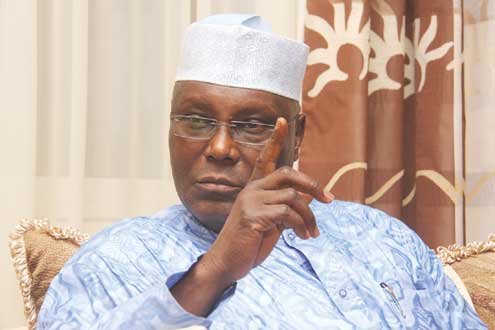
Former Vice President, Atiku Abubakar
In this interview with PREMIUM TIMES, former Vice President Atiku Abubakar, speaks on President Goodluck Jonathan’s eligibility to contest the 2015 presidential election ; why he joined seven governors to float the “New PDP”; his presidential ambition, role in the registration of PDM and other issues.
———————————————-
At what point did you decide to team up with the seven governors and others to ‘make things right’ in the PDP, considering the fact that some of them were never your political associates and had in fact worked against you at some point?
If you dig into the history of how the Peoples Democratic Party, PDP, was formed in 1998, you will understand that one cardinal objective of the party is to stamp out dictatorship and executive high-handedness in Nigeria. It was commonly agreed upon among the founding fathers of the party that the PDP was going to be a political party that will operate and function by the rules, and that decision-making in the party would comply with democratic norms.
But along the line, and not too long after the party won the presidential election in 1999 and also won the majority of seats in the National Assembly, the PDP began to change in character and in content. The change in character had to do with the fact that some elements in the leadership of the party began to wield an iron fist; and the change in content began when the PDP started to change its own laws to gratify the desires of a few powerful individuals in the party.
So, the effort to correct the wrongs in the PDP didn’t just start now. And that is why I will want to correct you on the appellation of ‘rebel governors.’ Those of us who have come together to champion crusades to return the PDP to the dreams of its founding fathers are not leading a rebellion against the party. What we are doing is to further strengthen the PDP and reconnect it to the Nigerian people.
When did I join the governors? This happened after four delegations, one after the other, were sent to me. I did not give them any terms or preconditions because I believe in their sincerity or purpose.
Some say they saw this coming when some of your associates moved to register PDM and succeeded in doing that. Is it not safe to conclude that you are in this to destabilize the PDP because you now probably have an alternative platform on which you could realize your ambition? Or you are in this because you are not getting fair deal from the party as you complained recently?
Let me correct you on the two notions you have raised here. One is that I do not have a hand in the formation of the PDM. Absolutely none! True, some of the people in the party (PDM) may be my political associates; just the same way they are political associates with other leading members of the PDP. You will recall that the PDM is the very back bone of what we today have as the PDP. If some members of the PDP feel aggrieved about the way the party is being run and then decide to float another party, the best I can do is to persuade them not to go in that direction. I do not possess the right, or even the powers to prevent them from forming and belonging to a political party of their choice. The second wrong notion you raised is to say that I am in this struggle because I am not being fairly treated in the PDP. And then, I should ask you: Am I the only one who is not being fairly treated in the PDP? I can confirm to you that over 70 per cent of members of the PDP also feel that they are not being fairly treated by the party. That is why we are demanding for a change in the way the party is run, and that is why the actions we have been taking thus far enjoy popular support among members of the PDP.
With your action, haven’t you betrayed the party leaders some of whom facilitated the waiver granted you only two years ago?
Don’t forget that I didn’t leave the PDP in the first instance as a matter of choice. There was a process deliberately orchestrated to expel me, alongside some other members, from the PDP in 2005. Do not also forget that I did not return to the PDP at the mercy of any individual. My return to the party was borne out of a genuine reconciliation effort led by a respectable statesman in the person of former Vice-President Alex Ekwueme. I am a loyal member and a leader of the Peoples Democratic Party. I also have personal values. As a politician, my core value is to protect the tenets of democracy. I will never betray my values for democracy to satisfy political conveniences, not even when I could have directly benefitted from such infractions.
Is it that Atiku has not learnt his lessons, some might say? Don’t you think some of them might be regretting backing your waiver?
To be honest with you, I do not seem to understand who the “they” you are referring to are. I will probably ask you to explain it further.
In clear terms what is your grouse against Bamanga Tukur? (We understand both of you are from the same locality in Adamawa State).
Alhaji Bamanga Tukur is a respectable citizen of Nigeria, who has contributed immensely to the growth of our national economy through his involvement in the private sector. I cannot hold any grouse against such a person, even if we don’t share the same kindred. But being successful in running corporate boardrooms does not mean that you can be successful in running a political party. Bamanga Tukur doesn’t understand the art of running a political party and a lot of people understand that deficiency in him, but chose to keep quiet about it.
It is believed that the role you have played so far in this saga is not unconnected with your plan to contest the 2015 presidential election. Must Atiku be president?
My presidential ambition dates back to 1992 when I stepped down for the late Bashorun MKO Abiola. Since that time, I have been at the forefront of every presidential contest in Nigeria. I am a democrat to the core and I believe that the only way to earn and run a successful presidency is by a popular mandate, through the mechanisms of a political party. Every democratic government, in the true sense of the term, stands on a tripod: the candidate, the political party and the people. These three cords have to be well knitted before you can campaign for, and win a presidency. So, anybody who wants to be president through the mechanisms of a political party must be interested in reconnecting the party to the Nigerian people.
Must Atiku be President? No. It is not a birth right. The difference I had wished to make when I ran was to give back to a country that has done so much for me. I owe to Nigeria; Nigeria does not owe to me.
A commentator said the other day that this time if you lose the current war you are waging against the party it could deal a deadly blow on your political career. Do you agree?
I don’t understand the context under which the commentator made that submission; but I think it is very unfair of him or her to say that I am waging a war in a democratic setting.
You were conspicuously absent at the trouble-shooting meetings so far convened on this crisis. Why? One had expected that you would attend the meetings held last Friday in Abuja between your group and your former boss, former President Olusegun Obasanjo. Were you not invited?
I had foreign engagements lined up for me six months earlier and I was just waiting for the convention to come and go.  These engagements had involved foreign leaders. You will not advise that I stay away from those commitments. As a human being, I cannot be in two places at the same time.
It looks like you and Obasanjo are already finding a common political ground now because some of those governors are Mr Obasanjo’s political associates. What is your political relationship with him now? Do we take it that you could work together in the build up to the 2015 polls?
I will work with anybody who has a genuine intention of rebuilding the PDP.
One of the conditions the “New PDP” reportedly gave President Goodluck Jonathan is that he should drop his presidential ambition. Is this true? Isn’t that a way of trampling on his right to seek elective office in a democratic environment like ours?
That is not correct. No person has a right to stop the other from pursuing his rights as guaranteed by the law. If President Jonathan doesn’t have the rights to contest the 2015 presidential election, only the court can make such pronouncement, not an individual or a group of individuals. It is entirely up to Dr. Jonathan to say he will run or not. My view is that with zoning in the PDP now dead, anyone qualified under the constitution is free to run.
Do you foresee early resolution of this current crisis? Can the PDP be one family again?
A resolution of the crisis in the PDP is in the best interest of all members of the party. But like I said, I will not be a party to any agreement where the values of democracy will be betrayed for political conveniences. The PDP needs to respect its own laws and also honour its own conventions.
In 2011 at ThisDay Dome in Abuja, you reportedly said those who make peaceful changes impossible make violent change inevitable. Do you still stand by this as we approach 2015?
To start with, you will recall that the original copyright of that quote belongs to the 35th president of the United States of America, President John F. Kennedy, during a speech he made in the White House in 1962. I have made reference to that quote as you rightly mentioned in 2011 in protest to the abiding culture of lawlessness and arbitrariness in the PDP.
I have heard people extrapolate that quotation from me and giving it a completely different meaning which, in purpose or by mere conjecture, is outside the ambiance of the norms and values that I subscribe to.
Today, the PDP finds itself in the midst of a mess, largely because the party has refused to retrace its steps to the path of constitutionality and internal democracy. And, to have a situation in which leading members of the party walk out on the president and the party leadership, demanding for internal democracy should itself be considered as a peaceful process of change.

PremiumTimes

Nigeria Politics 101

KELECHI DECA
Until you understand fully how enlightened self interest can push politicians to take stands ordinarily they would not accept. And how the wisdom of staying in the corridors of power (or the gates of power) instead of the mansions of the powerless can go a long way into forcing political marriages of convenience.
Only then would it dawn on you that contrary to the assumptions most of us ordinary, uninformed, non politicians hold, these politicians think through every action before they stake their allegiance.

Recently several informed commentators, many of them with ears to the ground have been trying to unravel the real horsetrading that led to the emergence of the All Progressive Congress (APC). And what has led that party which started on a wobbly state to grow strong and stronger, while its perceived nemesis the PDP is growing weaker. Was it love for Nigeria or anger towards the PDP, or just the quest for power. This is because the APC as constituted has some of the strangest political bedfellows in the history of Nigeria.
And talking about history. This is the first time in the history of Nigeria that the map of political coalition is being drawn from the South West to the North. This two regions have never had any coalition and have never agreed in political principle before. What could be responsible for this. Is it that the South West has moved away from their progressive enclave, embracing conservatism towards the centre, or is it that the North is shirking its conservative garb to lean towards progressivism? Or better still, the two groups have lost their traditional ideological bases and embraced a hybrid political system known as Nigerianism, devoid of ideological leanings?
Since independence, we have witnessed a North and East political marriage of convenience. We had the NPC/NCNC after independence, we also had the NPN/NPP during the second republic. We have also had the NCNC/AG which led to the formation of UPGA,( a political arrangement many say was Nigeria's best opportunity to turn the fortunes of Nigeria for good, but was sacrificed on the alter of self.) but never a North/ West agreement.
To what extent can this new political alignment get to. Does it have what it will take to mount the quality opposition that is badly needed to strengthen this democratic experiment? Will efforts be made to make it more appealing to people outside this two regions especially the South East and the South South so it can have the spread needed to claim a national party status?
I still believe that the quality of our democracy will depend on the quality of democracy within the political parties.

NationalDaily

Jonathan: What Went Wrong

 by James Uzondu

News Introduction: 
Like all informed observers know, the clash of interest of who the 2015 elections should favour is the reason for the split in the ruling Peoples Democratic Party, PDP. But there are other unanswered questions: Why are the rebels in PDP so obsessed with pulling down the chairman of the party, Alh. Bamanga Tukur? Why are they hell-bent on embarrassing the president, distract and frustrate his government? Why are they interested in him failing? What has he done? - By Samuel Odaudu and Mike Odiakose
Dr. Goodluck Ebele Jonathan is an immense man of history. Looking at his lowly background, it would have appeared ridiculous and deceptive for any one, be it a soothsayer or prophet conversant with his beginning to have predicted that he would one day become the president of the most populous Black nation on earth, Nigeria. Devoid of colour and glitter associated with aristocratic kids who are born with silver spoons in their mouths, the story of his gradual, unpredictable but steady rise from grass to grace has captured several imaginations and has as well rattled the pompous who bestride our checkered socio-political space like peacocks.
His story is indeed a powerful statement, a symbolic seed of destiny sown into many a dreamer – the Nigerian child - a positive mentality. Among the sweating, toiling and hapless Nigerian masses that endlessly wait for socio-economic consolation before 2010, the emergence of President Jonathan was and still remains unquenchable inspiration. In many quarters, it became a proverb: ‘If Jonathan can make it, I can make it also’, almost quoting the president himself when, in 2010 at the Eagle Square during the Peoples Democratic Party’s, PDP, presidential primary in Abuja, he said, “Fellow Nigerians, if I could make it, you too can make it!”
If personal history is the only parameter used in deciding who gets what in the journey of life, young Jonathan and people in his category would have perpetually remained unknown as a result of their inconsequential and disadvantaged backgrounds in life.
As told by himself, he told Nigerians and the rest of the world that, “My story is the story of a young Nigerian whose access to education opened up vast opportunities that enabled me to attain my present position. As I travel up and down our country, I see a nation blessed by God with rich agricultural and mineral resources and an enterprising people. I see millions of Nigerians whose potentials for greatness are constrained by the lack of basic infrastructure.

“I see Nigerians who can make a difference in the service of their country but are disadvantaged by the lack of opportunities. My story symbolises my dream for Nigeria. The dream that any Nigerian child from Kaura-Namoda to Duke town; from Potiskum to Nsukka, from Isale-Eko to Gboko will be able to realize his God-given potentials, unhindered by tribe or religion and unrestricted by improvised political inhibitions. My story holds out the promise of a new Nigeria. A Nigeria built on the virtues of love and respect for one another, on unity, on industry, on hard work and on good
Governance”, President Jonathan crisply summarised his life history.
President Jonathan was born on November 20, 1957 into typical indigent Ijaw-speaking family in the Niger Delta region. In his village, fishing was the dominant occupation; a village where life was raw without infrastructure. A peer into what tomorrow would look like then had presented a rather hazy and uncertain future. Little did he or his family members know that that boy in the rural Bayelsa village would become the 14th Head of State of the Federal Republic of Nigeria.
He has a remarkable academic pedigree. President Jonathan holds a BS degree in Zoology, MSc degree in Hydrobiology and Fisheries Biology, and a Ph.D degree in Zoology from the University of Port Harcourt in Rivers State. he had worked as an education inspector, lecturer and environmental protection officer be fore his foray into politics in 1998 when the ban of politics and political campaign were lifted by the regime of General Abdulsalami Abubakar.
His story is a steady progress of a meekly but unstoppable life defined by purpose and providence. He has served as a former deputy governor under Chief Dieprieye Alamieyeseigha in from May 1999, then he was sworn-in as governor of Bayelsa State on December 9, 2005, after the controversial removal of Alamieyeseigha as governor of the state. During the countdown to the 2007 presidential election, he was nominated by his party, the PDP, as running mate of Alhaji Umar Musa Yar’adua blessed memory, the former governor of Katsina State. Thus he served the country as Vice President of Nigeria.
Before he became Nigeria’s president, Dr. Jonathan had worked in the public service.
As Vice-President, Dr. Goodluck Jonathan was sworn-in as President of the Federal Republic of Nigeria on May 5, 2010, after the death his boss, President Umar Musa Yar’adua. On May 18, 2010, Governor Namadi Sambo of kaduna State, President Jonathan’s nomination, was approved by the National Assembly for the position of Vice-President.
Prior to that, when the ailment of President Yar’adua had rendered him incapacitated to carry out his duty as President of Nigeria as required by the constitution of Nigeria, and in the face of the cloudy political situation in the country orchestrated by the way and manner his worsening health condition which was mismanaged by members of his kitchen cabinet, Vice President Jonathan was confirmed Acting President by the Nigerian Senate under the invocation of the “doctrine of necessity” by the Senate President, David Mark, on February 9, 2010.
The controversies that surrounded ailment and the subsequent demise of President Yar’adua on May 5, 2010, and the dramatic manner in which Dr. Jonathan ascended the seat of power as Nigeria’s president was an indisputable, ineffaceable and strange statement about the role of providence in the centre of his life. He rode on this divine hands and guidance, and the populist will of Nigerians into the 2011 presidential election in which he won with remarkable difference.
The 2011 general election was one moment of history for the Nigeria’s nascent democracy. Nigerian electorate was faced with an auspicious moment of history-making decision. There was a presidential candidate who came from a minority group, Ijaw (though unconfirmed reports said Ijaw is about the fourth largest ethnic group in Nigeria); a presidential candidate who was not rail-roaded into the race by some self-important and selfish godfathers.
The Nigerian electorate made a bold statement for a radical political statement to the effect that, in the new Nigeria project, it is possible for a minority person to be elected into any political position in Nigeria.
Before President Goodluck Jonathan emerged victorious in the 2011 election, there were threats that the country would be made ungovernable for him if he eventually won the presidential election. Contrary to belief in some quarters that it was the defeated presidential candidate of the defunct Congress for Progressive Change, General Muhammadu Buhari, that started that inflammatory comment, it actually started within the ruling PDP.
A founding member of the party and political ally of former vice president, Atiku Abubakar, Alhaji Lawal Kaita had said in October 2010 that, “the North is determined, if that happens, to make the country ungovernable for President Jonathan or any other Southerner who finds his way to the seat of power on the platform of the PDP against the principle of the party’s zoning policy in 2011”. Kaita had at that time warned that the North should not be blamed for the calamity that would befall the country if Jonathan emerges President. Then other persons took cue from Kaita.
Threats of violence became a sing-song in the camp of Atiku ahead of the 2011 convention of the PDP where the party picked its presidential candidate. Atiku made a blunder of carrying this politics of “do or die” into the Eagle Square convention ground of the PDP in January 2011 where the party delegates elected its presidential candidate. When Atiku was given the microphone to address the delegates, he wasted the limited time talking about the violence and calamity that would befall the country if power did not shift to the north. This was after he had earlier threatened that those who make peaceful change impossible make violent change inevitable. These threats did not go down well with most of the delegates, including his supporters and the outcome of that convention is now history.
The violence that trailed the outcome of the 2011 presidential election was further fueled by the comments of Buhari who asked his followers to take up arms if the election was rigged. But unfortunately, even before the result was announced in some parts of the north, violence had erupted claiming the life of thousands of innocent Nigerians, including youth corps members. It is ironical that it is the same places where Buhari won that protest by his supporters took place.
Since Jonathan was sworn in as president in 2011, the violence which those opposed to his candidature promised in order to make Nigeria ungovernable has been the biggest challenge his administration has been facing. It has blossomed into national security challenge. It is interesting that the violence and the misgovernance are concentrated mostly in the north. Members of Boko Haram sect are considered major suspects in the perpetration of mayhem. Practically, the economic, social and other activities of the north, especially in eastern parts of the region have been crippled. This thus led to the declaration of state of emergency in Yobe, Borno and Adamawa states.
Northern leaders that are believed to be sponsoring this violence never took the warning by Bishop Hassan Mathew Kukah serious that the wonton destruction and killings will take the north 30 years back until the people they are using to commit the havoc turned their guns against northern elites. Most of them, until recently, stopped going to their villages and holed up in Abuja and Kaduna as a result of the activities of the monsters they created.

The Tukur Factor and Amaechi Connection

While the Jonathan administration is trying to curtail the security challenges, members of his PDP were busy causing distractions within the party. Apart from about 11 states where flawed state congresses were conducted as reported by the Independent National Electoral Commission, INEC, all was well in PDP until the March 8, 2012, national convention of the party where a new National Working Committee, NWC, headed by Dr. Bamanga Tukur was elected.
Prior to the election of Tukur, only the governor of Adamawa State, Murtala Nyako, openly expressed objection to the emergence of Tukur for very obvious reasons. Tukur is an indigene of Adamawa State and as one of the founding fathers of PDP, he was in the forefront for the revisit of the flawed congresses in the state. Other governors did not buy into Nyako’s campaign against Tukur and the governors played active role in convincing the other eleven aspirants that went into the race to step down for Tukur.
No one knows exactly what went wrong between Tukur and PDP governors but political observers believe that Tukur’s insistence that the party is an institution that must be respected and party supremacy must also be entrenched in PDP is the root of the rift between him and some PDP governors.
According to Tukur, the NWC, the president, governors and every other member of the party, irrespective of their status, must stay under the party and not on top of it. “We as leaders of your party are here. Our job is to ensure that we support all actions being done to help the promotion and development of our people. Let us build the institution of government strong; it is not the personality; it is the institution. For us, the party is supreme it is not the NWC or the President or the Governors it is the institution of the party itself that is supreme because all of us come in and go.
“Once that institution is respected and organised and committed, you can be sure that our country will be great and we will be able to raise our heads high before any nation”, he said. Unfortunately, most of the governors are uncomfortable with the zeal and commitment of Tukur to the reform agenda. It is feared that it will erode their powers as lords of the manor in the states chapters of the party.
Prior to the election of Tukur, PDP had the misfortune of having national chairmen that are always running cup in hand to the governors for assistance. Since the governors pay the former national chairmen, they dictated the tune. That was the sorry state before Tukur took over the leadership of the party.
PDP governor, who allowed the governor of Rivers State, Rotimi Amaechi, to preside over their meeting by virtue of his former position as the chairman of the Nigeria Governors Forum, NGF, before the inauguration of PDP Governors Forum, ganged up against Tukur and were working at cross purposes with the national leadership of the party. Amaechi was in the forefront in the battle against the leadership of PDP unknown to many of his colleagues that he has an agenda that is not unconnected to the politics of 2015.
It is believed that Amaechi wants Tukur out because of his fear that with Tukur in the saddle, he will not be able to manipulate the national leadership of the party to favour his rumoured ambition to contest for the position of vice president in 2015. To secure the support of the PDP governors, Amaechi is always there to support them anytime they have issues with the PDP leaders, President Jonathan or the federal government.
Prior to the inauguration of PDP Governors Forum, Amaechi’s group infiltrated the PDP NWC and recruited the former Deputy National Chairman, Dr. Sam Sam Jaja and former National Secretary, Prince Olagunsoye Oyinlola, as their anchor men. They instigated the palace coup against Tukur when they attempted to reverse the sack of the Adamawa State executive committee loyal to Governor Nyako. Naturally, Tukur fought back and when he had a leeway from the judiciary that removed Oyinlola and the National Auditor, Chief Bode Mustapha, who were brought into the NWC by former President Olusegun Obasanjo, he never allowed it to slip by.
The removal of Oyinlola and Mustapha compounded the perceived rift between Tukur and some governors. When Tukur eventually led NWC members on reconciliation tour of the six geo-political zones, some governors that had axe to grind with him stayed away.
To break Amaechi’s stranglehold on PDP governors, the leadership of the party inaugurated the PDP Governors Forum and appointed the Akwa Ibom governor, Godswill Akpabio, as the chairman. That move not only sent Amaechi to the back seat but also split the governor with Amaechi having only about six PDP governors behind him. The rift among PDP governors was moved to the larger Nigeria Governors Forum where their election ended up splitting the forum with one faction headed by Amaechi and the other headed by Governor Jonah Jang of Plateau State.
The 19 northern governors had earlier adopted Jang as their consensus candidate and presented him to the 25 PDP governors as their choice for Amaechi’s replacement. But like the Biblical Judas, some of the northern governors that dragged and adopted Jang, even when he never indicated interest, later betrayed him when the election proper was conducted. Governor Sule Lamido was to confess later that the northern governors that betrayed Jang were himself, Governor Babangida Aliu, Governor Aliyu Wamakko Magatarda of Sokoto, Governor Murtala Nyako of Adamawa and Governor Musa Kwakwanso of Kano who are today known as the ‘G5 Governors’ or the rebel governors by the media.  
Amaechi’s ambition to go for the position of vice president on a joint ticket with either Governor Sule Lamido of Jigawa State or Governor Rabiu Musa Kwakwanso of Kano State against his kinsman, President Jonathan, did not go down well with his people back home and he was practically ostracised by his brother governors in his region. In Rivers State, Amaechi lost control of PDP structures from the ward to the state levels when a High Court declared Felix Obuah as the legitimate chairman of the state chapter of PDP.
There was another development before then. Amaechi has been having a running battle with some chieftains of the party after he allegedly instigated the sack of the chairman, vice chairman, all councilors of Obi/Akpor Local Government Area of Rivers State. All entreaties for Amaechi to prevail on the Rivers State House of Assembly to reverse the decision fell on deaf ears leading to eventual suspension of Amaechi and some members of Rivers Assembly from the PDP.
The crisis in Rivers Assembly culminated in physical combat between Amaechi’s supporters and anti-Amaechi law makers when there was an attempt to unseat the speaker. Nigerians watched with disbelieve when one of the lawmakers used the mace to attack another lawmaker after Amaechi and security aides invaded the House to stop the attempt to remove the speaker that is fiercely loyal to him.
After this incident, the northern G5 Governors who have since abandoned governance in their states on accounts of 2015 interest went to Rivers State on solidarity visit only to have irate crowd waiting for them at the airport. They got more than they bargained for after the youths pelted their convoy. The youths were angry with Amaechi for working with those they believe are all out to deny their region opportunity of having Jonathan enjoy second term as provided for in the constitution.
Since Amaechi fell out with the leadership of PDP, he is said to have been hobnobbing with the defunct ACN that merged with other parties to form the All Progressives Congress, APC. His unofficial entry into ACN split the party in the state and some of their members that were not happy with this development like Abiye Sekibo dumped the party and returned to the PDP. Because of the rapport between Amaechi and the opposition parties, they took over any issue affecting the embattled governor, even matters that are purely internal affairs of PDP. The APC governors are also the ones still nudging Amaechi to continue with the battle over the control of the NGF.
When PDP eventually organised the Special National Convention on August 31 to fill the vacuum created by the mass resignation of all the members of the National Working Committee, NWC, whose election in 2012 was considered flawed, the G5 Governors that are agitating for power shift to the north alongside Atiku staged a walkout and went to Shehu Musa Yar’Adua Centre where they announced the birth of the New PDP. For the first time in several years, two political arch-rivals, Atiku and Governor Nyako sat on same table, united by individual quests for political relevance. The New PDP is basically made up of people who are either aggrieved or are in the race for the 2015 presidential race. Some of the aggrieved governors like Lamido who are considered Obasanjo boys went into the marriage of convenience with Atiku who, until now, does not see eye to eye with Atiku.
While Obasanjo is aggrieved that he had lost control of Ogun State chapter of PDP to Prince Kasamu faction, in addition to the sack of Oyinlola and his other loyalists from PDP NWC, Atiku is hoping to use the platform to contest the 2015 presidential election, even after he was reported to have used proxies to register the Peoples Democratic Movement, PDM. To ensure they get the support of Obasanjo, the New PDP appointed Oyinlola as the National Secretary while Amaechi’s nominee, Dr. Sam Sam Jaja, was given position of Deputy National Chairman. Analyst believe that implosion in New PDP is inevitable as it is believed that with Oyinlola as National Secretary, Obasanjo will use Oyinlola, Lamido and Kwakwanso, to checkmate Atiku.
Besides, Obasanjo has once again, rekindled his old rift with Atiku. The media war is expected to be sustained in the coming days.
As PDP leaders work round the clock to settle the crisis in the party, it is believed that the conditions put forward by the New PDP are almost impossible to meet. The conditions include the sack of Tukur who was elected at a national convention by delegates; reversal of the sack of Adamawa and Rivers executive committee that was removed by a court order; lifting of the suspension slammed on Amaechi despite the fact that the case is subjudice since Amaechi is already in court; stoppage of the trial of former Governor Bukola Saraki for fraud by the EFCC and the automatic return of Oyinlola and others former NWC members.
So far several high level meetings have not yielded any results. But one easy way out for Jonathan and other PDP leaders is the resolution of some pending petitions about flawed congresses and imposition of candidates which Tukur has, for whatever reason, ignored since he came into office despite several reminders.
2015
As earlier hinted, the 2015 presidential election is the most important factor in the ongoing political permutations. The conflicts are the symptoms of big national blackmail by politicians to slaughter national interest on the alter of selfish interest.
According to the findings of this magazine, opposition think that everything is wrong with Jonathan. The major reasons why they are after him and why they think they can and must get him out of the way by all means are, among others:
+The president is from a minority group in Nigeria.
+The president does not dole out free money to some self-appointed godfathers to be shared as was the case in the past.
+The president is some one who is humble, gentle and weak and so he cannot hurt a fly, hence, his political traducers must take undue advantage of him.
+They (rebels) are afraid that if the remarkable progress of his Transformation Agenda which has had positive impacts in the road constructions and maintenance, rail transportation, improved electric powers supply and the transparent reform through the privitisation of the sector, reforms in the oil sector, the revolutionary drive in the agricultural policies, the establishment and the spread of the Almajiri Schools and establishment of federal universities in which the north is the major beneficiary, among others, is not halted or distracted, his electoral value will be enhanced ahead of the 2015 to the disadvantage of his ambitious opponents.
+The president has tenaciously upheld the tenets and practice of the rule of law, party discipline, which is what has pitched the president and Tukur against unruly elements in the party. The national chairman of the party used to be paid by state governors and so they dictated the tune of the party, but when Tukur came, all that changed and because they are not paying him, they cannot dictate to him to do their bidding, they must be problem.
+The president is a detribalized Nigerian who, against the thinking of politicians, has ensured that federal projects and appointments are evenly distributed, even when it does not favour his people of the Niger Delta.
Like the former Minister of the Federal Capital Territory, Alh. Abba Gana, observed in a recent interview, the rebel PDP splinter groups are over ambitious. According to him, “all of them want to be president of Nigeria and there is just one seat”, he said. To achieve their ambition, therefore, they must fight Jonathan by all means, hijack the party structure from his hands, pull down his government through major political distractions. 

NigerianNewsWorld

2015: Is Jonathan constitutionally qualified to contest?

  •  by  Shaba Ibrahim
  • THE debate over the qualification or otherwise of President Goodluck Jonathan, to seek re-election in 2015 is assuming an interesting dimension, with  members of the public expressing divergent views on the matter, the most recent being the view expressed by J. S. Okutepa, a Senior Advocate of Nigeria (SAN) in a national newspaper last week.
    While not disputing the learned SAN’s right to air his views on such a topical issue, especially as a member of the privileged class of legal practitioners, I am however of the view that the opinion expressed by the learned SAN borders more on curious moral logic than law.
    A brief foray into the high points of the learned SAN’s postulation will be helpful in appreciating the basis of my conclusion. Hear him:
    That by virtue of Section 137 (1) (b) of the Constitution of the  Federal Republic of Nigeria 1999 as amended, President Goodluck cannot seek re-election in 2015 having, according to him “…been first elected as president in 2007.”
    That by the said provisions,  “a person contesting the office of the vice president is by implication contesting the office of the President.”
    That President Jonathan, “even though elected as vice president, was elected as President because in the absence of the President, he became the President on the basis of the election that brought him and the late President to office.”
    That a Nigerian President can only spend a maximum of eight years in office, as it is not the intention of the framers of our Constitution that anyone should spend more than eight years as President, notwithstanding the circumstance.
    The learned senior counsel has cited in aid of his submission the cases of Marwa V. Nyako (2012) 6NWIR (Pt 1296) P.200-311, P.D.P V. INEC (1999)7 SCNJ 297 and concluded that  President Jonathan would be breaching the Constitution should he be re-elected as President in 2015, having been so elected at two previous elections.
    With due respect to the learned Senior Advocate, his interpretation of Section 137 (1)(b) of the Constitution does considerable violence to the much-cherished principle of constitutional interpretation, which is that one must not ascribe a reasoning so incongruous and unreasonable in interpreting the provisions of the constitution. At the risk of stating the obvious, President Jonathan was elected as Vice President and NOT President in 2007 and I am at a loss as to how the office of the President and the vice President can be said to be the same when the Constitution has set for each separate and distinct roles. I also cannot see how the two offices would approximate to the other in whatever circumstance as posited by the learned SAN.
    Jonathan assumed office as President in 2010 soon after the death of President Umar Yar’Adua. He was NEVER elected as such. The language of the law is clear and unambiguous and must be construed literarily. If the farmers of our Constitution intended that the residue of tenure of a dead President would count as full tenure for a succeeding vice, it would have been so stated in clear terms.
    I find the cases of Marwa Vs Nyako and PDP Vs INEC (supra) unhelpful to the learned SAN’s argument as a judicial authority is precedence for that which it decides only; there cannot be precedence by assumption as in none of the cases relied upon by the learned SAN was the provision of Section 137 (1)(b) directly in issue. The term of years envisaged by the Constitution is one that has arisen by means of a democratic election and no more. This is settled law!
    Another issue upon which the learned SAN based his argument is that under no circumstance does the Constitution contemplate anyone spending more than eight years in office as president.
    President Jonathan, in the estimation of the learned SAN, would be spending ten years as president if he is to contest election as President in 2015. Again, in my respectful view, this argument stands logic on its head, for if a man elected as Vice President could be deemed to be President, what then happens to a man elected Vice President for eight years seeking election as President? To be persuaded by this rather dreadful submission of the learned SAN on this issue is to declare a two-term holder of the office of vice president ineligible to contest the office of the president soon after his tenure as Vice President! This cannot be said to be the intention of the framers of our Constitution! I, therefore have no hesitation dismissing the views expressed by Mr. Okutepa on the appropriate interpretation of the section of 137(1) (b) same being circuitous, absurd and unduly restrictive. Let me not say that those views were influenced by the medium of expression!
    Not even the antagonists of Mr. President can in my view legitimately canvass this argument as was done by Mr. Okutepa because my understanding of their case against Mr. President is one founded on the morality of offering himself for contest, having allegedly pledged to run for just a single term in the build up to the 2011 elections. Otherwise, of what use would it be, asking an ab initio disqualified candidate to enter into an undertaking not to run for a particular office for a second term?
    I submit that the alleged undertaking not to run in 2015 is in itself an admission of the legal right of Mr. President to contest for a second term, which to my mind places only a strong moral burden on him, if indeed such an undertaking exists.
    Shaba is the Special Adviser to the governor of Kogi State on  Multilateral Cooperation.
    NigerianTribune

    Seizure of Mark, Tambuwal, others’ passports: New PDP withdraws allegations

  •  by  Olawale Rasheed and Clement Idoko-Abuja
  • THE Kawu Baraje-led faction of the Peoples Democratic Party (PDP) has withdrawn its earlier allegations and condemnation of purported withdrawal of diplomatic passports of leaders and members of the National Assembly, admitting that there is no truth in the said report.
    The faction had, in a statement by its publicity secretary, Chief Chukwuemeka Eze, expressed worries about what it called “the dire implications of the reported directive by the presidency for the withdrawal of the diplomatic passports of the Senate president, David Mark, speaker of the House of Representatives, Honourable Aminu Tambuwal and other members of the National Assembly.
    But in a sudden volte face, the faction, in a counter statement, withdrew the allegations.
    “Following the new revelations from both the presidency and the National Assembly, through our national chairman, Alhaji Abubakar Kawu Baraje, that there is no iota of truth in the report that the presidency has directed the withdrawal of the diplomatic passports of the leadership and members of the National Assembly, as reported in most of the national dailies today (Sunday), we hereby withdraw the release on this subject matter, pending further investigation of the facts.
    “Though our release was an attempt to alert the president to the implication if such an unholy move was found to be true, but now that it has been confirmed that there is no such a move, we thank God, as that would have been an unwise policy that will work against the presidency of Dr Jonathan,” the withdrawal statement noted.
    The faction, however, stood by its earlier disclosure that  “Senator Joy Emordi was sacked as Special Adviser to the President on National Assembly Matters because of her candid advice that inducing members of the National Assembly financially to impeach their principal officers would be counter-productive. If this is true, we hereby demand her immediate reinstatement.”
    The statement observed that “Senator Emordi, to be bold enough to tell the president the implication of such a corrupt inducement of the lawmakers, should earn commendation rather than a sack,” advising that “instead of sacking such a forthright and patriotic amazon, the president should sack those hawks around him planning to ridicule him by encouraging him to embark on acts capable of making him very unpopular among his supporters and followers.
    On the alleged stoppage of work at the Port Harcourt airport, the Baraje faction demanded the immediate sack of the Minister of Aviation, Mrs Stella Oduah.
    Meanwhile, the Nigeria Immigration Service (NIS), has denied reports in some sections of the media that it has been ordered to withdraw all diplomatic passports of National Assembly members, including that of Senate president and speaker of the House of Representatives.
    Spokesman of the service, Mr Obua Chukwuemeka, told the Nigerian Tribune in Abuja, on Sunday, through telephone that the service had never received any such directive from the presidency or any other source.
    He said he was surprised to read the report on two national dailies (Nigerian Tribune inclusive), suggesting that the presidency sought the advice of the Comptroller-General of immigration on the issue.
    Chukwuemeka said to the best of his knowledge, there was no such order to withdraw the diplomatic passports of the lawmakers, adding that NIS had never directed any of its officials to enforce any such order.
    “I think this is pure mischief and an attempt by some persons to cause strain relationship between the Comptroller-General of Immigration and the National Assembly.
    “How can it be possible for the presidency to bypass the Foreign Affairs ministry, even the Ministry of Interior and other relevant agencies to direct Immigration Service to carry out such an order?” he said.
    NigerianTribune

    Dilemma Of Nigeria In 2015


    By: Abba Mahmood

    By 2015 it will be exactly 16 straight years since the ruling Peoples Democratic Party (PDP) came to power. Within those years, the party has been able to produce three presidents, including the incumbent Goodluck Jonathan. Within those years, Nigeria has earned more money than it ever did in the previous 39 years since the country got independence from British colonial rule. Within those years, virtually all the assets of the government have been sold to some individuals in the name of privatisation. But, within those years, there has been this paradox: the more resources available in the country, the higher the poverty rate among the Nigerian people.
     There are many indicators to suggest that the next election will not be the same as the previous ones. For one, for the first time in the history of Nigeria, the opposition parties have been able to come together and present a formidable platform. Secondly, the people are getting tired of the same policies that have failed to have positive impact on their lives since 1999. Thirdly, for Nigerian democratic process to mature, deepen and widen, there has to be periodic ability by a party in power to get defeated and vice versa like is happening in other countries such as neighbouring Ghana. After all, election is not the same as democracy, even though free and fair election is an important element of democracy.
     But by far the greatest factor that will lead to the inevitable change in 2015 is the ongoing crisis in the PDP. In the PDP today, governors are feeling they are sidelined; the National Assembly members are complaining they are sidelined; in fact, even President Jonathan is thinking he is sidelined by the Bamanga Tukur- led PDP National Working Committee. Virtually all the state branches of the PDP are in various forms of crisis. The PDP is suffering from terminal cancer which appears to be not properly managed and is just waiting for its final journey to political grave and oblivion.
    However, non-performance by the PDP and dislike of the PDP will not automatically translate to support for the opposition or liking the other party blindly. It takes more than that. The opposition have to earn the support. The opposition have to work for it. For instance, if the opposition bring up the same candidates as they have been doing over the years, there will be voter fatigue and voter apathy. The choice will be very narrow. In fact, it will be a big anti-climax for a nation that is in dire need of change. That is the real dilemma of Nigeria for 2015. The air has not been fresh as promised by Dr Jonathan in 2011 and the only way to excite the public is to bring fresh ideas, fresh vision and fresh candidate who must have had a distinguished career and a solid pedigree in public service, who cannot be easily shot down by past misdeeds or corruption and who is capable of being accepted across the nation.
     The record of the PDP since 1999 has been abysmal, to say the least. Nigeria has four refineries in Warri, Port Harcourt, Eleme and Kaduna. Over 14 years since the PDP came to power, Nigeria is still selling crude oil and buying petroleum products from outside, leading to the petroleum subsidy scam exposed last year. It is just like selling cows to buy cow-tail pepper soup. Why are the refineries not working after all these years and with all the resources expended in the downstream sector for goodness sake?
     Every modern economy is run on power. Electricity is the main engine room of growth. With adequate power, there will be no unemployment as people will have the ability to set up small-scale enterprises to earn a living, pay taxes, reduce crime and grow the economy. Obasanjo alone spent $16billion on the power sector. Apart from unbundled PHCN there is NIPP, Presidential Task Force on Power, Ministry of Power, NERC etc -- so much bureaucracy with very little to show except the increase in overhead costs. No one announces any megawatts in functioning economies. Electricity is just like the air one breathes. Here, under Abacha, Nigeria generated 4,000mw but, about 16 years after, government is still beating its chest that we have attained 4,000mw! This is just what the Grand Mosque in Mecca consumes every day, and we are not ashamed to cite it as an achievement!
     The primary responsibility of any government is protection of life and property; in other words, maintenance of peace and security of the people within its jurisdiction. The police who are the main law enforcement agency constitutionally are undertrained, underequipped and are therefore under-forming with the result that the military had to be drafted to help in the maintenance of law and order in many parts of the country.
    In fairness to President Jonathan, he inherited these problems. But his party has been incapable of addressing them effectively. Consequently, there is warfare everywhere instead of welfare for all. President Jonathan inherited a fractured society with dilapidated infrastructure about four years ago when he assumed leadership. As the first PhD holder to be the president of Nigeria, everyone was expecting a great sense of statesmanship and good statecraft. Here in Africa, we have a very good example. With the demise of apartheid in South Africa, President Nelson Mandela’s deliberate policy of reaching out to the white population, after the African National Congress took power, was one of his great acts of statesmanship, in order to create an environment in which the various groups that make up South Africa have a sense of belonging. Here, this noble policy has not been internalised.
     To compound matters, President Jonathan set up a cabinet composed of first-class local sycophants and those whose allegiance is primarily to the Bretton Woods institutions. They confuse the president with graphs, charts and statistics that have no meaning to the real life situation of average Nigerians. Agriculture which is a key to the national economy and important to the welfare and stability of the nation, being the largest contributor to the country’s GDP, is not being given the priority it deserves. The agriculture minister has textbook approach to agriculture and is only interested in cassava. The finance minister who is Nigeria’s first coordinating minister of the economy has centralized everything, causing stagnation. Consequently, instead of an Abuja Consensus, Nigeria is taking the Washington Consensus economic dosage hook, line and sinker. To make matters worse, federal appointments are getting more lopsided and skewed in total disregard of the Federal Character like Yar’Adua did with his Katsina clique. It appears like one bad turn is breeding another.
     The gap between the rich and the poor is widening. The gini coefficient used by economists as a measure of the inequality of income and wealth is getting worse: less than 100 billionaires as against over 100, 000, 000 who are living below poverty line. Rising inequality and a polarization of society will inevitably lead to further social dislocation. Government has to ensure that the growth is more equitable and that opportunities are not limited to a privileged few. 
     Meanwhile, President Jonathan and all his supporters must know that 2015 is  not about any section continuing or not continuing, as they keep saying south-south must have a second term; it is not about a minority must have two terms or three terms in this case, like the other presidents who are from the majority tribes, as they argue. It is about performance and non-performance; it is about progress and lack of it. There is poverty, insecurity, corruption and decayed infrastructure. These are the problems of the people requiring to be addressed and not any south or north. God save Nigeria.

    Leadership

    Nigeria’s 80% Graduate Unemployment


    By: Sam Nda-Isaiah
    There are several figures on employment in Nigeria, but, to get the actual statistic, the place to start is to suspect any figure that emanates from the Jonathan government. It’s a no-brainer to assume that all such figures would be skewed towards the everyday lies of the government. Even then, a source that works for the Jonathan government, not long ago, declared that there were more than 40 million Nigerians currently unemployed. That figure is more than the population of all the countries in West Africa and almost double the population of Ghana (25 million), which is next in size to Nigeria. The Nigerian government’s 40 million unemployment figure is also bigger than the population of 52 of the about 60 countries on the African continent. If this scenario does not scare anyone, then, nothing else will. But President Jonathan is not in the least perturbed, as he has not as much as mentioned the unemployment problem since he became president in May 2010.
    Even as bad as this sounds, the figures are in fact much higher. A federal government establishment very recently requested applications for employment. The establishment specifically asked for fresh graduates and that they should all apply online. All this was to cut down the number of applications. In spite of that, more than 12,000 people applied. The parastatal needed 25 people. Meanwhile, Nigerian universities and polytechnics continue to churn out more than 150,000 graduates (bachelor’s degrees and HND) annually. Well-meaning Nigerians should be worried.
     The figure I saw about a fortnight ago on graduate unemployment in Nigeria is 80 per cent. That sounds more like it. Other credible sources say about 70 per cent of the total Nigerian working age population is unemployed. Yet, President Jonathan does not see an emergency. He does not even see a problem at all. The only figure Jonathan sees is 2015. He is completely sold to his self-succession idea that nothing else matters. Not even crude oil theft that is about to collapse his government and scuttle the democratic regime (more or less) that the nation currently enjoys.
     Last week’s controversial shooting of unarmed squatters in Abuja should give us an indication. It is no longer news that nearly all uncompleted buildings in Abuja have squatters, most of them unemployed graduates. Many of them might have been victims of last week’s panic shooting by security agents. And you cannot completely blame the security agents who have become quite desperate about ensuring that the Boko Haram menace is contained. If the security agents were wrongly tipped off, and if indeed they believed the occupants were Boko Haram insurgents, they would not be totally unreasonable to open fire even though there will be the need for a thorough investigation into the matter.
     But my point is that as long as unemployment persists at the current levels, there will be many more panic shootings like this. Besides, many of these graduates will eventually be recruited into the ranks of Boko Haram insurgents, Niger Delta oil theft syndicates and Ombatse cults any way. Many others will join the ongoing very “lucrative” kidnapping enterprise, and some will end up as armed robbers. Many women will end up in prostitution and some of the men might end up as male prostitutes to serve the current large market for homosexuals. But many more, angry enough, will take up arms against the state. They will not be Boko Haram, Niger Delta militants, armed robbers or kidnappers. They will claim to be fighting for Nigeria and they will not attack the wrong people. That is the one that government people should be afraid of. The only way to stop that from happening is to stop this stupid stealing of public funds and start working for the people.
    This is not the first time I have discussed this very dangerous issue. I am repeating a write-up I did on October 22 last year to give Jonathan an idea of what he should be doing. If he is serious!

    Did Jonathan Know It Was World Poverty Day?
    First published on October 22, 2012
    Last week Wednesday, October 17, was the International Day for the Eradication of Poverty. The day came and passed but the Nigerian government didn’t take any notice. The day is officially recognised by the United Nations, and nations set this day apart to discuss ways to eradicate poverty. That’s what happened across the world on Wednesday.
    It is quite telling that the Nigerian president and his handlers didn’t even mark the day. And that is for a country that has 110 million of its 167 million citizens living below $1 a day. That, precisely, shows how seriously Nigerian leaders take their people. This is further proved by the 2013 budget estimates just submitted to the National Assembly in which agriculture, which employs the vast majority of the people, received only 1 per cent of the budgetary allocations. Governance in Nigeria is not about the people.
    It is extreme poverty that has compromised the security situation of the nation. It is what breeds the Niger Delta militancy, the Boko Haram insurgency and, substantially, the criminality that stalks the land. And this extreme poverty is engendered by the extreme corrupt practices of those who govern the country. It is this extreme corruption that will make it possible for N2.6 trillion of the about N4.5 trillion budget of last year to be stolen in the name of fuel subsidy payments. If we add the deficit, then, the actual budget of last year was less than N4.5 trillion. And it is from this that N2.6 trillion was stolen. That means that nearly three-quarters of the budgetary allocation was stolen last year. There is nowhere in the world that such brigandage would happen and the government would still be in power.
     Imagine what would have happened if N1 trillion of the stolen N2.6 trillion had been ploughed back to agriculture in the six geopolitical zones of the country. To give an idea: the total investment of the four GSM companies since GSM came into Nigeria is just a little over N1 trillion, and we all know the level of activity and employment that the GSM revolution has generated in the past 11 years. And imagine that the balance was put into the implementation of policies that would create millions of small businesses that are the engine of job creation. An average small business creates between two and five new jobs. So imagine that five million small businesses were created. That could potentially mean the creation of up to 25 million new jobs. This is how it is done in serious countries and it could be even more successful in Nigeria where the average Nigerian, including the barely educated is at heart an entrepreneur.
     Free enterprise is the basic engine of prosperity, but, as has been established by such leaders as Deng Xioping of China, who was basically the harbinger of China’s economic superpower status, government has to invest in the big things that private companies cannot do, apart from adopting the right policies. That is also what is responsible for the economic success of South Korea, Thailand, Israel, Malaysia, Brazil, Singapore and a host of other countries that have successfully created jobs for their citizens.
     In the United States today, the internet has created a boom in its economy, but it was the government that did the initial hard work and the very heavy investments to create the internet in the first place that made it possible for entrepreneurs to create Google, Yahoo, eBay and Facebook of this world. So even in free enterprise economies, government is necessary to do the very big things. And serious governments all over the world busy themselves how to make life easier for their people through policies and interventions that create jobs and eradicate poverty. But not the Nigerian government, apparently.
    The Nigerian government could start encouraging internal job creation by patronising the few industries and service providers that are now barely surviving. If all government officials including the nation’s legislators used only Peugeot and other cars assembled in Nigeria as their official vehicles, for instance, PAN in Kaduna would pick up and other car manufacturers would open plants in Nigeria to create jobs. It is the reason that Toyota, Mercedes and BMW all have plants in South Africa, even though South Africa has a population of 50 million and Nigeria has 170 million. If there is a market, investors will overcome other problems.
    Ask MTN how it is doing it. If all government hospitals bought only medicines made in Nigeria, the pharmaceutical industry in Nigeria would rise again as it did during the PTF days – at the time the pharmaceutical industry operated at nearly 80 per cent capacity for precisely this reason. If the federal government invested heavily in mass housing as the military did in their days, several jobs would be created. The Abacha government showed that was possible with the Gwarinpa Estate which was adjudged as the biggest housing project in Africa. These are the little things that add up to make a huge difference. But, the last time I checked, President Jonathan had abandoned Nigerian rice farmers and had asked Malawian farmers to start exporting their rice to Nigeria.
    Our problems are even much bigger. Since 1999 when Obasanjo and the PDP came to power, the price of oil has risen to unprecedented levels. Because of this high price, all oil-producing countries have experienced prosperity. Saudi Arabia and Venezuela have built new cities as a result. The people of Russia have experienced corresponding prosperity, Angola has surged, and even the people of the very corrupt Equatorial Guinea saw a difference. Poverty in all oil-producing countries reduced as a result –except in Nigeria where the number of those living on less than $1 a day increased from less than 80 million in 1998 to the current more than 110 million. This spike in poverty levels has happened at a time oil prices moved from less than $20 per barrel during the military era to when it got as high as $147 per barrel. It is only corruption that can explain this paradox.
     In eradicating poverty, countries leverage on their strengths. Nigeria has a large population of nearly 170 million with an internet penetration of nearly 50 million users, 105 million mobile phone users, with large arable land, mineral resources in virtually every state of the federation, with potential for oil in all the six geopolitical zones of the nation. Nigeria has no reason to have 110 million people living below the poverty line.

    EARSHOT
    Governors Must Now Look Beyond Oil
    State governments are beginning to dig into their savings to pay salaries because the Jonathan government has been unable to pay them what is due to them. In the last three months, there has been a N466 billion shortfall in payments to state governments.
    The reason, of course, has principally been because of the massive crude oil theft that has now reached an industrial scale, according to Chatham House, a London-based think-tank. Jonathan is uninterested in solving the problem because he knows the thieves and will not disturb their smooth stealing operations. If the president doesn’t know the thieves, the security agencies should draw his attention to “General” Boyloaf’s last statement, which is to the effect that it is they (Niger Delta militants) that are stealing (sorry, taking) the oil, because it belongs to them. But that is not my beef today as I have written and talked enough on the oil theft but the president is not interested. I am more concerned at this moment about states and their governors.
    For a long time also, some of us have said state governors should look beyond oil. Many didn’t listen. Now they know why. They may be able to augment with the savings for now but, very soon, even that will be depleted and banks will not grant them loans because it will be obvious that they will not be able to repay any such loans, since their only source of repayment – the federal government – had become defective and ineffective. There appears to be danger ahead for everyone. But state governors must start looking beyond oil immediately.

    Leadership