Thursday, 24 October 2013

Ministerial ‘Tani o Mu Mi’


Olusegun-Adeniyi-bkpg-new.jpg-Olusegun-Adeniyi-bkpg-new.jpg
The Verdict By Olusegun Adeniyi. Email, olusegun.adeniyi@thisdaylive.com

First, I sincerely apologise to my non-Yoruba readers who might feel bothered by the title for today’s piece, especially considering that I could simply have used the word “impunity” which conveys more or less the same meaning. However, what I have found out about the Yoruba language (I guess it is the same with all our local languages) is that certain phrases have far deeper meanings than their literal interpretations. Therefore, when Yoruba people say someone is displaying a behaviour akin to “tani o mu mi”, the kind of impunity being so described carries with it a certain sense of hubris for the perpetrator(s) and danger for the larger society.

Ever since the story of the purchase of two armoured cars worth about N255 million by the Nigerian Civil Aviation Authority (NCAA) broke on saharareporters.com, I have followed the controversy in the media with keen interest. Yet for me, the tragedy is not even in the transaction, as scandalous as it is, but in the official reactions. At a time most people were still prepared to give the Minister of Aviation, Ms. Stella Oduah, the benefit of the doubt, her media assistant, Mr. Joe Obi, went public, arguing that the purchase of the vehicles was a response to the threats made on the minister’s life.

According to Obi, “a lot of entrenched interests felt that they had been dislocated from the sector. The minister began to receive series of threats to her life, but because of the general lack of security in the land, she did not want to raise an alarm but kept it quiet and then decided to protect herself. So those vehicles were purchased in response to the personal threats to her life because of the giant steps she has taken to reposition the sector.” On why two vehicles were needed, Obi said: “normally, you don’t buy one utility vehicle but you buy two at a time because you must have a back-up for public officials. The level of exposure which came with her job warranted the purchase of the vehicles.”

I really do not know what to make of that statement nor that of the coordinating spokesman for aviation agencies, Mr Yakubu Datti, who accused the opposition of trying to bring down a “rising star” of this administration.  However, since the responsibility for accountability can never be delegated, the NCAA Director-General, Capt. Fola Akinkuotu, may be the real culprit here, going by the provisions of section 20 of the Public Procurement Act. Unfortunately, it would appear that neither the DG nor his minister ever heard of what is commonly referred to as the “front-page” test in confronting ethical dilemmas. For their benefit, the “test” requires officials to ask themselves this salient question before taking crucial decisions: “how would I feel if the course of action I am considering were reported on the front page of a widely read newspaper or on an online blog?”

What such introspection does is that it serves as a caution against irresponsible behaviour in the public arena. But in our country today, most officials tend to believe their actions are beyond public scrutiny so long as they are in the good books of the appointive authorities. That perhaps explains why a few days after Oduah’s cars-for-protection story broke, Akinkuotu called a press conference to announce that the Federal Government was concerned not about the misuse of public funds but rather about how the information got leaked to the public. A defiant Akinkuotu, who evidently cannot understand that he has by his action abused public trust, declared with magisterial authority that the NCAA was “in the process of trying to find the source of this leakage and I am very concerned about it. I am not saying that they broke into our office, but they obtained the information illegally. It is criminal...”

I must state at this point that despite what has happened, we should not diminish the achievements of Oduah in the aviation sector. And whatever the misgivings about her recent statement following the Associated Airlines plane crash, I believe it was more a case of mis-speak than a display of insensitivity. But I find it difficult to rationalise the purchase by the NCAA of such expensive toys for her official pleasure. I am also worried about the process (or lack of one) that led to the acquisition of these cars; the implications of having an agency over which the minister has oversight buy them; and the little details of whether indeed the vehicles cost as much as the stupendous amount of public money being claimed by the NCAA authorities. Coscharis should also be worried about why almost every public procurement scandal involving vehicles is about the company---from COJA to First Lady Summit and now aviation!

However, the most critical issue in this unfortunate saga is its implication for the credibility of this administration. For instance, in the face of the ASUU strike that has grounded public universities for four months now, how would the federal government convince the lecturers that some of the demands they are making are unrealistic (given the nation’s limited resources and competing demands) when a quarter of a billion Naira was spent to buy two cars for just one minister? How do you justify such profligacy at a time several Nigerian university graduates are unemployed and majority of our people wallow in abject poverty? And then the most pertinent question: what exactly is the meaning of public service when so much resources could be cynically committed to the maintenance of just one official whose personal interest (even if in the guise of security) is deemed to be more important than that of the people on whose behalf she is in office? 

Let us be clear about something: this sort of scandal is not limited to the Ministry of Aviation or for that matter, the federal government. It can be located at virtually all levels of government in our country. In fact, majority of the governors spend huge sums of money (sometimes running into billions of Naira) buying state-of-the art automobiles, chartering airplanes and feeding all manner of indulgences and personal vanities at public expenses. So what has actually caused problem for Oduah is not the act itself (as reprehensible as it is) but rather the contempt with which her officials responded to the issue. Yet public office holders who believe in their own invincibility are poor students of history. Malcom Gladwell, famous journalist and author, (remember “The Tipping Point”), made that point rather poignantly in his most recent book, “David and Goliath”. Power, according to Gladwell, has an important limitation. “It has to be seen as legitimate, or else its use has the opposite of its intended effect”, which may then come with dire consequences.

All said, I do not believe that the systemic abuse that is evident in this matter will be resolved with the sack of Oduah by President Goodluck Jonathan who yesterday instituted a probe. That won’t happen anyway and the well-connected minister who is currently in Israel ahead of the president must know that. Besides, on the balance of available evidence, I am of the opinion that it is the NCAA that should actually be held accountable for this sordid drama. But even at that, what has come out quite clearly from the entire transaction is that in the conduct of government business today in our country, we have gone beyond impunity to “tani o mu mi”--a strange place where both the codes of morality and the boundary between right and wrong have simply disappeared. That is what should worry all of us.
 
ThisDay

The struggle to tame Lagos


A walk along the two kilometers of light rail that Lagos authorities have managed to build in three years gives a sense of how hard it is to impose order on one of Africa’s most chaotic cities.
From either side of the concrete structure – no track has yet been laid – the crowded slums and highways of Nigeria’s lagoon-side commercial hub teem with activity.
Its trademark yellow buses overtake, undertake and force their way down impossibly narrow side streets, where women stir pots next to canals clogged with rubbish.
With between 15 million and 21 million people – the upper estimate is the official one, though no one really knows – and generating a third of GDP for Africa’s second biggest economy, Lagos has become almost as alluring to yield-hungry investors as it is to the 4,000 or so economic migrants who turn up each day.
Violent crime, mushrooming slums, police extortion and widespread fraud have often held investment back, but in the past decade, authorities have started trying to tackle some of the obstacles, especially maddening traffic bottlenecks.
“Just keeping Lagos roads moving without rail, pushing that kind of tonnage just through our road network, now that’s the eighth wonder of the world,” says Governor Babtunde Fashola.
Fashola and his predecessor, Bola Tinubu, have tried to turn the city from a byword for squalor into a glitzy business hub. Their success will rest on projects like the light rail, which has involved massive and controversial slum clearance.
If they manage, it could become an investment hub in Africa and a model for fast-urbanizing African nations. If not, it might face a dystopian crime-ridden future not unlike its past.
“WE CAN’T STOP THEM COMING”
If Lagos were a country its GDP would make it Africa’s seventh biggest economy – more than twice the size of Kenya’s. Its large consumer market is already well established for firms like Unilever, Heineken and Nestle.
One of Africa’s biggest stock markets sits here, as does its second biggest market in government bonds. Industry is hampered by poor power generation, but the service sector is booming.
Lagos accounts for more than half the non-oil economy of Africa’s leading energy producer, says economist Paul Collier, who sees it as key to breaking the country’s dependence on oil.
“Lagos is Africa’s best chance of a productive megacity,” he wrote in The Plundered Planet. “As oil runs down and is replaced by a new economy … Nigeria’s economic future lies in Lagos.”
But it faces a daily challenge just trying to keep up with the pace of population growth, much of it on the edge of water.
Nigeria, already pushing 170 million people, will be home to 400 million by 2050, making it the world’s fourth most populous country, according to the global Population Reference Bureau (PRB). Lagos will have roughly doubled in size by then, Fashola and demographers agree.
On top of Nigeria’s high birth rate, there is migration.
“The more successful Lagos is, the more people it attracts. That’s the Catch-22,” said Kayode Akindele, partner in a Lagos-based consultancy. “Social services can’t keep up.”
Fashola’s planning commissioner Ben Akabueze thinks Lagos could have 35 million people by 2025 on current growth rates. In 1970, authorities say, there were just 1.4 million Lagosians.
“We can’t stop them from coming,” Akabueze told Reuters from his office in mainland Lagos’s noisy, heaving Ikeja district. “There’s been a net positive migration almost on a daily basis.”
To try to cope better, the government is rolling out a compulsory residents’ registration. “Everybody is welcome,” Akabueze says. “But we want to document the people who stay.”
VEHICLES FOR CHANGE
The influx puts pressure on inadequate housing, and spawns unemployed youths with few options for making a living outside the street gangs – the infamous ‘area boys’ who informally control territory and extort money from passers by.
But the biggest headache is travel. The transport authority says there are 9 million road trips a day in the city. Some Lagosians get up at 4.30 a.m. to make the office by nine.
Things are improving; highways were widened and police stationed at bottlenecks. New ferry services now beat traffic by crossing the lagoon in a state one fifth of which is water.
Tutu Adewale, an assistant to a financial professional, used to spend three or four hours each way commuting by bus along a tangle of bridges. Now it takes her 45 minutes by boat.
“I made do with it, but it’s such a relief now,” she said.
The $2.5 billion light rail project will take more time. China’s state-owned China Civil Engineering Construction Corporation (CCECC) began work in 2010, but there are still 25 km left to build on the $1.3 billion east-west line, and no work has started on the 35 km north-south one.
The project is behind schedule because there is barely a stretch of land on which someone isn’t living or trading.
Thousands of illegal settlements erected by slum dwellers have been destroyed this year. No one has been compensated, because they were never supposed to be there to begin with.
Amnesty International in August condemned the eviction of 9,000 residents of Badia East and the razing of their homes in February, leaving many to sleep in mosquito-infested streets.
In one incident, 72 traders from the Igbo ethnic group were deported to their ancestral lands after their houses were bulldozed. That appeared to give slum clearance an ugly ethnic dimension, and Fashola made a reluctant public apology.
“My shop was just right in front of that bridge,” said Igbo trader Uche Okonkwo, 43, surveying the wreckage of a market trashed to make way for the rail. “They demolished the warehouse, the shops, the offices, the showroom, everything.”
FUTURE FOR THE POOR?
Fashola’s defenders say slums have to be removed if projects like the light rail are to happen, but critics say the heavy-handed approach shows a lack of sensitivity to the poor.
The governor is fixing the city for the besuited business types, they say, but has been slow on things like low-cost housing to help those sleeping under bridges or on rubbish tips.
“Much as I admire Fashola, I don’t see enough being done to help those at the bottom,” blogger Tolu Ogunlesi told Reuters in a chic art cafe in the prestigious Victoria Island, an area housing one the world’s highest concentrations of millionaires.
“They’re talking about building 1,000 low-cost housing units a year, but we need hundreds of thousands a year,” he said.
There’s no shortage of housing projects for the rich. Moss-dusted colonial-era houses in leafy Ikoyi district are becoming rare as they get torn down and swapped for luxury flats.
At Bar Beach on the Atlantic Coast, tonnes of sand is being poured into the ocean to reclaim it for the proposed Eko Atlantic city, a Dubai-style gated community that will have chrome skyscrapers, business parks, palm trees and a marina.
Being on water is the only thing it will have in common with the Makoko slum a few miles away, where 100,000 fishing people live in houses on stilts with no sanitation.
“MORE ACCOUNTABLE”
At his desk piled high with papers, Fashola resents the notion he has neglected the poor. He points to projects like massive mains water provision, which will when finished provide 10-20 liters a day to Lagosians, even if the city swells to 35 million, he says.
But the state’s message is: if you leave the poverty of your village to live on the streets in Lagos, that’s your lookout.
“If you have nowhere to stay, then stay in your village. You can’t simply jump on a bus and come live under a bridge,” Akabueze says.
The governor has won praise for dealing with crime. Many area boys have been co-opted – some as yellow-shirted traffic cops, while others keep order in bus terminals.
Violent crime has steadily fallen since he took office in 2007, though there was been a spike in kidnapping this year.
“There was a time security was a big problem, especially robbery, but you have to hand it to them, things got a lot better,” said Lagos tycoon Tony Elumelu.
Many fret about what will happen when the governor steps down in 2015.
“Everything Fashola’s done can easily be reversed. You’d just have to do nothing, it would be reversed,” said Akindele.
Yet a growing number of business people feel the state’s efforts to bring some kind of order to Lagos may be becoming irreversible. Corruption is rife, but institutions function; rubbish is collected, streets are swept, hedges trimmed.
“Lagos is depersonalizing politics,” United Bank for Africa CEO Philips Oduoza said. “Institutions are becoming more important than people, and that could outlast the governor.”
Reinforcing this are rocketing tax receipts; 65 percent of state revenues are now non-oil.
The governor, who gets up at 7 a.m. and works until 3 a.m., says his to-do list isn’t getting any shorter.
“In a football match, the last 15 minutes can be the most decisive,” he says, creaking back in his leather chair. “So I intend to finish with as much pace as we started.”

BusinessDay

Monday, 21 October 2013

Double Tragedy Hits Edo Family


When 35 year-old Adesuwa got married to Kevin Okihria from Iruekpen in Esan West Local Government Council, Edo State in 2004, she prayed that the resentment that bedevilled the union from some of her in-laws will fade with time.

late-kevin_okihria
Few years after the union, a lot of issues, including the couple’s inability to have a child of their own, compounded her fate. The sordid situation ended up with the death of both the mother in-law and her husband under mysterious circumstances that now pose a great threat to her life. Before then, Adesuwa and Kevin Okihria were inseparable despite the odds, praying and hoping that one day, they would have their own baby to bless their union.
The relative peace they maintained in their home was the envy of friends and neighbours at their No 18, Modupe Street, Balogun bus-stop Ikeja, Lagos who though were aware of the challenges the couple faced, marvelled at how their marriage stood the test of time. This was however, short-lived as Kevin’s mother took ill and they found themselves saddled with the sole responsibility of taking care of her.
The distraught widow narrated her story: “Shortly after Madam Okihria took ill, members of her family decided that she was brought to Lagos for proper medical attention which was a far cry to what was obtained in the village. When we brought her to Lagos, she was admitted at the Naval Hospital, Ojo where she spent two weeks during which various diagnostic tests were conducted on her. I and Kevin noticed that she was not responding to the medications been administered on her, so we decided to take her elsewhere.
This, however, did not go down well with doctors at the Naval Hospital who had no choice than to compel my husband to sign an undertaken which he did. The quest to get the best for mama took us to four different hospitals that included; Rivet Hospital, Ajao Estate, Mobineki Hospital, Dopemu, Unity Hospital,Ikieja and Trinity Hospital off Awolowo way and the General Hospital in Ikeja. “In all these hospitals, it was only at Rivet Hospital that it was discovered that Mama was suffering from kidney failure, liver enlargement and septicemia.
We were told that mama had to be put on dialysis. We couldn’t really understand why the repeated calls put through to my husband’s siblings who reside in Nigeria, most especially, one Linda Okhiria(Kevin’s sister), was not replied. I called Kevin’s brother,Tony Okhiria who lives in the United States to report his sister’s attitude but Tony advised me to simply ignore Linda because her presence would not help matters rather she might compound issues;and he encouraged us not to relent in taking care of their mother.
“A few days later, to our surprise, Linda showed up at the hospital and without talking to any one, asked mama repeatedly “have you reversed the thing”? After some seconds, mama managed to mutter, “yes, I have reversed it”. And Linda left. I and my husband were lost because we had no clue what that was all about. Mama pleaded with us to take her away from the hospital; when we demanded to know why, she simply said “well, I am saying this because if I die here, your brothers and sister will heap the blame on you.
They will even insinuate that you used me for ritual purposes. “Out of the fear of what mama told us, we notified some family members. It was the collective agreement of these groups that saw mama taken back home to her villager in Edo State. On getting there, mama was admitted for further treatment at the Irrua Specialist Hospital and we engaged the services of one Sister Lovett to take care of her, we also sent weekly allowance to Lovett for her upkeep.
These gestures did not impress her relatives who never saw anything good in whatever we did; tongues started wagging that we deliberately “dumped mama to die.” When it got out of control, we were compelled to visit mama at Irrua where we observed that she was fast deteriorating. “On our return to Lagos, I told my husband that based on the countenance and body language of some of his family members during our visit; they might have plotted to bring mama back to Lagos.
But Kevin said that would not be possible, I was however taken aback when he added “I know they want to get me through my sick mother but I am not sure they will bring her here, for what? he asked. “A few days later, on arrival from an outing, we met a vehicle which we immediately recognized as a Peugeot wagon driven by one Mr. Samson that ply the Ekpoma to Lagos route parked at the entrance of our house; on a closer look, we saw mama all by herself with no family member accompanying her inside the vehicle, half dead.
We were shocked and raised alarm which attracted our neighbours. “We immediately put on hold every other thing and sought for a hospital to take mama to; but due the bed sore and the stench from the sore, we were turned down at the hospitals we went to. This made my husband to Tony, his elder brother in the USA and one of his uncles in the village informing them of the situation. He specifically informed the uncle to help him look for another maid because he has concluded plans to return her back to the village.
“After some meetings, the family decided that we take mama to a hospital in Benin City instead. There was however, division amongst them as some thought there could be spiritual connotations to the issue and as such, mama should be taken to some traditional healing home instead. Others argued that the medical doctors who all along had treated her be allowed to continue, another group also thought she should be taken to church instead. This last group won as the woman was taken to one ‘God fearing Church’ in the Ogida part of the Benin City where she eventually died.”
Crime Guard gatherd that after the death of their mother, the story took a different dimension. She continued, “After that, Tony, my husband’s elder brother in USA demanded to know how their mother died. “Whenever such questions of how their mother died was posed to Kevin by Tony, my late husband wept bitterly. The calls persisted that at one point, I decided to put a stop to it by snatching the phone from him and putting it out. Also, my husband suddenly became paranoid and insomniac, talking all by himself and punctuating such talks with “they want to kill me, they have bewitched my home, and they have taken procession of our cars.
Doctors and sympathizers advised us to seek spiritual solution to the problem. That was when we decided to go to the Synagogue Church of Nations in Ikotun –Egbe, Lagos. “On our way to Synagogue Church to attend one of their Thursday services, my husband suddenly parked his SUV by a palm tree and pointing at it, he started shouting “look at them, they are here already.” When I looked closely at the top of the tree, I saw an owl perching on one of the branches.
After that encounter, we decided to shift the trip till the following day which was a Friday. At about 7pm of that Thursday, we checked into a hotel close to the Church. “At about 11 pm, Kelvin suddenly got up and said we should return home, according to him, some spirits were waiting at the gate of our house. After a heated argument that attracted some staff of the hotel, we were soon home bound getting to Ikeja a little after midnight. But to my shock, my husband suddenly exclaimed “oh they are not there, let’s go back to Ikotun”.
Out of fear and respect for him, I did not object to that. He reversed and we headed back to Ikotun, and arrived the hotel at about 1am. It took some minutes of pleading before the Manager ordered the security men to open the gate for us. We were also allowed into the room earlier allocated to us after which my husband changed into his night wear. Instead of relaxing, he suddenly changed back into the cloths he came in with and ordered me to pack our belongings as we are going back to Ikeja. “I objected.
From then, he became hysterical and started banging on the doors and windows. The other guests and staff woke up, all efforts to calm him down failed until he was allowed to sleep inside our SUV parked outside. All the while, I was in contact with Professor Goodluck and their family doctor who both advised me to take things easy promising they would come to my aid the following morning. The following morning which was a Saturday, hell was let loose as he became violent, chasing me and everyone in sight; when he eventually caught up with me, he hit me so hard in the face and dragged me on the floor to where our car was parked, shoving me in into the car.
He pulled off his shirt and asked me to put it on. I quickly did to avert more beating, a few minutes later, he jumped out of the car and ran away. In the midst of this confusion, I ran after him shouting to anyone in sight to help me hold him. “Some Mobile Policemen on guard at one of the companies nearby and some passersby managed to stop him.
Despite this attempt, he became so uncontrollable and at one stage, attempted to disarm a Mobile Policeman, that was when it was advised that his legs and hands be chained pending when we would gain access to the officials of the Synagogue Church. However, when the family Doctor came and observed his violent behaviour, he advised that we take him to the Psychiatric Hospital in Yaba instead. Kelvin gave up the ghost on our way to the hospital,” the widow lamented.
Source: Vanguard

NUTRITION – Is It Safe To Store Food In Takeout Containers?


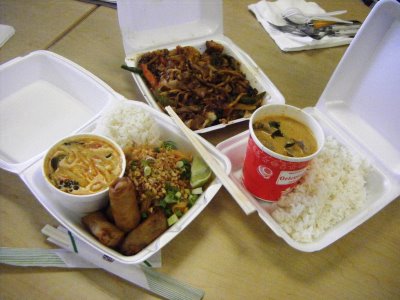
It’s probably safe to leave food in takeout containers. But the smart play is to wrap them in airtight packaging or seal them in storage containers. These practices help keep bacteria out.
takeout
Here’s another safety tip: Don’t let prepared food sit out — in your car or on the counter — for more than two hours. The reason is that bacteria can grow rapidly in food that’s unrefrigerated. And some bacteria make a poison or toxin that can make you ill, hence the term “food poisoning.”
If you don’t plan on eating takeout food immediately, you have two choices. You can keep it hot in a preheated oven at an internal temperature of 140 F (60 C) or higher. Or you can divide food into smaller portions, place in shallow containers and refrigerate. Reheat the food to a temperature of 165 F (74 C) just before serving.
InformationNigeria

''I Was Paid $2500 USD for Killing 2Pac''- Dexter Isaac | Full Story


An inmate who is currently serving a life prison sentence plus 30 years for murder and robbery, named Dexter Isaac has claimed responsibility for shooting Tupac Shakur in Manhattan’s Quad Studios in November 1994, setting off a chain reaction of violent reprisals that resulted in the eventual murder of both Shakur and the Notorious B.I.G., who was originally blamed for the assault. in his statement he said he was paid $2,500 for the shooting by James “Jimmy Henchman” Rosemond, a music industry figure who is now the CEO of Czar Entertainment and the manager of the Game.
In the statement, Isaac apologized to Tupac and Biggie’s families and said that he kept quiet until now because the statute of limitations for an assault charge has expired and he cannot be charged for the attack. Isaac also expressed regret for getting involved with Rosemond, whom he refers to as a “sucker.” Rosemond is currently a fugitive wanted by the DEA and federal marshals for his involvement with a cocaine trafficking operation.

TON

Osun Govt, CAN Reach Truce Over Education Policy


Aregbe_383661331
The Christian Association of Nigeria (CAN) and the government of Osun State have reached a truce over schools re-classification in the state that has strained relationship between the Christian body and the government.
The truce was reached after a closed door meeting attended by the governor, Ogbeni Rauf Aregbesola; his deputy, Otunba Grace Titi Laoye-Tomori; some executive members and the newly-sworn-in CAN executives led by its chairman, Elisha Ogundiya.
At the meeting, Governor Aregbesola allayed the fear of the religious body who had in the past accused the governor of planning to Islamize the state, saying government had no hidden agenda in the execution of its policies.
The governor noted that his government has always involved all social religious and political organisations and engage in broad discussion with all stakeholders on every policy of government.
He attributed the misunderstanding between government and CAN arising from the school re-classification to information gap.
CAN had protested the merger of some same-s*x schools with mixed ones, saying such much would defeat the heritage and religious tradition underlining the establishment of schools.
The Christian body had also expressed anxiety over the reclassification of schools, saying it would deprive Christians of some of their schools.
CAN therefore appealed to the government to find a middle of the road approach to the ongoing merger so that the heritage of the founding fathers of the affected schools would not be wished away.
CAN also demanded further explanations from the government on the recent Sukuk Bond sourced from the capital market.

InformationNigeria

Oduah and the triumph of corruption


Minister of Aviation, Ms. Stella Oduah
BEYOND the howls of outrage at the illegal purchase (with public funds) of bulletproof cars for Stella Oduah, the Minister of Aviation, Nigerians need to come to terms with the reality that the government has lost the war on corruption. The scandal partly explains why our airspace is dangerous; why billions of naira poured into the sector have not revived the industry and why officials charged with managing air transport are obsessed with their own comfort. Indeed, Oduahgate, if not properly handled, will have shattering implications for the Jonathan government.
While calls for the sacking of the manifestly incompetent minister have rightly gathered momentum, the Nigerian government must resolve to cleanse the aviation sector, initiate widespread reforms and flush out the obsequious and irredeemably corrupt bureaucrats that have held it hostage. Most importantly, we have to deal with the twin evils of pervasive corruption and the monumental waste represented by a bloated and over-pampered public service.
The task is daunting. President Goodluck Jonathan has, in three years in office, failed to demonstrate purposeful leadership and only pays lip service to fighting corruption and prudent financial management. It is dismaying enough that Oduah apparently sees nothing inappropriate in her actions and public anger over the $1.6 million (about N250 million) purchase, but it is even more troubling that the President has not deemed it fit to fire her. The National Assembly that should protect the public interest and exercise oversight on the executive is equally greedy and uncaring. A passive electorate and weak civil institutions have also fostered a culture of impunity and lack of accountability in those occupying public office.
The frightening case illustrates just how. According to news reports, the minister requested that the Nigerian Civil Aviation Authority purchase bulletproof cars for her. The officials obliged, spending $1.6 million of the agency’s funds to buy two BMW SUVs to massage Oduah’s vanity. Here is an organisation that complains of underfunding and lacks many of the essential up-to-date equipment that is standard everywhere else. This is shocking, but unsurprising. It is not yet known just how many similar expenses have been borne by other agencies being supervised by the Aviation Ministry. But it is known that the parastatals were asked, on “instructions from above,” to raise money for unexplained “activities” relating to the opening of the Akanu Ibiam International Airport, Enugu, in August, for which the cash-strapped Nigerian College of Aviation Technology alone raised N5.03 million.
In justifying the purchase, Oduah, through her aide, said she requested the cars due to “threats to her life.” That is troubling enough. This is certainly in line with her disdain for the public. Responding to criticism over the crash of an Associated Airlines plane that killed 14 persons recently, she had bizarrely attributed it to “an act of God,” and, to rub it in, added that plane crashes are “inevitable.” Even the most fair-minded person must be baffled and shocked by these actions and statements.
Since the minister and legislators are routinely maintained in circumstances described by a former Education Minister, Oby Ezekwesili, as “obscene luxury,” it is not surprising that bureaucrats not only routinely fail to discharge their duties, but also luxuriate at public expense. It has since emerged that the NCAA has purchased 34 new cars (13 Toyota Prado SUVs and 21 Corolla saloons) for its top managers despite a subsisting policy on monetisation of fringe benefits. The Director-General of the NCAA, Fola Akinkuotu, and the entire management and board should be immediately investigated by the Economic and Financial Crimes Commission and prosecuted and sacked if they are found to have broken the law. We sorely need upright, courageous officials that can say, “No,” to the unlawful demands of politicians in temporary tenancy of public office.
The probe should extend to all agencies supervised by the ministry whose shortcomings are all too obvious to the public. The Dana Airline crash of last year that claimed 151 lives and this month’s crash exposed how corruption, incompetence and blatant compromising of regulations and standards have made air travel a risky venture in Nigeria. The industry needs a massive shake-up to enable it to recover, just as it has rebounded in most other parts of the world after the slump that followed the September 2001 terror attacks on the United States.
Mind-boggling cases like this are bound to catch the attention of those who have been dehumanised and debased by an insensitive government. At an exchange rate of N155 to $1, Oduah’s vanity would establish eight cottage clinics of N30 million each, or fund the sinking of 50 boreholes in a country where only 17 per cent of its 160 million people have access to pipe-borne water, according to a UNDP report. Most ministers also enjoy the extra-budgetary perks Oduah got. The steep damage of this era to public finance will not be wiped out so easily.
The Jonathan government’s chronic lack of transparency makes the odious cars purchase possible.  In a decent world, Oduah would not be defending the scurrilous affair but answering questions from anti-fraud agencies. The President should fire this minister immediately. Failing to do so suggests a lack of modicum of integrity in government. The President should search for an honest, passionate professional that understands aviation to succeed Oduah, the latest in a long line of ministers who lack knowledge of the industry.
Jonathan should take the war against corruption more seriously, while the National Assembly should adopt a more vigorous and effective stance on its oversight responsibility. Nigerians should not be complacent but continue to demand accountability from public officials.
 
Punch