Tuesday, 26 November 2013

Court Orders Finance Minister to Disband Tax Appeal Tribunal


up0201213-FIRS-logo.jpg - up0201213-FIRS-logo.jpg
FIRS logo


Tobi Soniyi

A Federal High Court in Abuja has restrained  Tax Appeal Tribunals established by the Federal Inland Revenue Service (FIRS) from adjudicating on tax matters and federal revenue.
Justice Adeniyi Ademola, while giving judgment in an appeal filed by TSKJ Construces Internacionals Unipessoal LDA, declared tax appeal tribunals illegal saying the bodies were established in contravention of section 251 (1) (a) and (b) of the Constitution of the Federal Republic of Nigeria.
The judge also ordered the Coordinating Minister for the Economy and Minister of Finance, Dr. Ngozi Okonjo-Iweala, to immediately disband the eight tax appeal tribunals constituted by her, saying they were illegal.
TSKJ had dragged the FIRS to court challenging the judgment of a tax appeal tribunal wherein the tribunal asked the company to pay the sum of $12.9 million as tax liabilities for 1997, 1998,1999,2000,2001 and 2002 to FIRS.
TSKJ, a non-resident tax payer obtained a contract for the construction of the Nigeria Liquefied Natural Gas (LNG). In executing the contract, the company used TSKJ Nigeria, its subsidiary to render logistic support service to it in the course of the contract.
The fact of the case as reviewed by the court showed that TSKJ filed self-assessment forms on deemed profits meaning that its profit could not be ascertained.
The company made deductions of recharges being the cost paid to its local subsidiary. FIRS disallowed the said deductions on the ground that the deductions were not allowed under the turnover basis assessment. FIRS consequently issued additional assessment in respect of the wrong deductions made by TSKJ.
The company objected to the additional deductions and filed an appeal at the tax appeal tribunal, asking that the additional assessment be set aside. The tribunal also dismissed the company's claims following which an appeal was filed at the Federal High Court.
Justice Ademola upheld the argument of the company that the tribunal lacked the jurisdiction to entertain the suit on the ground that the FIRS (Established) Act 2007 under which the tribunal was established conflicted with the exclusive jurisdiction of the Federal High Court conferred by section 251 (1)(a) and (b) of the constitution.
The judge said: "The respondent counsel's arguments that Tax Appeal Tribunal created by FIRS (Established) Act 2007 as being an administrative panel and not a court affecting the exclusive jurisdiction of the Federal High Court on federal revenue and taxation of companies are mere semantics, misconceived and untenable in law in as much as their decisions affect the civil rights and obligations of companies in relation to taxation matters and revenue of the federal government."
The judge found that the jurisdiction of the tribunal was in direct conflict with the jurisdiction of the Federal High Court.  He therefore advised that the constitution should be amended before such jurisdiction could be conferred on the tribunals.   He consequently, upheld the appeal by TSKJ.
The judge ordered the finance minister to disband the tribunals with immediate effect

ThisDay

MKO Abiola’s wife, Doyin arrested for fraud


Former Managing Director of the defunct Concord Newspapers, Dr. Doyin Abiola has been arraigned before the Federal High Court, Lagos, for fraud, SaharaReporters claims.
A press statement signed by Police Public Relations Officer DSP Ngozi Isintume-Agu reads thus:
“The Financial Malpractices Investigation Unit (FMIU) of Special Fraud Unit (SFU) says that between 2006 and 2008, as a Director of the Integrated Microfinance Bank, Dr. Abiola granted to herself without collateral and approval from the Management, the sum of N26,611,246.48.
Dr. Abiola, of 42/46 Moshood Abiola Crescent, Ikeja, Lagos, and wife of the late Chief Moshood Abiola, is one of four Managing Directors or Directors of Integrated Microfinance Bank (IMFB) located at 6A Adeniyi Jones Avenue, Ikeja, who were arrested and charged by the SFU.
The others are Akinteye Simon Ademola, Dr. Jerry Orimovuohoma and Oladapo Bello.
The SFU said the four officials of IMFB unauthorized credit facilities to the tune of N327,566,000 to themselves and other related companies without collateral and that the loans are still outstanding.  In the forensic investigation conducted by FMIU of SFU, the Directors were found wanting in the discharge of their duties while on the Board of Integrated Microfinance Bank (IMFB).
· Ademola of Plot 7, block 90, Mobolaji Ogunde Crescent, Magodo GRA Phase 2, Lagos converted the sum of N131.176 million to his personal use without approval.
· Orimovuohoma of 129B Oba Ladejobi Street, GRA, Ikeja granted unauthorized credit facility to the tune of N29,200,000.00 to himself without collateral.
· Bello of 23/25 Ijora Causeway, Ijora, Lagos recklessly granted the sum of N3,200,000.00 to himself without collateral.
The bank liquidity was greatly affected with the sum the directors took” the statement reads.
The case comes up at the Federal High Court on December 10,2013.
 
DailyPost

Monday, 25 November 2013

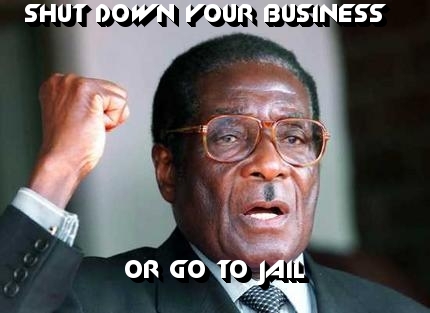
OUTRAGE: Zimbabwe Gives Nigerian Traders One Month to Shut Down Their Businesses


Zimbabwean authorities inform they have given foreign shop-owners, mostly Chinese and Nigerian nationals, an ultimatum to shut down their businesses by 1 January 2014, hand them over to Zimbabweans or face arrest.
mugabe_textA top official of the black empowerment ministry said only Zimbabweans had the right to run shops that have sprung up across the country and are termed foreign businesses targeted under the nation’s black empowerment laws, the state-controlled Herald newspaper reported on November 22, 2013, Friday.
Permanent secretary for the empowerment ministry, George Magosvongwe, told a Parliamentary committee that the government would enforce regulations which reserve certain sectors of the economy to Zimbabweans on January 1, 2014.
Under the country’s economic empowerment legislation, areas reserved for locals include retail and wholesale businesses, barbershops, hairdressings, beauty salons, bakeries, employment agencies and grain milling, among others.
“I confirm that some non-indigenous entities are still operating in the reserved sectors and there is a deadline for January 1 for them to comply with the requirement to relinquish their holdings in that sector.
“You will realise Mr. Chairman that 1 January is a month to come and we are putting in place measures for enforcement in the event that they do not comply,” Mr. Magosvongwe said.
He said the ministry was preparing measures to ensure the exit of foreigners from the retail sector would not result in shortages.
“There is need to ensure that we don’t create shortages in the economy, but certainly the ministry is going to enforce the reserved sectors rule.
“And we will bring in the enforcement agencies from right across the Government departments and the local authorities to ensure that enforcement happens,” the secretary added.
The January 1, 2014 ultimatum was gazetted in May, making it mandatory for all locally and foreign-owned firms in reserved sectors to apply for indigenisation compliance certificates. Only locals will be given those certificates.
A number of laws passed in 2007 demand foreign businesses to cede 51 percent control to local blacks. The foreign shop owners have been criticized for taking retail trade opportunities from Zimbabwean traders by selling cheap imports.
Poor townships and city flea markets have in recent years been inundated by shops run by foreigners. According to state media, shop owners who fail to comply will be arrested.

InformationNigeria

Oliseh: Nigerian football bond is forever


Sunday Oliseh was a ferocious force for Nigeria’s Super Eagles during the best moments in their history. Now retired and living in Belgium, the former holding midfielder spoke to FIFA.com about the highs and lows of USA 1994 and France 1998, the Olympic title that “no one can take away.” Also on the table in this frank discussion is the Nigerian football philosophy, terrace culture in the west African nation, former clubs like Ajax and Juventus and, of course, that goal from 1998 against Spain that will live on forever. 
Firstly, let’s just get it out of the way, and talk about that goal. Do you still get reminded of the long-range stunner you scored in the win over Spain at the 1998 World Cup?
Sunday Oliseh [Laughs] People don’t just ask me about the goal, or remind me about the goal, they show me the goal all the time. Just two days ago someone took me aside in Abu Dhabi (UAE) and played me the video on the internet. He asked me: ‘do you know the fellow who scored this goal?’ I just laughed.
You only scored four goals for the national team, so it must be a personal highlight to get such a cracker on such a big stage.
I think it was God’s way of arranging things so that people wouldn’t forget me. Every time I see it I think to myself ‘wow, I never knew I was that good’ [laughs].
Can you talk a little bit about the power of football in your native Nigeria?
Nigeria has a philosophy of football. It’s a philosophy you can’t credit to anybody; it’s not down to an individual or a group. If anyone tries to take credit for it, he’s just telling lies. The philosophy is attacking football. Going forward, we’ve always been good. We’ve always played it this way.
Nigerian fans seem happiest when the ball is pinging around  quick, one-touch passes.
It gets to the point when you hear the fans say ey, ey, ey with each pass of the ball and ooh when the team loses it. That ey is like when it starts to touch, when it starts to happen with the ball. It’s always been there, from long before my generation and when we were playing. That ey means, ‘yeah, go ahead, play.’ We touch it around and around and then when it gets taken away, the fans ooh as if to say: ‘give it back, give it back  it’s ours.’
sunday
Sunday Oliseh in action during USA 1994 FIFA World cup

As one of your country’s best-ever players, and a member of its so-called golden generation, how do you view the current state of football in Nigeria?
The moment my generation retired it was like somebody just shut the doors. Nigeria didn’t prepare for our departure. The golden generation just left and that was it. No one thought to bring some of the young ones into the team while we were still there, so they could learn from us. They should have been sitting on the bench to learn from me, and to learn from Jay-Jay Okocha and all the others. They could have asked us questions and we could have told them answers. We didn’t do that, and it was a real problem for the country’s football. Things fell off after us. We went onto a wilderness of trial and error for some years.
But the Super Eagles are reigning African champions now for the first time since 1994 and they’ve qualified for next year’s FIFA World Cup™ in Brazil.
The current national team coach Stephen Keshi, who was my captain at the World Cup in 1994, is a good one. Love him or loathe him, he brought back the African Cup of Nations title to the country, and the last time Nigeria did that was when we were playing.
Speaking of those great Super Eagle teams of old, can you talk about why, when everything looked to be falling into place, your teams from ’94 and ’98 stumbled at the first knockout round?
In the group stages we didn’t have to travel. We stayed still and so there were no logistical issues. We just played. But once we reached the next stage, we had to start moving around and there needed to be a plan. Our knowledge of preparations at the time were not good enough to help us through. We won our groups in both tournaments, but we had problems to solve after that, and it cost us.
Do you feel a sense of having missed out on something great?
With the quality we had in 1994 and 1998 we should have at least gone to the quarter-finals, or maybe the semi-finals. But it’s a learning process.
On a brighter note, people still talk about the Nigerian Olympic-winning side from Atlanta 1996. You were barely 22 years old, but you played a crucial part alongside the likes of Okocha, Emmanuel Amunike and Taribo West. What did it meant to win Gold?
It was a world title and it’s something no one can take away. You are Olympic champion for all of your life. It was the first tournament ever where we played on a different continent, and we were there in America before everyone. We were there a month before the competition. We worked our behinds off and the team was young. Most of the players had a point to make. We had so much talent and it all came together. We covered for each other and we had the kind of luck you need to go all the way.
Do you often run into your old team-mates, guys like Taribo or Nwankwo Kanu?
At the holiday times, when I go home to Nigeria, I always run into these guys. And when we see each other, that’s it – I drop what I’m doing, all appointments are cancelled and I go talk about the old days with Taribo [West] or whoever else. We walk around Lagos and chat for hours and hours. The family complains, but who cares? [laughs] It’s never planned, it just happens.
It sounds like there’s a special bond with your team-mates.
We suffered a lot and we won things a lot, so there’s a bond. It’s there forever. My parents, they understand it when I disappear for these little meetings with my mates, but my brothers and sisters, they give me a hard time about it.
You’ve played for some top clubs, like Ajax, Juventus and Borussia Dortmund. Do you still follow their fortunes?
Absolutely. I live and breathe football. My wife always says ‘If I don’t have football I get sick.’ I follow all of my former clubs, with a passion. I hope every year to have at least one finish as a champion.
And how are you finding their progress?
For the past three years Ajax have been winning titles, so at least one of my ex clubs is winning. And Juventus is always Juventus, so that’s good. Dortmund is back at the top in Germany, so it’s fun for me. I’ll follow them all my life.
Dortmund, where you played for four years, seem to be going through an historic moment. Can you talk about it?
They are trying to revolutionise German football with the way they play. In the seven years I played in the country, and long before that, the German game was based on physical dominance. I love watching this current Dortmund team play because they’re going in a different direction.  But I’m not ashamed to say it: I love the way [Pep] Guardiola works with Bayern Munich. It’s a joy to watch the way Bayern is changing into a next-level team. The Germans call it Teamgeist, it’s like a team spirit, and they have so much of it. Everybody knows what to do and they know when to do it.
 
NationalMirror

The Disgraceful Conduct Of Lagos PPRO Ngozi Braide - An Open Letter to IGP MD Abubakar


Lagos PPRO Ngozi Braide
By Sandra Duru
Our dear gallant, patriotic, detribalized and ever-dynamic IGP, we sincerely hope that all is well with you and your new wife, Zarha Bunu? We 're sorry that we had to make this letter an open matter; apologies; it was borne out of the bureaucratic inconvenience of your office.
Dear lovely IGP, we wish to bring to your notice of the bizarre idiosyncrasy of Ms Ngozi Braide, the Police Public Relations Officer (PPRO), Lagos State command and the unethical conduct of your officers in Lagos State command.
Ngozi, a young woman saddled with the responsibility of laundering the image of the Police institution in Lagos State is currently destroying the institution she's being heavily paid to defend with her youthful exuberance, arrogance, incompetence, etc.
Sir, without much ado, the ordeals of one of our friends in the hands of Ngozi Braide and some of her happy-trigger officers in Lagos State, goes as thus:
The beginning of the illegality, the exhibition of unprofessionalism and recklessness by the Lagos Police Command under the supervision of Ngozi Braids, Lagos State PPRO:
Sir, our friend, Mr. Abragahou Aminu, a Lagos based french teacher, while trekking along Ketu-Ojota road on Tuesday 19th November, 2013, saw an ugly incident between two Police officers (a policeman and a policewoman both in uniform) and a commercial driver. Aminu, being a man with a high level alertness, brought out his mobile handset and started recording/snapping the public show of shame.
However, a police officer saw Aminu when he was recording the incident and pounced on him. Aminu was mercilessly beaten by the policeman for recording public unrest. He was initially detained at the Ketu Police station. When we contacted Ngozi Braide, Lagos PPRO to intervene, she insulted us, saying that she had been looking for a scape goat amongst Nigerians that do record the illegal activities of the Nigerian Police. Ngozi banged the call and the next we heard was that Aminu has been transferred from Ketu police station to the Lagos PPRO, then to Ikeja police Area "F" command. All these happened simply because Aminu used his mobile phone to record an incident between a commercial driver and a-team of police officers.
Aminu's phone was seized on the order of Ngozi, the Lagos PPRO while the policeman fighting with the commercial driver was released unconditionally while the innocent teacher, Mr Abrangahou Aminu was detained up till saturday 23rd November before he was arraigned at a Magistrate Court in Yaba, Lagos. More also, we wish to inform you that the commercial driver that a policeman was having a public show of shame with, was not detained for a second.
The cruel incarceration of Aminu and the exhibition of lawlessness by Ngozi Braide, Lagos PPRO:
Dear IGP, as stated above, Aminu was arrested on Tuesday 19th November, 2013 and kept in four different police detention cells before his kangaroo Arraignment on Saturday 23rd November, 2013. All moves made by us to secure the release of Aminu on bail were rejected by your men in Lagos command acting to the instruction of Ngozi Braids, Lagos PPRO. Aminu was first arbitrarily detained at Ketu Police Station, from Ketu, he was transferred to the PPRO's office where he was harassed for hours. From PPRO's office, the innocent Aminu was transferred to Area F detention cell, and from Area F to X-squad cell. All these acts of injustice and unprofessionalism were perpetrated by your men simply because a man was caught recording an incident with his mobile phone!
Sir, may we bring to your notice that the police possesses no power to keep an accused in custody for more than 48 hours at most. May we also remind you that the PPRO's office is not meant for the tourtoring of an accused. May we also inform you that the X-squad detention cell that Aminu was detained for about 96 hours wasn't meant for civilians but for that of undisciplined/errand officers.
Sir, it might interest you to note that while at Ngozi Braide's mini-detention room, Aminu was compelled to re-write his statement under duress to suit Ngozi Braids. He was made to write an apology letter, which he did after he has been irresponsibly threatened/tortured. Aminu was also given a letter of apology to sign which he did under duress. His phone was seized, cloth was torn and most of the vital information related to this case which he stored on his phone memory were deleted except one photo, all in order to cover up the unprofessional acts of your men.
Sir, may we also inform you that Ngozi Braids said she consider it as disservice to the Police force for civilians to be recording their activities while Aviation Minister, Stella Oduah could not be sanctioned for buying armoured cars. Ngozi also averred that the police had been looking for a scape goat amongst Nigerians that do record their acts of unprofessionalism. Ngozi claimed that uploading the corrupt and immoral activities of the Police on the social, print and electronic media is disservice to the nation! Dear IGP, to us, we consider Ngozi's affirmations as reckless and irresponsible!
The hues and cries about Aminu's nationality:
Dear IGP, may we inform you that your officers in Lagos under the supervision of PPRO Ngozi Braide arrogantly claimed that Aminu possesses no constitutional right to record the incident leading to his unlawful incarceration and unlawful detention simply because he is a Togolese. Sir, your officers, out of ignorant, have forgotten that Togo is a West Africa country, hence, he possesses diplomatic immunity, freedom of movement and trade as entrenched by the law of the economic community of west African states (ECOWAS). In addition to that, Aminu's ECOWAS passport is valid and yet to expire. His residential and working permits are valid.
The questionable arraignment of Aminu at Magistrate court:
Dear IGP, after all the pleas and moves made by us and about 20 human rights journalists, lawyers and concerned Nigerians to have Aminu released on bail were curiously, unlawfully  rejected by Ngozi Braide with the aide of the Lagos Police Commissioner, Alhaji Umaru Tanko, Aminu was sadly arranged in court on Saturday 23rd November, 2013.
Alas, our team of lawyers secured the bail of Aminu but no one was on ground to sign his bail paper.
It is an incontrovertible fact that Saturday is not a working day in Nigeria. Sir, we make bold to avow that Aminu was arraigned on Saturday in order for your men to have ample of opportunities to suffer him the more in their detention cell thereby causing him more mental, psychological and emotional traumas.
Furthermore, may we inform you that when we met with the Police Commissioner (CP) over Aminu's ordeal, we discovered that Ngozi Braids had satanically lied against him. The C.P said Aminu would not be released because we had alerted well-meaning Nigerians about his ordeal via social media. Sir, may we ask that when has it become an offence to run/alert/cry/report to the public via the social media? When has it become a crime for one to exercise his/her rights to speech and expression?
Our charter of demands:
Dear IGP, having patriotically and moderately perused and exposed the unethical and unprofessional display of your officers in Lagos, we hereby give your esteemed institution 7 days, starting from today to meet the following demands or risk a never-seen-before mass and court actions (lawfully):
(1). immediate removal of Ngozi Braids as the Police public Relations Officer (PPRO) in Lagos State. We also demand for her immediate demotion as she has proven to be Immatured. Ngozi Braids has also proved that she deserves not the exalted position she currently holds.
(2). Immediate withdraw of the suit against Mr. Aminu Abragahou as he did nothing wrong to warrant being prosecuted and persecuted. Attempting to expose illegality, absurdity, immorality and unprofessionalism doesn't warrant being caged.
(3). Immediate arrest and prosecution of the police officers who arrested Aminu in Ketu. The police officers who were involved in the show of shame with a commercial driver that Aminu was recording in Ketu should also be arrested and prosecuted.
(4). Having suffered enormous psychological, emotional and mental humiliations in the hands of the men of Nigeria Police Force, we demand that the Nigeria Police should adequately compensate Mr. Aminu Abragahou as he has lost his teaching job during his ongoing ordeal. It will amount to a crime against humanity should Aminu's heavily pregnant wife be allowed to suffer.
Lastly sir, may we conclude this letter by reminding you of the words of Martin Luther King which says that "In the end, we 'll remember not only the words of our enemies, but the silence of our friends." Sir, May we also remind you of the words of Ralph Waldo Emerson which goes as thus: "all lives are interrelated, we are being caught up in an inescapable network of mutuality and tied up in a single garment of one destiny; whatever affects one directly affect all indirectly"
Dear IGP, consequent upon the above words of marble from Ralph Waldo Emerson and Martin Luther King, we wish to remind you that injustice anywhere, is Injustice everywhere!
Dear IGP sir, as the outstanding Man of the year 2013 (an award you recently bagged in Abuja), we put it to you that we 're anxiously awaiting your quick response to this letter. Sir, may we remind you that both the words and silence of our friends shall be remembered when divine judgement is being delivered.
Thanks and God bless.
Yours truly,
High Chief Sandra Duru,
Executive Director, Pre-Adult Affairs Organisation (www.pre-adultaffairs.org)
Zest Entertainment & Media Limited(www.bareitoutwithsandraduru.tv)
Ikeja, Lagos, Nigeria.
234-8026741128
CC: President FRN
CC: Senate Committee on Police Affairs
CC: Fed Min of Police Affairs
CC: Police Service commission
CC: African Diplomatic Mission
CC: ECOWAS
CC: Relevant Human Rights lawyers/NGOs/ Journalists
CC: NANS

 
Saharareporters

Angola Bans Islamic Religion; All Mosques To Be Destroyed

Angola1


  • 1432
     
    Share


Nov. 25, 2013
By popular demand, Angolan authorities have taken pre-emptive action and decided to ban the Muslim religion, which they consider a cult, NOT a religion. They see what Muslims are doing to non-Muslims, especially in Africa, and are taking steps to prevent the same from happening in Angola.
In early October 2013, the Muslims living in Luanda in the municipality of Viana Zango were shocked to see the minaret of their mosque dismantled into pieces on the ground without permission. On Thursday 03 October in the morning, the Angolan authorities decided to destroy the mosque Zango located in the urban district of Viana 17 km. The governor of Luanda Bento announced in a radio spot that radical Muslims are not welcome in Angola and the Angolan government is not ready for the legalization of mosques in Angola.
Image: Guardianlv
And on Tuesday, November 19, the Minister of Culture, Rosa Cruz e Silva said. “Regarding Islam, the legalization process has not been approved by the Ministry of Justice and Human Rights. Therefore all mosques would be closed until further notice. “ It should be noted that the Angolan government has made closing of all mosques a priority. The only two mosques located in Luanda have already received a warning document signed by the mayor of the municipality of Viana José Moreno.
The provincial governor of Luanda, Bento Bento, said on the airwaves of local radio that “radical Muslims are not welcome in Angola and the Angolan government is not ready for the legalization of mosques.” Minister of Culture, Rosa Cruz e Silva explained that the law on freedom of religion will be reviewed given the current national context , noting that the Government will redouble its efforts to fight relentlessly against religious cults like Islam which are contrary to the customs of Angolan culture.
This decisive action taken by the Angolan head of state is based on a desire to guard against the rise of the Wahhabi ideology that has created havoc, death and destruction in Africa and elsewhere. And as rightly explained Tunisian philosopher Mezri Haddad: “Islamism and Islamophobia feed each other. Worse, long-term Islamism as an ideology destroy Islam as religion. “
According to the International Religious Freedom Report 2008, Islam in Angola is a minority religion with 80,000 – 90,000 adherents, composed largely of migrants from West Africa and families of Lebanese origin. The Muslims comprise between 2.5 to 3 percent of Angola’s overall population of 17 million people, most of them Christians.
Angola President José Eduardo dos Santos
In the last decade, but especially during the last few years the Muslim community in Angola has grown appreciably and Islamic activities have become more common in major cities. Mosques have sprung up in a number of places and Qur’anic schools have been built to provide Islamic instructions and teach Arabic language to adherents.
Public attitudes toward Islam have been generally negative. Cultural differences between Angolan and Muslim immigrants have been the basis for negative views toward Islam, as was the perceived link between Islam and illegal immigration. Since the September 11 attacks, there has been a deliberate attempt to link Muslims with terrorism. It has become a matter of routine at Luanda airport for security officers to detain Muslims arriving from Sahelian countries.
On September 1, 2008, a Muslim mob attacked non-Muslims in the community of Andulo. The school-age daughter of a deacon at one of the churches was decapitated. Forty Christians were assaulted or tortured. The mob burned three church buildings. They also went to non-Muslim houses to intimidate them or destroyed items of property. Stones were thrown at the headquarters of a local Christian project, causing some damage. An Angolan Christian leader said that the local police were unable to stop the attack and fled the scene.
NewsRescue

How Jonathan Will Lose in 2015 By Bayo Olupohunda


With no known accomplishment in public service, President Goodluck Jonathan rode to the Presidency in 2011 on a wave of undefined hope with the assistance of an unsuspecting media, and a gullible electorate. To his supporters, Jonathan was a bolt of lightning that would unite Nigeria, restore prosperity, and bring “a breath of fresh air” to the polluted politics of Abuja, and Nigeria in general. His detractors, on the other hand, saw a recluse with a murky past and little evidence to warrant the adulation heaped on him. Who was right? As his first term drags on painfully, it has become clear that Nigerians who supported and voted for him had invested their hope in a phantom. Under Jonathan’s leadership, the economy has, forget the chest-thumping rhetoric of the finance minister, Mrs. Ngozi Okonjo-Iweala, been a mess and this country has never been more divided. It has now turned out that electing one based on little other than the sentimental rhetoric of a deprived childhood may not have been such a good idea after all. To say that Jonathan was a phenomenon in 2011 will not be an exaggeration. He ran a huge campaign and broke records in vote totals. But it will be impossible for him to match those levels of excitement in 2015.

Usually, in a presidential election, the odds of getting re-elected have always favoured the incumbent. But in a depressed economy like ours, or when the public perceives the incumbent as feckless in spending, dithering or simply not up to the task, this conventional wisdom will not matter. And that is the case with President Jonathan. Several factors, when taken together, make it almost impossible for him to win a re-election in 2015. President Jonathan cannot win. This President has several key flaws which have already blighted his Presidency. His most telling undoing, of course, has been the fact that he has not been much of a party leader with his party now crumbling under his watch. To begin with, the mist has cleared and millions of Nigerians (except for sycophants) have seen with their own eyes that “the breath of fresh air’’ was just more of the same old political rhetoric. In 2015, Jonathan’s campaign will not have the historical significance it did in 2011.


Second, which is the reason for this piece is how the demographics that saw him elected President will work against him in 2015. The President has alienated just too many Nigerians, including large numbers from his own party, the Peoples Democratic Party. In 2015, many will vote against him or simply just stay home–that’s for want of a credible and well-accepted candidate from the opposition. President Jonathan is a self-created myth. There is little substance behind the façade other than the deceptive style of politics that has long defined Nigerian politicians.

In 2011, his campaign avoided specifics; his speeches contained no substance. His greatest asset was his “unknownness.” As a blank slate, Nigerians imagined whatever they wanted in the next president. They were aided by a campaign which played up the sentiments of his deprived childhood. It was a deceptive farce cleverly scripted to mirror the lives of ordinary Nigerians who immediately connected with someone they thought was one of their own. How wrong have they been? He was thought to be an outsider who would clean up Abuja. Any PDP presidential candidate who gained the nomination in 2011 was likely ensured the presidency. Having said that, Jonathan will lose the next election because his greatest asset, his “unknownness”, no longer exists. The imagination of Nigerians can no longer be manipulated in the presence of facts. Simply put, Jonathan will not be re-elected because ordinary Nigerians can now see him for who he is. What people are getting now is nothing like what they were promised or imagined. What was a blank slate upon which to imagine a Jonathan presidency now is a full-blown portrait filled with disappointment and more of the same. Gradually, it is appearing a great mistake was made in 2011. That mistake is now apparent to most Nigerians. Even his South-South home base and party stalwarts in the PDP establishment recognise his failings, although neither is willing to publicly discuss them. It is hoped that the PDP will have the courage to look elsewhere in their next convention. Although that is unthinkable, they can only hope that this election does not destroy what remains of the party. The cracks are already visible. Based on the debacle presently rocking his party, that fear is not unfounded.

The most compelling image of Jonathan is the one showing him ducking all of the tough issues that have come his way. For him, the buck stopped with a plethora of committees and with Okonjo-Iweala. But her Bretton Wood prescriptions have worsened the economy with unemployment figures reaching a record high.

Why and how Jonathan will lose this next election is less difficult to understand than how he won the first time. Certainly, the demographics will be less favourable this time unless something dramatic happens during the polls. In 2011, the President won in almost all the zones of the federation. In 2015, he will not have such a luxury. Take the South-West zone for example. The zone was a battleground which contributed immensely to his first term victory. In 2015, it will present a test case for Jonathan. For one, the influence of his party has waned in the zone. In many of the South-West states, for example, the PDP has become too fractious and weakened. The emergence of the All Progressives Congress, with Maj-Gen. Muhammadu Buhari (retd.) and Bola Tinubu hoping to consolidate on a renewed alliance will make the South-West a no-win for the President. If the alliance between the APC (Yoruba and Hausa/Fulani) work, Jonathan’s second term is best forgotten. If the opposition presents a credible candidate, perhaps, it will be the first time an incumbent will be defeated. The South-West and the North are key battleground zones. The crisis rocking the fractious PDP fuelled by his controversial chairman, Bamanga Tukur, may yet turn out to be his Achilles’ heels.

The politics of the Nigeria Governors’ Forum also offers a glimpse into how Jonathan will not be re-elected. Governor Chibuike Amaechi won 19 out of 35 votes in the NGF chairmanship election, while Governor Jonah Jang got 16 votes with the Yobe State Governor abstaining. Many of the governors who voted for Amaechi have sympathy for the APC. Seven of the nine PDP governors that supported Amaechi are now in the “New PDP” with a chance of defecting to the APC anytime: Sokoto, Kano, Jigawa, Adamawa, Rivers, Kwara and Niger (also called the G7 governors). Kebbi and Gombe are still in the Jonathan camp of the “Old PDP” but their next move is almost predictable. Note that Sokoto, Kano, Jigawa, Niger, Kebbi and Gombe all voted for Buhari in 2011. The South-East zone, which also has a valid claim to the presidency, will intensify its quest in 2015. It may likely pitch its tent with the party that offers the best chance to actualise this dream. Will Jonathan be a one-term president? It is very likely.