Sunday, 29 December 2013

What is ‘tribalism’ and why does is matter in South Sudan? – By Andreas Hirblinger and Sara de Simone


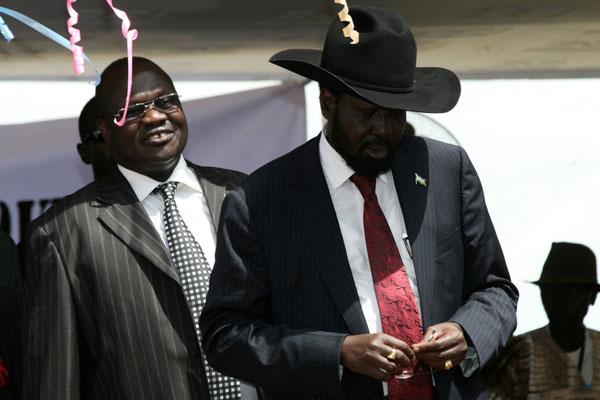
MacharKiir
The differing ethnicities of Riek Machar and Salva Kiir can too easily suggest that the current conflict in South Sudan is all about ‘tribes’.
References to ‘tribes’ and ‘tribalism’ form part of the standard repertoire of media reporting and expert analysis aiming to make sense of the resurgent armed violence in South Sudan. In their attempts to explain the recent rupture between South Sudan’s President Salva Kiir and other members of the SPLM leadership, commentators have universally noted that President Kiir belongs to the Dinka ethnic group, whereas Riek Machar is a Nuer. Hannah Bryce, writing for Chatham house – a foreign policy think tank – argues that the current struggle illustrates “the prevalence of political ‘tribalism’ at the highest office”. Thus, in the search for straightforward explanations, ‘tribalism’ is a concept which many commentators readily tap into. However, the key protagonists in South Sudan’s crisis also make use of a distinctly anti-tribalist rhetoric and warnings of ethnic conflict in order to justify their political agendas as well as the use of force.
Ethnic framings
There is no doubt that the dynamics of armed violence in Juba and across South Sudan have taken on an ethnic dimension. The violence has its origins in a stand-off between different factions of the presidential guard. This fault-line quickly spread within the armed forces, as the fighting over key strategic locations in Juba pitched members of the Dinka and Nuer ethnic groups against each other. Reports of targeted killings and perpetrators selecting victims based on their association with specific ethnic groups suggest that distinctions between friends, enemies and respective combat strategies are now widely informed by the framework of etnic belonging.
The logic of violence now also informs the dynamics of violence in Jonglei state, where armed youth have targeted civilians specifically based on their ethnic identity (as recent incidents in Akobo and Bor make clear.) The defection of Peter Gadet, identified as an ethnic Nuer, as well as reports of mobilisation in Unity State suggest that South Sudan is on the brink of civil war.
Ethnicity provides a lens through which power struggles have been framed throughout most of Southern Sudan’s recent history. Not least have perceptions of exclusion and marginalization from power and resources often been accompanied by ethnic scape-goating. The close linkages between ethnic belonging, armed conflict and survival tightened during the decades of civil war, involving virtually all ethnic groups. This militarization of ethnic identity became particularly stark after the SPLA split in 1991 lead by Riek Machar and Lam Akol. In its aftermath, armed violence between the two SPLA factions became increasingly ethicized, leading to indiscriminate targeting of civilians on both sides. As a result, ethnic identities became more pronounced and exclusive, as well as more relevant for the ordinary South Sudanese, both inside and outside the armed forces.
Ethnicity matters in South Sudan not only through the direct or indirect dependency of armed forces and militias on their military and political leaders. It also matters in the provision of protection to the wider population. Given the formal state’s weakness outside of South Sudan’s urban centres, the majority of the rural population continues to understand the provision of protection and security as a communal matter.
Since the Comprehensive Peace Agreement (CPA) in 2005, attempts to reform the security sector, to formalise and democratise the security apparatus and to detach the organised forces from political leadership have produced very limited outcomes. This is most visible in poor central control over the armed forces, as demonstrated by Peter Gadet’s defection. It also took Riek Machar only a couple of days (after the first eruption of violence) to claim control over the armed forces in Jonglei state. These centrifugal dynamics have been accompanied by a surge of ethnic violence against the Dinka populations in Bor, albeit it must be noted that many attacks are carried out by forces not formally associated with those who defected from the SPLA. These dynamics suggest a close link between struggles over political leadership, the personalised control over armed forces used in the latter, and ethnic belonging.
Ethnic fragmentation  
It is important to note that the use of ethnicity as a frame of reference in the resurgent armed conflict stands in contrast to the much more subtle and complex role of communal belonging in South Sudan’s everyday politics. Since the political transition of 2005, the strengthening of political institutions, as well as the presence of the state at the local levels of government, has created political dynamics in which ethnicity often plays a pivotal role. Attempts to create a decentralized system of governance based on democratic principles have in many places created tensions between different ethnic communities, which perceive access to government services as well as political representation at the local level of government more often than not through an ethnic lens.
These tendencies have been exacerbated by recent political reforms which have given a prominent role to ‘traditional’ authorities, which should provide the linkage between local governments and ethnic communities. These reform processes and the quest for strengthening the state in more distant locations have led to increased ethnic fragmentation across the country – a process through which territory became more strongly linked to notions of communal belonging.
However, the ethnic categories invoked in struggles over access to state resources hardly match the categories invoked in the current armed violence. Rather than in the broad terms such as Dinka versus Nuer, ethnicity matters most of the time in local politics. While these are often referred to through concepts of ‘clan’ and ‘section’, the meanings of such denominations vary across the country. What these smaller denominations have in common, is that they do not satisfactorily explain the current political crisis.
Politics of Accommodation
In the national power struggle, none of the prominent protagonists has openly played the ‘ethnic card’. The outbreak of armed violence on the night to Monday 16 December is closely linked to the political stand-off between President Salva Kiir and other leading members of the SPLM, including a number of former members of the government. The frictions between the SPLM leadership had become public through a press conference on 6 December 2013 in which senior members of the SPLM, including the former vice president Riek Machar, the former SPLM secretary Pagan Amum, as well as the widow of the SPLM’s deceased leader John Garang, accused President Kiir of “dictatorial tendencies.” They diagnosed “deep-seated divisions within the SPLM leadership” and demanded that party structures to be reformed in order to make possible “collective leadership.” These requests remained unaccounted for.
On 14 December, key members of the SPLM highest executive organ, the Political Bureau, walked out of the National Liberation Council (NLC) meeting, due to what they described as the lack of political dialogue. It is remarkable that the demands made by the political opposition make no mention of ethnicity or ‘tribalism’ in their condemnation of the recent political manoeuvres by the presidency. Instead, they criticized the strengthening of authoritarian tendencies, the lack of collective and democratic decision making and Salva Kiir’s growing influence on party processes.
The avoidance of ethnic framing in public discourse coincides with political dynamics in which the major protagonists have actively aimed to promote ethnic accommodation and reconciliation since the CPA. During his tenure as Vice President, Riek Machar strongly advocated the initiation of a national healing and reconciliation process, and apologized to the Dinka Bor community for the Bor massacre pursued by his faction in 1991. Salva Kiir’s strategy of rule has been remarkably similar, aiming at ethnic accommodation at the national level, as visible in the reshuffle of the national cabinet in August 2013.
As a native of greater Bahr el Ghazal, the President ensured the strong representation of the Nuer from Upper Nile and other ethnic groups from Equatoria regions through placement of regional representatives in the second and third most prestigious government positions, namely the Vice Presidency and the Speaker of the National Legislative Assembly. While some of the prominent political figures dismissed by the President were ethnic Dinka, such as the former governor of Lakes State Chol Thong Mayay, many of the new cabinet members belong to other ethnic groups. What seems to be most relevant in the choice of new members of the government is political loyalty to the President as well as the balancing between different regions and ethnic groups across the country, in order to achieve inter-ethnic accommodation.
The Irony of Non-tribalism
In their reaction to the recent incidents, the political leadership in both factions utilised an explicitly universal and anti-tribalist rhetoric. Members of the SPLM leadership loyal to Kiir have recently stressed that the armed violence unleashed in South Sudan is not tribal. More drastically, Kiir recently warned about a repetition of the 1991 Bor massacre, stating that his “government is not and will not allow the incidents of 1991 to repeat themselves again”. Drawing on the memories of past ethnic conflict, Kiir thus justified the military action taken against parts of the SPLA as well as the civilian population through an explicitly anti-tribal language. In a comparable vein Riek Machar has accused Salva Kiir of “inciting tribal and ethnic violence”.
The threat of ethnic conflict is used by both sides as a strategy to legitimise the crackdown on the alleged perpetrators of violence. In the public space, ethnic categories are not used to differentiate friends and enemies. Rather, by accusing the respective antagonists of inciting or committing ethnic violence, ethnicity informs current strategies of violence in a much more subtle manner. Through the construction of an existential threat identified in the antagonists malevolent ‘tribalism’, both factions aim not only to mobilise for conflict within their own constituencies, but to legitimise the use of force vis-a-vis an international audience, increasingly worried about the possible consequences of ethnic conflict in South Sudan.
Andreas Hirblinger is a PhD candidate at Cambridge University. Sara de Simone is a PhD candidate at L’Orientale University of Naples.
AfricanArguments

El-Rufai, 103 Others Escape Death As Aircraft Tyre Bursts On Landing At Lagos Airport


NASIR-EL-RUFAI TWEETSWhat could have been a major air disaster at the tail end of 2013 was averted, Sunday, when a Boeing 737 aircraft with about 104 passengers and crew members including former Minister of the Federal Capital Territory, Malam Nasir el-Rufai, had a burst tyre at the Murtala Mohammed Airport, MMA, Lagos.
The aircraft, which reportedly departed the Nnamdi Azikiwe Airport, NAA, Abuja around 9am had a bust tyre on landing at the Lagos Airport.
Announcing their narrow escape via his twitter handle some few hours ago, the former FCT minister said: “Upon landing in Lagos, our Aero aircraft lost a tyre. The pilot did a great job of breaking to a halt. My phones flew under seats”.
See more tweets below:
tweets
Reacting to the incident, General Manager, Corporate Communications of the Federal Airports Authority of Nigeria, FAAN, Mr Yakubu Dati said: “A (sic) aircraft Boeing 737-500 with Registration No 5N-BLC, operated by Aero contractors landed safely at the Murtala Mohammed Airport, Lagos, following loss of pressure in one of the tyres, today December 29, 2013.
“The aircraft which landed at 10.50am had a total of 104 passengers and crew members on board.
The aircraft has since been towed to the apron and Accident Investigation Prevention Bureau, AIPB has commenced investigation into the incident”.
InformationNigeria

Night time encounter with President Jonathan


undefined

It was the occasion of my uncle’s birthday party, which President Goodluck Ebele Jonathan honoured in person. I had the good fortune of being the one asked to serve him. His security detail scanned me with some device before they allowed me to approach him. While attending to him, I noticed the look in his eyes. At that point, something happened to me that made me become somewhat unconscious of my environment for some seconds.


Gosh, he’s got the sexiest eyes I have ever seen. And when you talk about a man being good-looking, sweet, and gentle, then you are referring to my one and only heartthrob, GEJ.

There’s really something about my President that keeps me thinking about him all the time. I just can’t put it in words but I know there’s this unexplainable feeling I have for him. I often wonder if anyone else feels same way about him.

Back at my uncle’s party I guess he noticed I was kind of lost, so he said, “young lady, hope all is well,” and I managed to reply “yes” and I immediately left for my bedroom.

Since then, every night when I go to sleep, I dream about him. All day long, I think about him. There’s nothing that thrills me more than his smile. Whenever he smiles, I feel something spark inside of me.

He’s got all a woman would ever desire in a man. Is it his height or his sexy eyes? Oh my! Everything about him is so appealing and to sum it up, he is the president of a great nation, Nigeria, the giant of Africa.

Of course, he is way older than me, but I just can’t explain why I have this special feeling for him. He is 56 years old and I’m 23, but like they say, ‘love is blind’ and I guess that blindness has caught up with me and I just can’t help it.
I think something I just can’t explain happened between me and Mr President during my first encounter with him and ever since then the feeling increased.

Later on, the night of my uncle’s birthday, I was in my room, unable to stop thinking of how I made a fool of myself and possibly embarrassed my uncle-if at all he had noticed what had transpired. In the middle of my thoughts, I got a call from an unknown number. I picked the call; someone with a rather stern voice, more or less, ordered me to hurry up and come towards the gate where Mr President’s convoy was parked. I did so.

On getting there, lo and behold, it was Mr President that had sent for me through one of his SSS agents. Mr President stepped aside from his guards and asked if I was okay, I replied that I was. Then he told me to feel free, that he isn’t a demi-god. I guess he thought I was scared or feeling inferior before him which wasn’t the case.

I summoned courage and replied it was nothing close to that. With a look of curiosity, he asked me to tell him what it was then. I told him that his eyes caught my attention and sort of mesmerised me. He smiled and signalled to one of his guards who gave me a card and told me the specific time I could call. I was restless until that time came and I dialled the number. While the phone was ringing, I had a call which woke me up from a very beautiful sleep. I then realised I had been dreaming all the while.

Well, I don’t mind dreaming so long it’s about Mr President. I just love it when I have such dreams. Sometimes I wish he was as young as I am, or that I was a bit older so that I could have him as mine for the rest of my life. But I guess I just keep dreaming and dreaming and dreaming…

*Calebs writes in from Abuja, Jummaicalebs72@yahoo.com

Former Black Panther Assata Shakur Added to FBI’s Most Wanted Terrorist List


Freedomfighter
The FBI added Assata Shakur to its Most Wanted Terrorist List today. In addition, the state of New Jersey announced it was adding $1 million to the FBI’s $1 million reward for her capture. Shakur becomes the first woman ever to make the list and only the second domestic terrorist to be added to the list.
Assata Shakur, the former Joanne Chesimard, was a member of the Black Panther Party and Black Liberation Army. She was convicted in the May 2, 1973 killing of a New Jersey police officer during a shoot-out that left one of her fellow activists dead. She was shot twice by police during the incident. In 1979, she managed to escape from jail. Shakur fled to Cuba where she received political asylum. She once wrote, "I am a 20th century escaped slave. Because of government persecution, I was left with no other choice than to flee from the political repression, racism and violence that dominate the U.S. government’s policy towards people of color."
In 1998, Democracy Now! aired Shakur reading an open letter to Pope John Paul II during his trip to Cuba. She wrote the message after New Jersey state troopers sent the Pope a letter asking him to call for her extradition.
RUSH TRANSCRIPT
I hope this letter finds you in good health, in good disposition, and enveloped with the spirit of goodness. I must confess that it had never occurred to me before to write you, and I find myself overwhelmed and moved to have this opportunity.
Although circumstances have compelled me to reach out to you, I am glad to have this occasion to try and cross the boundaries that would otherwise tend to separate us.
I understand that the New Jersey State Police have written to you and asked you to intervene and to help facilitate my extradition back to the United States. I believe that their request is unprecedented in history. Since they have refused to make their letter to you public, although they have not hesitated to publicize their request, I am completely uninformed as to the accusations they are making against me. Why, I wonder, do I warrant such attention? What do I represent that is such a threat?
Please let me take a moment to tell you about myself. My name is Assata Shakur and I was born and raised in the United States. I am a descendant of Africans who were kidnapped and brought to the Americas as slaves. I spent my early childhood in the racist segregated South. I later moved to the northern part of the country, where I realized that Black people were equally victimized by racism and oppression.
I grew up and became a political activist, participating in student struggles, the anti-war movement, and, most of all, in the movement for the liberation of African Americans in the United States. I later joined the Black Panther Party, an organization that was targeted by the COINTELPRO program, a program that was set up by the Federal Bureau of Investigation to eliminate all political opposition to the U.S. government’s policies, to destroy the Black Liberation Movement in the United States, to discredit activists and to eliminate potential leaders.
Under the COINTELPRO program, many political activists were harassed, imprisoned, murdered or otherwise neutralized. As a result of being targeted by COINTELPRO, I, like many other young people, was faced with the threat of prison, underground, exile or death. The FBI, with the help of local police agencies, systematically fed false accusations and fake news articles to the press accusing me and other activists of crimes we did not commit. Although in my case the charges were eventually dropped or I was eventually acquitted, the national and local police agencies created a situation where, based on their false accusations against me, any police officer could shoot me on sight. It was not until the Freedom of Information Act was passed in the mid-'70s that we began to see the scope of the United States government's persecution of political activists.
At this point, I think that it is important to make one thing very clear. I have advocated and I still advocate revolutionary changes in the structure and in the principles that govern the United States. I advocate self-determination for my people and for all oppressed inside the United States. I advocate an end to capitalist exploitation, the abolition of racist policies, the eradication of sexism, and the elimination of political repression. If that is a crime, then I am totally guilty.
To make a long story short, I was captured in New Jersey in 1973, after being shot with both arms held in the air, and then shot again from the back. I was left on the ground to die and when I did not, I was taken to a local hospital where I was threatened, beaten and tortured. In 1977 I was convicted in a trial that can only be described as a legal lynching.
In 1979 I was able to escape with the aid of some of my fellow comrades. I saw this as a necessary step, not only because I was innocent of the charges against me, but because I knew that in the racist legal system in the United States I would receive no justice. I was also afraid that I would be murdered in prison. I later arrived in Cuba where I am currently living in exile as a political refugee.
The New Jersey State Police and other law enforcement officials say they want to see me brought to "justice." But I would like to know what they mean by "justice." Is torture justice? I was kept in solitary confinement for more than two years, mostly in men’s prisons. Is that justice? My lawyers were threatened with imprisonment and imprisoned. Is that justice? I was tried by an all-white jury, without even the pretext of impartiality, and then sentenced to life in prison plus 33 years. Is that justice?
Let me emphasize that justice for me is not the issue I am addressing here; it is justice for my people that is at stake. When my people receive justice, I am sure that I will receive it, too. I know that Your Holiness will reach your own conclusions, but I feel compelled to present the circumstances surrounding the application of so-called "justice" in New Jersey. I am not the first or the last person to be victimized by the New Jersey system of "justice." The New Jersey State Police are infamous for their racism and brutality. Many legal actions have been filed against them and just recently, in a class action legal proceeding, the New Jersey State Police were found guilty of having an, quote, "officially sanctioned, de facto policy of targeting minorities for investigation and arrest," unquote.
Although New Jersey’s population is more than 78 percent white, more than 75 percent of the prison population is made up of Blacks and Latinos. Eighty percent of women in New Jersey prisons are women of color. There are 15 people on death row in the state and seven of them are Black. A 1987 study found that New Jersey prosecutors sought the death penalty in 50 percent of cases involving a Black defendant and a white victim, but only 28 percent of cases involving a Black defendant and a Black victim.
Unfortunately, the situation in New Jersey is not unique, but reflects the racism that permeates the entire country. The United States has the highest rate of incarceration in the world. There are more than 1.7 million people in U.S. prisons. This number does not include the more than 500,000 people in city and county jails, nor does it include the alarming number of children in juvenile institutions. The vast majority of those behind bars are people of color and virtually all of those behind bars are poor. The result of this reality is devastating. One third of Black men between the ages of 20 and 29 are either in prison or under the jurisdiction of the criminal justice system.
Prisons are big business in the United States, and the building, running, and supplying of prisons has become the fastest growing industry in the country. Factories are being moved into the prisons and prisoners are being forced to work for slave wages. This super-exploitation of human beings has meant the institutionalization of a new form of slavery. Those who cannot find work on the streets are forced to work in prison.
Not only are the prisons used as instruments of economic exploitation, they also serve as instruments of political repression. There are more than 100 political prisoners in the United States. They are African Americans, Puerto Ricans, Chicanos, Native Americans, Asians, and progressive white people who oppose the policies of the United States government. Many of those targeted by theCOINTELPRO program have been in prison since the early 1970s.
Although the situation in the prisons is an indication of human rights violations inside the United States, there are other, more deadly indicators.
There are currently 3,365 people now on death row, and more than 50 percent of those awaiting death are people of color. Black people make up only 13 percent of the population, but we make up 41.01 percent of persons who have received the death penalty. The number of state assassinations has increased drastically. In 1997 alone, 71 people were executed.
A special rapporteur appointed by the United Nations organization found serious human rights violations in the United States, especially those related to the death penalty. According to his findings, people who were mentally ill were sentenced to death, people with severe mental and learning disabilities, as well as minors under 18. Serious racial bias was found on the part of judges and prosecutors. Specifically mentioned in the report was the case of Mumia Abu-Jamal, the only political prisoner on death row, who was sentenced to death because of his political beliefs and because of his work as a journalist, exposing police brutality in the city of Philadelphia.
I believe that some people spell God with one "O" while others spell it with two. What we call God is unimportant, as long as we do God’s work. There are those who want to see God’s wrath fall on the oppressed and not on the oppressors. I believe that the time has ended when slavery, colonialism, and oppression can be carried out in the name of religion. It was in the dungeons of prison that I felt the presence of God up close, and it has been my belief in God, and in the goodness of human beings that has helped me to survive. I am not ashamed of having been in prison, and I am certainly not ashamed of having been a political prisoner. I believe that Jesus was a political prisoner who was executed because he fought against the evils of the Roman Empire, because he fought against the greed of the money changers in the temple, because he fought against the sins and injustices of his time. As a true child of God, Jesus spoke up for the poor, for the meek, for the sick, and the oppressed. The early Christians were thrown into lions’ dens. I will try and follow the example of so many who have stood up in the face of overwhelming oppression.
I am not writing to ask you to intercede on my behalf. I ask nothing for myself. I only ask you to examine the social reality of the United States and to speak out against the human rights violations that are taking place.
On this day, the birthday of Martin Luther King, I am reminded of all those who gave their lives for freedom. Most of the people who live on this planet are still not free. I ask only that you continue to work and pray to end oppression and political repression. It is my heartfelt belief that all the people on this earth deserve justice: social justice, political justice, and economic justice. I believe it is the only way we will ever achieve peace and prosperity on this earth. I hope that you enjoy your visit to Cuba. This is not a country that is rich in material wealth, but it is a country that is rich in human wealth, spiritual wealth and moral wealth.
Respectfully yours,
Assata Shakur
Havana, Cuba
DemocracyNow

Jonathan is last PDP president –Primate Ayodele


Jonathan is  last PDP president  –Primate Ayodele
By OLAJIIRE ISHOLA (dapo_ishola01@yahoo.com)
Primate Elijah Babatunde Ayodele, founder and spiritual head of INRI Evangelical Spiritual Church located at Oke-Afa, Isolo Lagos, is one man of God whose predictions have always been dogged by controversies. But convinced about the inspiration for the annual predictions, Primate Ayodele simply brushes off the disbelief of those who doubt his pronouncements as many of the predictions came to pass.
With the country sitting on the threshold of 2014, Sunday Sun sought audience with him on what to expect in the coming year. Looking into the future, he declared that the PDP would never regain the presidency after the tenure of President Goodluck Jonathan. He also implored Nigerians to pray against the break up of the country. Please read on…
Many of the predictions you made in January 2013 had come to pass. One of them was the outbreak of cholera in some parts of this country. Now 2014 is close by. What should Nigeria, Nigerians and the entire world hope for?
Before now, I have said it that Obasanjo and Jonathan will fight and that one had come to pass. Now 2015, but let us take it from 2014, Jonathan will want to make some amendments by negotiating with different interest groups. Part of the negotiation will be the removal of the Peoples Democratic Party’s Chairman, Alhaji Bamanga Tukur. There is going to be gang up against Jonathan. People will want to remove him. Part of the negotiation Jonathan will want to enter into will be the post of the vice president, secretary to the government of the federation. The founding fathers of the PDP will want to come together to save the party. Jonathan will concede some to have his way for his second term ambition. If Jonathan has his way, the second term will be a great setback for this country. Jonathan needs to pray because of his health and that of his wife.
On the five governors that defected to All Progressives Congress (APC), two or three of them will still go back to PDP. Some other PDP governors are still planning to move to the APC. Go and mark my words, APC too will still experience crisis. What will cause APC crisis is power tussle and self interest. I want Nigerians to know that God said I should inform them that Jonathan is the last PDP president that will rule this country. I have said it on several occasions that we need to pray so that this country will not disintegrate into fragments. I don’t know how soon it will be, but I foresee this country breaking up. The national dialogue or conference being planned by the Jonathan government will not produce any meaningful result. Go and mark my words this national conference outcome will be dumped by this government and any government that comes after Jonathan. This conference you see them setting up will only serve as a foundation for a bigger national conference that is coming in future.
We need to pray very well. All what we are seeing presently will lead to a strong probe coming to aviation sector. Some people will mount pressure on President Jonathan to remove Princess Stella Oduah, Diezani Allison-Madueke and Arunma Otteh. This will be part of negotiation Jonathan will enter into. There will be no improvement in the stock market.
Before now I had predicted that All Progressives Grand Alliance (APGA) would retain Anambra State. The governor-elect of Anambra State needs to pray very well, because there will be court action against his election that may threaten his smooth running of the state. This coming year, I foresee a lot of crisis coming up in Rivers, Delta, Nasarawa, Gombe, Yobe, Kano, Sokoto, Borno and Plateau states. There is going to be ethnic crisis in Delta State. We need to pray against ocean surge in Lagos State. In 2015, an unknown man will emerge as the governor of Lagos State.
Fashola and Tinubu should pray against quarrel between the two of them. I foresee quarrel coming up between them to the extent that it will cause some members of APC breaking away to join PDP in Lagos. Let us pray for Osun, Oyo and Lagos states, so that we will not witness death among royal fathers. Olofa of Offa town in Kwara State needs to pray very well so that he can return to his stool. Those that ganged up against him will be exposed. Boko Haram is in its last lap, but we need to pray so that God will weaken them more. Nobody will be able to capture Shekau, the leader of Boko Haram sect; Government will only end up killing him. Nigeria needs to pray against more deadly attacks from Boko Haram.
ASUU needs prayer so that government will not infiltrate them that may lead to the union breaking up into fragments. The last is not yet heard about strike, as Nigeria Labour Congress and doctors will still go on strike. NUT will table some demands before the Federal Government, which will lead to NUT wanting to go on strike. Let us pray against boat mishap in Lagos State. Many things will still be exposed as regards the oil subsidy saga in Nigeria. Jonathan government will not be able to manage corruption crisis in Nigeria, because corruption will get to its highest peak during Jonathan’s administration. Economic and Financial Crimes Commission will not achieve anything, because the corruption is bigger than what EFCC can tame. Let us pray very well for God to avert death among the Nollywood actors and actresses, both Yoruba and English genres. Let us pray against problem among Fuji musicians. We need to pray for guidance for both print and electronic journalists. God is planning to bless Nigeria with natural resources that we’ve not seen before in this country. We are going to witness reforms in the Governors’ Forum. Let us pray against problems in our airports, especially Abuja and Lagos airports. A big probe is coming to FAAN and NCAA. Let us pray against the menace of pirates on our sea coastlines. African countries will still want to have common currency. Nigeria will change its currency in future. Our economy will not improve. Let us pray against rise in the attack on our petroleum pipelines. GTB, First Bank, WEMA and Sterling banks will retrench this coming year. New banks coming up.
New telecommunication company still coming. Mainstream, Keystone banks will have their names and managements changed in the nearest future. Nigerian electricity will not be stable until 2015/2016. We need to pray for Queen Elizabeth of England so that she will not lose someone close to her. She should, as a matter of fact, pray for her husband. Let us pray so that we don’t lose an African president come next year. Let us pray so that an African president will not face an ICC case that may force him to want to resign. A minister will be jailed in France as a result of corruption. Let us pray against cholera and measles outbreak. We need to also pray against rise in hypertension cases and eye problem. Aviation fuel price will rise this coming year. New airlines are coming into the local sector of the aviation industry. We need to protect our airports against external attack. There will be heavy importation of arms and ammunition through seaports in the coming year. We need to pray to avert death in the Nigerian Army. Many parastatal boards will be changed next year. Let us pray again against plane crash. America and United Kingdom need prayer against external attack. Israel needs prayer against attack. Syria crisis will soon be resolved, but before the resolution, Syria will experience more violence. Let us pray against coup d’état in any of the African countries. We need to pray against crisis in Kenya, South Sudan and Mauritius. Also Guinea Bissau will not be left out. The crisis in Egypt will continue, but it will soon be resolved, as the military will announce new date for election. There is going to be a lot of revelations in NNPC to the extent that it may lead to the removal of the Group Managing Director of the company. Let us pray against crisis in the Central Bank of Nigeria.
We need to pray because God revealed to me that not all the senators that begin the year will see the end of the year. Not all the members of the House of Representatives that start the year will see the end. There is going to be serious gang up against the Speaker of the House of Representatives. Let us pray against increment in the prices of foodstuffs. Let us pray against the death of a national leader in 2014. Our royal fathers need our collective prayers. I foresee beautiful road networks coming in Nigeria. We also need to pray against railway accident.
TheSun

US Spy Drone Crashes Into Ibadan Building, Captured [Photo]


0
undefined
A mysterious spacecraft, which residents of Awotan in Ido Local Government Area of Oyo State called a “drone”, was reported to have crashed into a building at Omiremi Quarters in the community, leaving a crater on the roof of the building, just as aviation sources confirmed the object as a United States’ drone on an espionage mission in Nigeria.
Considering the registration number, TX 5803, inscribed on a black battery under the craft, a source said the space craft must have taken off from  NASA base in Texas in the US, stating that the battery attached to the spacecraft powered it and enabled it to move around so that it could do the bidding of those who sent it.
Though many aviation sources told Sunday Tribune that the object could be a device used in espionage, another source, however, believed that the craft was a “nondescript aviation device”.
It will be recalled that the United States of America has, in recent times, come under attack by other countries for spying on their activities which may have confirmed the discovery of the spacecraft in Ibadan.
The craft, which was said to have dropped down from the orbit, flew into a toilet in the house of Ashipa of Awotan, Chief Tajudeen  Adetoro, a few minutes after his grandson, Afeez  Adewale and daughter-in-law, Adikat, left the toilet where they had gone to answer the call of nature.
According to Chief Adetoro, the mysterious aircraft forced itself into the toilet through the roof making deafening sound, saying it could have killed Afeez and his mother, if it had met them in the toilet.
The spacecraft, with a product number QR X30, has four stands and a rounded compartment housing its engine. It has a dry cell battery, USB drive, a censor and cables, while each of its stands has a two-way roving fan mounted on them.
The residents of the sleepy community told Sunday Tribune that the object was not a toy due to the fearful noise it made and the way it flew about, adding that it could be an explosive.
“When it flew out, we rushed after it and it was found hanging on the antennae of our neighbour…making a terrible noise and emitting heavy smoke,” Chief Adetoro narrated.
He said they ran for safety on hearing the loud bang made on the roof of their house only to discover that the object had entered the toilet hitting its wall in an attempt to exit.
Information obtained about the object from the internet revealed that it shares similarities with a device called Walkera QR X350 GPS which is sold for roughly $500.
Though the product description on it is not intelligible, Sunday Tribune learnt that it could be a remote-controlled transmitter that gives no signal when in the air, but which is used for gathering information.
How flying object crashed into building in Ibadan Mother, son escaped death
It is almost unbeliavebale, but it is real. A drone-like object fell from the sky on the roof of a house in Ibadan last Sunday shattering the roof of the house. MARUF BELLO writes that luck saved a mother and her son from being killed by the object.
FOR Afeez Adewale, a 16-year-old boy, sheer luck saved him and Adikat, his mother, from being sent to their early graves a few minutes after they left the toilet in their house, last Sunday, at Omiremi Quarters, Awotan, Ibadan.
Afeez had gone to the toilet to answer the call of nature not long after his mother had come out of the same toilet only to hear a loud bang on the roof of their house, specifically the toilet.
The object was said to have forcefully fallen on the roof of the toilet breaking through and shattering its asbestos.
According to the Asipa of Awotan and landlord of the house, Chief Tajudeen Adetoro, it wasn’t long after Afeez and his mother left the rest room when they suddenly heard a frightening sound on the roof of the toilet.
Chief Adetoro, who is Afeez’s grandfather, said it was God that saved the mother and son, saying the source of the drone-like object was unknown.
“We were in panic; we were almost dead when we heard the sound suddenly and all of us scampered for safety. It was after a few minutes that we thought that hiding in the house was not the solution but to find a way to get the object out of our house due to the horrible and disturbing noise it was making that my son and I fearfully moved to the scene to know what it was.
“When we got there, we stood a little away looking at it from a short distance. It was then we saw it clearly and it was seriously struggling making a frightening noise in its bid to find an escape route. As it was struggling, it was hitting every angle of the toilet walls forcefully shrieking and trying to exit the toilet.
“It was during the struggle that it escaped through the same point it gained entry. When it flew out, we rushed after it and it was found hanging on the antenna of our neighbour. It hung there making a terrible noise and emitting heavy smoke. I think in the process of struggle to get it out, it lost one of its components, a stand. I asked my son to climb the facial board to remove it.
“When he brought it down, it was heavy and there were so many red illuminating lights all over it blinking every second,” the chief narrated.
He said when the material had been removed from where it was stuck so that they could examine it thoroughly, the object repeatedly tried to fly away.
“It  was then I asked my son to remove some of its compartments to render it inactive. We removed the battery, its censor, among others. At that time, everybody in the neighbourhood had gathered to see the wonderful object,” he added.
Chief Adetoro said they initially thought it was a mere toy but after a close look, it was discovered that “the material could be a bomb, more so that ever since we captured and incapacitated it nobody had come looking for it because we initially felt that it was one of the toys parents bought for their children for Christmas and New Year.
“Also, when we considered the manner with which it got in and exited, we felt that the object was being monitored and controlled from somewhere. After careful consideration and examination of the compartments of the object we thought it could be an explosive.
“When nobody from this community came to claim it, we concluded that the object was more than what we thought it to be; it must have travelled a long distance,” Afeez’s father said.
The Chief Imam of Awotan Central Mosque, Sheik Abdulai Adesina, and a woman who are both neighbours of Chief Adetoro confirmed the incident, saying “the sound of the object was highly terrifying and fearful.”
When the object was examined, it is made up of components such as a dry cell battery, a censor housed by a white case, a USB  (memory card) drive and a panel that is well cased as well as lots of cables.
According to Chief Adetoro, the community had informed security agents about the incident and called for investigation on it, noting that if left unravelled, it would be difficult to douse tension and erase fear among the residents of the community who now believed that they were being targeted for attacks.
The object, Sunday Tribune investigation revealed, has since been handed over to security operatives.
Tribune

Amaechi Goes Ballistic On Jonathan, First Lady… Denies Impregnating Soyinka’s Daughter

patience-Amaeachi-JonathanGovernor of Rivers State, Mr. Rotimi Amaechi has opened a can of worms on the frosty relationship between him, President Goodluck Jonathan and the First Lady, Dame Patience Jonathan.
Amaechi, who is Chairman of the Nigeria Governors Forum, NGF, told journalists at an interactive session in Port Harcourt, the Rivers capital weekend, that while the First Lady wanted to rule the state by proxy, her husband, President Jonathan, wanted to cripple the state economically to the advantage of his home state, Bayelsa. But he refused to allow both of them have their way, hence, the once rosy relationship turned sour.
Mrs. Jonathan, like Amaechi is from Rivers State. Bayelsa was also part of the old Rivers State.
The frosty relationship between the governor on one hand and the president and his wife on the other hand is at the root of the present political crisis in the oil rich state with the State House of Assembly under lock and key following the polarization of the Assembly along the line of pro and anti-Amaechi lawmakers.
The state Assembly, comprising of 31 members is unevenly divided with six lawmakers purportedly encouraged by the presidency attempting to hijack the legislative arm of government from the majority, who are considered pro-Amaechi and are 25 in number.
He said: “The wife of the President wanted to macro-manage governance in Rivers State and I said no, you cannot. I was elected. If I fail, they will not say the wife of the President failed; they will say Governor Amaechi failed. I am accountable to God, men and women of Rivers State.
“The wife of the President was not elected the Governor of Rivers State. I was elected. I am not in any way the wife of the President. I am the Governor of Rivers State, married to Judith Amaechi.
“I am telling you why they want to crucify me. This fight is about change. It is about good governance. It is about accountability. They do not like Rivers State. They hate us. We are losing. Tell me one thing that Rivers State has gained from being part of the South South under Goodluck Jonathan’s Presidency”.
The governor, who was elected on the platform of the Peoples Democratic Party but defected along with four other governors to the All Progressives Congress (APC) recently, also laid the blame for the resurgence of militancy and kidnapping in the state at the doorstep of the First Lady.
“By the time the wife of President Jonathan brought out the militants, we had almost got to zero point of no kidnapping in Port Harcourt. Where we were witnessing kidnapping were villages near Bayelsa and Abia States. We were thinking of how to go there with military surge, to chase the criminals back to their bases”, he said.
Amaechi added that his principled stand has earned him reproach from the president’s wife, who, according to him, is bent on removing him from office using federal power.
“She also held a Security Council meeting with them in Otuoke (President Jonathan’s hometown in Ogbia LGA of Bayelsa State), declaring that they would use federal ‘mighty’ (instead of might). But we have God Almighty.
“Is there any governor that has passed through what I passed through that is still alive? I am still talking as the Governor of Rivers State because there is God. They can use their federal ‘mighty,’ but I depend on the Almighty God.”
He also accused President Jonathan of not helping the situationby trying to under-develop Rivers at the expense Bayelsa State.
He cited the Zonal Air Force originally earmarked for Rivers by the late President Umaru Yar’Adua but which was relocated to Bayelsa and the transfer of Soku oil wells to Bayelsa as some of the perceived ill-treatment the state got from Mr. Jonathan despite voting massively for him in the 2011 presidential elections.
“The Nigerian Liquefied Natural Gas Company (on Bonny Island in Rivers State) is even the worst. The members of the board and management of the NLNG came to me and pleaded with me to speak with the NNPC (Nigerian National Petroleum Corporation) to allow them to do Train Seven in Bonny, that will employ 10,000 Rivers people”, he said.
“I approached the NNPC and I went to the Petroleum Ministry. I do not want to call names, because most of them are my friends. They told me no. I thought it was a joke. That time, there was no quarrel between me and President Jonathan, because we had just finished elections (2011) and we were still chummy-chummy.
“I met with President Jonathan to kindly speak with officials of the NNPC and the Petroleum Ministry to allow NLNG to build Train Seven. President Jonathan said he wanted them to finish Brass LNG in his Bayelsa State, before they could build Bonny NLNG’s Train Seven. Mr. President said no and that he directed the officials of the NNPC and the Petroleum Ministry to say what they said.
“Mr. President said right from when he was the Deputy Governor of Bayelsa State, he had been trying to get the Brass LNG and wants to get it now that he is the President. You cannot force investors. So, we must wait for Bayelsa State before Rivers State can grow.
“The implication is that Rivers State will not grow until Goodluck Jonathan finishes his Presidency. Is that a good government? Is that a good party? Should I remain there? If I was lying, they would have replied me. What is Southsouth President? There is only one thing in politics, which is interest. You cannot play politics of Nigeria with religion or ethnicity”.
He added: “They took Soku oil wells from us and they took 41 oil wells from Etche to Abia State. Should I remain in that kind of party that is denying Rivers State its resources?
“When I said they could not account for N2.3 trillion for oil subsidy, they said what is your source? I was in a meeting with President Jonathan. Nigerians never knew that governors went on strike for three months. We refused to collect our monthly allocations, because we told President Jonathan that under Yar’Adua late Umaru under Gen. Obasanjo (former President Olusegun), the total oil subsidy was N300 billion.
“The first year of President Goodluck Jonathan, in 2011, oil subsidy became N2.3 trillion. Did we buy more machines, more human beings in Nigeria, we had 24 hours power supply, things have changed in Nigeria, that we now consume N2.3 trillion from N300 billion?”
He also denied the allegation that he was working against the administration of a fellow South-southerner.
His words: “Who is a South South President? For me, a Southsouth President is the man who feels for me and cares.
“For them to be doing the East-West Road (from Oron in Akwa Ibom State, through Ogoniland in Rivers State to Bayelsa, Delta, Edo, Ondo and Ogun States, terminating in Lagos State), I had to fight the Minister of Niger Delta Affairs (Elder Godsday Orubebe).
“They said they would borrow money. They borrowed money and are now doing the East-West Road. The Southsouth President should have borrowed the money since 2011 that he came in and completed the East-West Road.
“Unfortunately, Yar’Adua is not alive to speak for himself. I was part of the people who sat down with Yar’Adua to start the designing of coastal rail from Cross River, Akwa Ibom, Rivers, Bayelsa, Delta, Edo, Ondo and Ogun States, up to Lagos State. Have you heard of it again?”
He recalled a meeting he had with the late President Yar’Adua who, he said, asked what the Federal Government could do for Rivers State to stem militancy.
Amaechi said he suggested the provision of a skills’ acquisition centre and the then President proceeded to award contracts for the project to ‘prominent Rivers people’ only for President Jonathan, on replacing Yar’Adua, to sack the contractors.
The contracts, he added, were then re-awarded to other people.
“For four years, the Federal Government’s skills’ acquisition centre is yet to be completed. It is not about the contractor not working. They are not funding the contractor, because the project is in Rivers State,” he said.
Amaechi also looked at the party he left and declared that PDP is fast drowning ahead of the 2015 elections.
According to him, more PDP governors will defect to the APC and that the PDP could only win in 2015 by rigging.
He described the APC as the change agent Nigeria needs at this point in its history.
He said that by March 2014 the APC would have become the majority party in the Senate.
Amaechi said, “We are gradually forming government. We have taken over the House of Representatives. Before March (2014), we will take over the Senate. Just watch out.
“The pressure will mount so much that they (Senators) will move from the PDP into APC. For now, it is narrowing down closely everyday and we are counting. Watch out before March, if we will not have the number we are looking for”.
He also used the opportunity to debunk reports that he impregnated Nobel Laureate, Prof. Wole Soyinka’s daughter and that his wife, Judith, had run away from Government House, Port Harcourt, saying the rumour was spread by his political detractors.
“I read a story that I impregnated Prof. Wole Soyinka’s (Nobel laureate’s) daughter. That she is living in my house and my wife has run away. The story was bad. I had to call back my wife, so that they would know that she had not divorced me. She was not planning to do Christmas in Nigeria.
“She (Judith Amaechi) is back to see her husband, spend time with the husband, do some of her functions as wife of the governor, so that they will know that I am still married. Not just that I am still married, I am a Catholic.
“My marriage is as solid as a Catholic marriage. There is absolutely no room for divorce. What you have is room for annulment. There is only one ground for annulment of marriage in Catholic Church that is the marriage never took place. That means the woman either deceived him to marry her or the man deceived her into marrying him. Any other thing is called for better, for worse”, he asserted.

InformationNigeria