Saturday, 18 July 2015

Senators Saraki and Ekweremadu’s Elections Are a Nullity, By Jiti Ogunye


It is our considered view that the election of Bukola Saraki as the Senate President and Ike Ekweremadu as Deputy Senate President is illegal, unconstitutional, null and void. It is a sham. Put in another way, Bukola Saraki and Ekweremadu, are not, legally speaking, the Senate President and Deputy Senate President of Nigeria. They are impostors, who should stop parading themselves as senate president and deputy senate president. Asking Ekweremadu to yield up the office of the Deputy Senate President, as some partisans who have labeled him a PDP usurper have suggested, does not arise. De jure, he is not occupying the office of the Deputy Senate President from which he may resign. You cannot resign from an office you do not occupy. Why do we say so?
Since the National Assembly (NASS) erupted in crisis during its Eighth “inauguration” and the “election” of the leadership of the Senate and House of Representatives on Tuesday, June 9, 2015, a lot has been said and written about the issues in dispute in the crisis. Unfortunately, rather than subject the “election” in the NASS, in particular in the Senate, on that day, to a rigorous legal examination, in order to determine the legality of that election, many of the principal actors in the NASS leadership crisis or in the All Progressives Congress (APC) imbroglio, and a host of other interveners have been discussing the politics of the crisis and its “mishandling” by the APC leadership who, according to these interveners, were hell bent on foisting a leadership on the NASS. Many simple-minded gloaters have even reduced the serious issues thrown up by the crisis to a celebration of the “political defeat of Bola Ahmed Tinubu”, as if that alleged defeat was all that was needed to make the aberration that occurred in the Assembly acceptable. In this intervention, we seek to redirect the discourse. We argue that the NASS leadership crisis primarily should be discussed and resolved on the basis of enquiries about whether there has been a violation of the rule of law and the provisions of the of the Nigerian Constitution.
What transpired in the NASS on Tuesday, June 9, 2015 was a coup d’état. If it was merely a coup d’état by the treacherous members of the APC against their party’s choices for the offices that constitute the leadership of the NASS, we would not have been bothered. We are bothered because it was also a coup d’état against the Constitution of the Federal Republic of Nigeria, and the rule of law.
It would not have made any sense for the APC to have allowed its aspirant members to go on the floors of the Senate and the House to slugger it out amongst themselves. That is not the way a responsible party behaves. Strangely, some dubious partisans and jaundiced interveners have condemned the APC for striving to forge consensuses amongst its party members, insisting that the NASS should have been left alone to self-constitute its leadership, without the input of the parties of the respective members. This position that is being laundered as the correct approach that ought to have been adopted by the APC in order to guarantee the independence of the legislature is ignorant, plain dumb and silly.
On that day, while Senator Bukola Saraki of the APC, who has confessed that, like a typical coup d’état leader, he sneaked into the premises of the NASS at dawn, was “elected unopposed” as the Senate President, by 57 Senators, in the absence of 51 Senators, who were “ambushed” into a fence-mending and ranks-closing meeting that eventually turned out to be a hoax, Senator Ike Ekweremadu of the Peoples Democratic Party (PDP) “defeated” his opponent, Senator Ali Ndume of the APC by 50 votes to 24 votes (with one abstention) to clinch the post of the Deputy Senate President. Instructively, the APC controls the Senate with 59 (now 58) Senators, while the PDP has 49 Senators, meaning that 108 members ought to have congregated on the Senate Floor on the said date to constitute the leadership of the Senate. Alas, only 57 senators and 75 senators took part in the elections into the two offices.
In the run up to the “inauguration” of the Eighth NASS on June 9, 2015, after the initial intra-party horse-trading and compromises, two blocks within the APC, keenly interested in fielding candidates and contesting available positions in the NASS leadership, had emerged: The offices were those of the Senate President, Deputy Senate President, Speaker of House of Representatives and Deputy Speaker of House of Representatives. For the House of Representatives, there was the Femi Gbajabiamila and Yakubu Dogara blocks, and for the Senate, there were the Bukola Saraki and Ahmed Lawan blocks. To put its house in order, the APC, correctly and responsibly, in our view, conducted a straw poll amongst her elected legislators to determine the popularity and acceptability of the aspirants and adopt consensus candidates of the party for the positions. It would not have made any sense for the APC to have allowed its aspirant members to go on the floors of the Senate and the House to slugger it out amongst themselves. That is not the way a responsible party behaves. Strangely, some dubious partisans and jaundiced interveners have condemned the APC for striving to forge consensuses amongst its party members, insisting that the NASS should have been left alone to self-constitute its leadership, without the input of the parties of the respective members. This position that is being laundered as the correct approach that ought to have been adopted by the APC in order to guarantee the independence of the legislature is ignorant, plain dumb and silly.
At the end of the straw poll, which the Saraki and Dogara blocks boycotted and walked out of, obviously because they were in the minority and because they did not want the decision of the majority to bind them, the Lawan and Gbajabiamila blocks emerged victorious. Consequently, the APC directed all its legislators that were to participate in the NASS Leadership Elections to toe the party line and vote for the party’s candidates in the elections.
Saraki, Dogara, and Lasun, all defectors from the PDP, simply reached out to their kith and kin in the PDP. And it only took the infusion of Ekweremadu for the family reunion to be complete. Blood, as we know, is always thicker than water. It was an act of gross betrayal and misconduct.
Upon realising that they did not command the following of a majority of their party members, the Saraki and Dogara blocks surreptitiously hatched a conspiracy against their party’s interest and forged a coalition with the PDP against their party choices. That coalition led to the “defeat” of the APC choices in the elections, and the triumphs of the Saraki and Dogara blocks. In the House of Representatives leadership election, Dogara scored 182 votes to Gbajabiamila’s 174 votes. Given the result of the election, it was obvious that out of the 209 APC legislators in the House, about 36 of them leagued up with PDP legislators to defeat Gbajabiamila, their “party’s” candidate for the office of the speaker, and Monguno, their party’s candidate for the office of the Deputy Speaker. Saraki, Dogara, and Lasun, all defectors from the PDP, simply reached out to their kith and kin in the PDP. And it only took the infusion of Ekweremadu for the family reunion to be complete. Blood, as we know, is always thicker than water. It was an act of gross betrayal and misconduct.
Without any doubt, the leadership tussle in the NASS has shown clearly the fault lines in Section 50 (1) of the Constitution.
Was that act of betrayal illegal or unconstitutional? No, even if it is immoral. Section 50 (1) of the Constitution says so. It provides that “there shall be:- (a) a President and a Deputy President of the Senate, who shall be elected by the members of that House from among themselves; and (b) a Speaker and a Deputy Speaker of the House of Representatives, who shall be elected by the members of that House from among themselves“. By virtue of this provision, any member of the Senate or House of Representatives, be s/he of the majority party or minority party can be elected into any of the aforementioned positions, in so far as he or she is a member of the Senate or House of Representatives. It only stands to reason that if any legislator, regardless of the numerical strength of his party, can aspire to a leadership position in the upper and lower chambers, he or she can draw his electors from his own party or from other parties in the legislature. And any member can elect any other member of his choice to occupy any of the said positions, regardless of political party affinity or divide.
Without any doubt, the leadership tussle in the NASS has shown clearly the fault lines in Section 50 (1) of the Constitution. Section 50(1) needs an urgent amendment, such that the indubitable legislative intendment of having a majority party constitute the leadership of the parliament, while the minorities parties play the role of the parliamentary opposition can become more manifest and taken out of its current state of wooliness.
We are…not concerned about the moral wrong that the APC has suffered in the hands of her saboteur members, who, apparently fled a leprous PDP into the APC in the belief that staying back in the PDP in the 2015 general elections was going to harm their ambitions to get elected or re-elected into political offices. It was a mutation from one party to the other for political survival. It was “change”, indeed.
We have argued that the act of betrayal of the APC insurgents is not illegal or unconstitutional but immoral. But do we not all know that immorality, lack of integrity, opportunism and perennial power and money hunting are the hallmarks of a majority of Nigerian politicians? Lacking in scruples, values, principles and ideology, they change political parties, switch political allegiances and positions on any matter, based on their whims, caprices, political calculations and expectations, and pecuniary interests. Most of them are nothing but charlatans and political mercenaries. Lacking shame, noble comportment and decorum, but fixated on grabbing power for primitive accumulation and self aggrandisement, they do not mind dumping a “national conscience party”, “a national salvation congress”, or people redemption movement” for “a kidnappers party of Nigeria”, or “congress of Nigerian armed robbers”, regardless of the repugnance of such names, if the platforms give them an assurance of a short cut to power, and a shorter and surer route to the public till.
The APC that is now talking about party loyalty and supremacy, and is bellyaching about the treachery of the renegades within its ranks reeks of the vice of political prostitution, which usually is masked as patriotic expediency, political pragmatism, and free exercise of the constitutionally guaranteed right to freedom of association. We are, therefore, not concerned about the moral wrong that the APC has suffered in the hands of her saboteur members, who, apparently fled a leprous PDP into the APC in the belief that staying back in the PDP in the 2015 general elections was going to harm their ambitions to get elected or re-elected into political offices. It was a mutation from one party to the other for political survival. It was “change”, indeed.
As we have stated above, we are bothered because the events of June 9, 2015 have serious implications for Nigeria’s democracy, constitutionalism and the rule of law.
…by their own declarations and admissions, the organisers of the sham election on the floor of the Senate on June 9, principally the Clerk of the National Assembly and his cohorts, claimed that they organised that election pursuant to the Senate Standing Orders, 2015, as amended, which purportedly provides that elections into the two offices shall be by secret ballot, instead of the open ballot as provided by Orders 72 and 73 of the Senate Standing Orders, 2011. As it has now become glaring, there was, in fact, no such Senate Standing Orders, 2015.
It is our considered view that the election of Bukola Saraki as the Senate President and Ike Ekweremadu as Deputy Senate President is illegal, unconstitutional, null and void. It is a sham. Put in another way, Bukola Saraki and Ekweremadu, are not, legally speaking, the Senate President and Deputy Senate President of Nigeria. They are impostors, who should stop parading themselves as senate president and deputy senate president. Asking Ekweremadu to yield up the office of the Deputy Senate President, as some partisans who have labeled him a PDP usurper have suggested, does not arise. De jure, he is not occupying the office of the Deputy Senate President from which he may resign. You cannot resign from an office you do not occupy. Why do we say so?
As at the time of the dissolution of the Seventh National Assembly, on June 4, 2015, the operative Rules of the Senate were Senate Standing Orders, 2011. Between that dissolution and the inauguration of the Eighth Senate on June 9, the Senate was not in existence. It was a period of interregnum. The Senate leadership of the Seventh Senate went with the dissolution of that Senate. Therefore, that leadership, acting alone, or in concert with the generality of the members of the Seventh Senate could not have amended the Senate Rules to produce the Senate Standing Orders, 2015. By virtue of Order 110(5) of the Senate Standing Orders, 2011, two-thirds majority of the Senate shall decide proposed amendments and such amendments shall form part of the Rules of the Senate. This purported amendment is the act of forgery that is being alleged against David Mark, Ekweremadu and the Clerk of the National Assembly, which has now become the subject of police investigation.
First, by their own declarations and admissions, the organisers of the sham election on the floor of the Senate on June 9, principally the Clerk of the National Assembly and his cohorts, claimed that they organised that election pursuant to the Senate Standing Orders, 2015, as amended, which purportedly provides that elections into the two offices shall be by secret ballot, instead of the open ballot as provided by Orders 72 and 73 of the Senate Standing Orders, 2011.
While the crime of forgery that is alleged may lead to prosecution and conviction if investigation establishes a prima facie case, the effect of that forged or manipulated document on the election at the Senate is stark. Being the foundation of that election, the election is rendered illegal, null and void. No senate president or deputy senate president can be elected pursuant to a non-existent or forged Senate Standing Orders.
As it has now become glaring, there was, in fact, no such Senate Standing Orders, 2015. As at the time of the dissolution of the Seventh National Assembly, on June 4, 2015, the operative Rules of the Senate were Senate Standing Orders, 2011. Between that dissolution and the inauguration of the Eighth Senate on June 9, the Senate was not in existence. It was a period of interregnum. The Senate leadership of the Seventh Senate went with the dissolution of that Senate. Therefore, that leadership, acting alone, or in concert with the generality of the members of the Seventh Senate could not have amended the Senate Rules to produce the Senate Standing Orders, 2015. By virtue of Order 110(5) of the Senate Standing Orders, 2011, two-thirds majority of the Senate shall decide proposed amendments and such amendments shall form part of the Rules of the Senate. This purported amendment is the act of forgery that is being alleged against David Mark, Ekweremadu and the Clerk of the National Assembly, which has now become the subject of police investigation. While the crime of forgery that is alleged may lead to prosecution and conviction if investigation establishes a prima facie case, the effect of that forged or manipulated document on the election at the Senate is stark. Being the foundation of that election, the election is rendered illegal, null and void. No senate president or deputy senate president can be elected pursuant to a non-existent or forged Senate Standing Orders.
In underscoring the nullity of the Saraki and Ekweremadu’s presidency and deputy presidency, we find it very apt to use the analogy of a familiar legal principle.
“A court can only be competent, if among other things, all the conditions precedent for its having jurisdiction are fulfilled. In Madukolu and Ors. v. Nkemdilim (1962) 1 All N.L.R. (Pt.4) 587 at 594 Bairamian, F. J, (as he then was) stated the principles which, ever since, have been accepted in successive cases in the Supreme Court of Nigeria. ‘A court is competent, he said, ‘when – (1) it is properly constituted as regards numbers and qualifications of the members of the bench, and no member is disqualified for one reason or another; (2) the subject matter of the case is within its jurisdiction, and there is no feature in the case which prevents the court from exercising its jurisdiction; and (3) the case comes before the court initiated by due process of law, and upon fulfillment of any condition precedent to the exercise of jurisdiction. Any defect in competence is fatal, for the proceedings are a nullity however well conducted and decided; the defect being extrinsic to the adjudication.’ See Skenconsult(Mg.)Ltd, & Anor. v. Ukey (l98l) 1 SC 6 at 15.
…it does not matter that following the purported election of Saraki and Ekweremadu, they were subsequently sworn in and they later administered the oath to the other senators. All that is a grandiose nullity. And also it does not matter that following that farce of an election, Senators Saraki and Ekweremade have been receiving courtesy visitors, including the Nigerian Bar Association Leadership (a big shame!) and some funny civil society elections monitors. This sham of an election is incurably defective, and cannot be cured by this ineffectual showmanship.
For example, a judgment that is given without jurisdiction, or a judgment which is a nullity, which is liable to be set aside, cannot give birth to a good execution. It does not even matter that the Judgment sought to be set aside has been executed. In such a situation, both the judgment that is liable to be set aside and the execution that is predicated thereon will suffer the same fate. The oft-cited dictum of Lord Denning in the case of Macfoy v. U.A.C. Ltd (1961) 3 W.L.R. 1405 at p. 1409 P1] comes to mind here. He said: “any purported exercise of any function being without any legal or constitutional authority was null and void and of no effect. If an act is void, then it is in law a nullity. It is not only bad but incurably bad. There is no need for an order of the court to set it aside. It is automatically null and void without much ado, though it is sometimes convenient to have the court declare it to be so. And every proceeding, which is founded on it, is also bad and incurably bad. You cannot put something on nothing and expect it to stay there. It will collapse.
Thus, it does not matter that following the purported election of Saraki and Ekweremadu, they were subsequently sworn in and they later administered the oath to the other senators. All that is a grandiose nullity. And also it does not matter that following that farce of an election, Senators Saraki and Ekweremade have been receiving courtesy visitors, including the Nigerian Bar Association Leadership (a big shame!) and some funny civil society elections monitors. This sham of an election is incurably defective, and cannot be cured by this ineffectual showmanship.
There can be no equivocation on the critical question of whether an act in constitutional or not. If politicians prevaricate, the law does not. It is either a constitutional process has taken place or it has not taken place.
Also, it does no matter that the APC and the APC Presidency have accepted the sham election in the Senate as a successful coup d’état. They said “a somewhat constitutional process has taken place” and that they are ready to live with it. No sirs. You are wrong. There can be no equivocation on the critical question of whether an act in constitutional or not. If politicians prevaricate, the law does not. It is either a constitutional process has taken place or it has not taken place. An unconstitutional act cannot become “somewhat constitutional” because of the disposition to condone and accommodate such an act, based on political expediency or naïveté.
It is thus our submission that consequently, any Nigerian, be he a senator or not, who is affected by that election and is aggrieved has a right under Section 6(6)(b) of the 1999 Constitution, as amended, to invoke the Court’s power of judicial review and the Court is empowered ex debito justitiae to nullify the purported election. Mercifully, before his glorious transition, Chief Gani Fawehinmi, (Senior Advocate of Nigeria, SAN and Senior Advocate of the Masses, SAM), of blessed memory had helped in liberalising the anti-public interest litigation rigidity of the legal principle of locus standi (standing or capacity to sue).
Secondly, even if the election in the Senate had been conducted on the basis of the Senate Standing Orders, 2011, it still would have been flawed, for not following the due process and for lack of compliance with the provisions of the Senate Standing Orders, 2011.
By reading the proclamation to a half empty Senate Chambers, the Clerk willfully committed an act of illegality. But this is not the only procedural error knowingly committed by the Clerk on that date. Upon reading the proclamation to a Senate Chamber that was half empty, the Clerk persisted in his aberration by not proceeding to the roll call and confirming the writs of election as well as declaration of assets and liabilities of the Senators-Elect…
Order 2 (Rules 1-3) in Chapter II of the Senate Orders, 2011, provides for the first sitting of the Senate as follows: “on the first sitting of a new Senate, pursuant to the proclamation of the first sitting of the President of the Federal Republic of Nigeria, Senators-Elect shall assemble at the time and place so appointed; (2) Senators-elect, having assembled, the Clerk to the National Assembly shall: (a) read the proclamation for the holding of the first session of the Senate; (b) call the Senate to order, and proceed to the roll call and confirmation of writs of election as well as declaration of assets and liabilities of the Senators-Elect in alphabetical order; and (c) after the roll call, but before their swearing in, preside over the election of the President and Deputy President of the Senate; (3) each Senator-Elect called shall present the writ of election and the receipt for declaration of assets and liabilities which shall be laid upon the table by the Clerk.”
We submit that having failed or refused to comply with the Senate Rules contained in Order 2 (Rules 1-3) in Chapter II of the Senate Orders, 201, the condition precedent to the election of the senate president and deputy senate president was not satisfied, and thus all the steps taken thereafter, including nominations, acceptance of nominations, declaration as being elected unopposed, voting, conducting the president-elect to the chair of the Senate President, administering of oaths, all are a nullity.
The above stated procedure for convocation and inauguration of the Senate was not complied with on June 9, 2015, when the election purportedly took place. All the senators-elect did not assemble before the Clerk and his cohorts committed their grand fraud. It is after the senators-elect (not 57 or 75 of them, but all of them, save those who may be unavoidably absent, for example in the case of death, illness, detention in police or prison custody, or deliberate, clear and willful abstention from or boycott of the inauguration) had fully assembled that the Clerk can legally proceed to read the proclamation. By reading the proclamation to a half empty Senate Chambers, the Clerk willfully committed an act of illegality.
Being part of a conspiracy to foist a fait accompli on the absent senators, the Clerk was in a hurry to consummate an infamy.
But this is not the only procedural error knowingly committed by the Clerk on that date. Upon reading the proclamation to a Senate Chamber that was half empty, the Clerk persisted in his aberration by not proceeding to the roll call and confirming the writs of election as well as declaration of assets and liabilities of the Senators-Elect (again, we posit, not 57 or 74 of them, but all of them, save those who may be unavoidably absent, for example in the case of death, illness, detention in police or prison custody, or deliberate, clear and willful abstention from or boycott of the inauguration) in alphabetical order. The Rules say each senator-elect called shall present the writ of election and the receipt for declaration of assets and liabilities which shall be laid upon the table by the Clerk. Being part of a conspiracy to foist a fait accompli on the absent senators, the Clerk was in a hurry to consummate an infamy.
We submit that having failed or refused to comply with the Senate Rules contained in Order 2 (Rules 1-3) in Chapter II of the Senate Orders, 201, the condition precedent to the election of the senate president and deputy senate president was not satisfied, and thus all the steps taken thereafter, including nominations, acceptance of nominations, declaration as being elected unopposed, voting, conducting the president-elect to the chair of the Senate President, administering of oaths, all are a nullity.
To the rabblerousing defenders of the illegality that took place in the Senate Chambers on that day, who are contending that a quorum was formed to constitute the leadership of the Senate with 57 Senators, and later 75 Senators being in attendance, we say that you are wrong.
These rabble-rousers bandy, in isolation, Order 10 (1) of the Senate Standing Orders (Quorum) to justify their contention that there was a quorum to elect the Senate leadership. But Order 10 (Rules 1, 2 and 3) of the Senate Standing Orders, 2011 provide thus: “(1) The quorum of the Senate shall be one-third (1/3) of members of the Senate; (2) if, at any time during the daily sessions of the Senate, a question is raised by any senator as to the presence of a quorum, the presiding officer shall within 15 minutes forthwith, direct the Clerk to call the roll and announce the result and these proceedings shall be without debate; (3) whenever after such roll call, it shall be ascertained that a quorum is not present, the President of the Senate may direct Sergeant at arms to request and, when necessary, to compel the attendance of the absent senators, which order shall be determined without debate; and pending its execution, and until a quorum shall be present, no debate nor motion except to adjourn or to suspend sitting shall be in order.”
When the provisions of Order 10 ( 1-3) of the Senate Standing Orders and the above-cited provisions of the Constitution are properly read and construed, it becomes clear that those provisions do not apply to the first sitting of the Senate, and in particular the election of presiding officers of the Senate. They do not. In constituting the leadership of the Senate, all senators-elect not only have the right to contest in the election, they also have the right to participate in the election. They have the right to vote and be voted for. Therefore, none of them can be excluded, based on the forced application of the “one-third (1/3) of members of the Senate” quorum clause.
Section 54 of the Constitution also provides more forcefully in subsections 1-4 as follows: “(1) the quorum of the Senate or of the House of Representatives shall be one-third of all the members of the Legislative House concerned.”; “(2) the quorum of a joint sitting of both the Senate or of the House of Representatives shall be one-third of all the members of both Houses.”; “(3) If objection is taken by any member of the Senate or the House of Representatives present that there are present in the House of which he is a member (besides the person presiding) fewer than one-third of all the members of that House and that it is not competent for the House to transact business, and after such interval as may be prescribed in the rules of procedure of the House, the person presiding ascertains that the number of members present is still less than one-third of all the members of the House he shall adjourn the House.”; and “(4) The foregoing provisions of this section shall apply in relation to a joint sitting of both Houses of the National Assembly as they apply in relation to a House of the National Assembly as if references to the Senate or the House of Representatives and a member of either Houses are references to both Houses and to any member of the National Assembly, respectively.
Gathering to elect a leadership of the Senate may be a meeting or an assembly, but certainly not a sitting.
When the provisions of Order 10 ( 1-3) of the Senate Standing Orders and the above-cited provisions of the Constitution are properly read and construed, it becomes clear that those provisions do not apply to the first sitting of the Senate, and in particular the election of presiding officers of the Senate. They do not. In constituting the leadership of the Senate, all senators-elect not only have the right to contest in the election, they also have the right to participate in the election. They have the right to vote and be voted for. Therefore, none of them can be excluded, based on the forced application of the “one-third (1/3) of members of the Senate” quorum clause. The quorum clause applies to the ordinary sitting (or daily sessions) of the Senate, its committees or its joint sitting with the House of Representatives. It does not apply to the first sitting of the Senate, which, in the context of the Senate Standing Orders, is not a sitting, properly so called. At the inaugural first “sitting” of the Senate, all senators-elect are expected to assemble and participate in the election. Not one-third of them.
A sitting of the Senate, to which “one-third (1/3) of members of the Senate” quorum clause applies can only start or take place after the first “sitting” of the Senate, that is after the election of the Senate’s presiding officers, and not before. The Senate cannot sit without presiding officers. A court cannot sit without a judge or panel of judges presiding. Gathering to elect a leadership of the Senate may be a meeting or an assembly, but certainly not a sitting.
Order 5 of the Senate Standing Orders provides that after their respective elections, “the President and Deputy President of the Senate shall take and subscribe to the oath/affirmation of allegiance and membership prescribed in the Constitution before the Clerk to the National Assembly“. Order 6 of the Senate Standing Orders provides that “having been sworn, the President of the Senate returns his acknowledgment to the Senate for the honours confirmed upon him, thereupon takes the Chair, and then the mace (which hitherto lay under the table shall be laid upon the table).” Order 8 of the Senate Standing Orders provides that “every senate elect shall, before taking his seat, take and subscribe to the oath/affirmation of allegiance and membership prescribed in the 7th Schedule to the Constitution of the Federal Republic of Nigeria, before the President of the Senate.” And Order 11 (contained in Chapter III-Sittings of the Senate) of the Senate Standing Orders provides that “(1) the President of the Senate shall allocate a seat to each senator; and (2) a senator may only speak from a seat allocated to him, provided that the President of the Senate may change the allocation from time to time.”
Reading these orders and cited provisions of Sections 52 and 53 of the Constitution together, in relation to the “one-third (1/3) of members of the Senate” quorum clause, it should be very clear, even to the dull and unintelligent, that until the President and Deputy Senate President are sworn, take the Chair, the Mace of the Senate is laid on the table, every senator-elect is sworn and takes his seat, and the President of the Senate allocates a seat to each Senator, there can be no sitting or session of the Senate to which the “one-third (1/3) of members of the Senate” quorum clause can apply. At any sitting of the Senate, the President or Deputy Senate President must preside. A gathering of senators, where the President and Deputy President are yet to be elected, let alone presiding, is, thus, not a sitting for the purpose of applicability of the quorum clause.
In the same vein, and foundationally, Section 52. (1) of the Constitution of Nigeria provides that “every member of the Senate or the House of Representatives shall, before taking his seat, declare his assets and liabilities as prescribed in this Constitution and subsequently take and subscribe the Oath of Allegiance and the oath of membership as prescribed in the Seventh Schedule to this Constitution before the President of the Senate or, as the case may be, the Speaker of the House of Representatives, but a member may before taking the oaths take part in the election of a President and a Deputy President of the Senate, as the case may be, or a Speaker and a Deputy Speaker of the House of Representatives.
Section 52(2) of the Constitution provides that “the President and Deputy President of the Senate and the Speaker and the Deputy Speaker of the House of Representative shall declare their assets and liabilities as prescribed in this Constitution and subsequently take and subscribe the Oath of Allegiance and the oath of membership prescribed as aforesaid before the Clerk of the National Assembly.” And Section 53. (1)(a) of the Constitution provides that “at any sitting of the National Assembly – (a) in the case of the Senate, the President of the Senate shall preside, and in his absence the Deputy President shall preside;
As every observer of the charade called an election in the Senate witnessed, the Senate Chambers was invaded by PDP cheerleaders, including PDP Governors, who stormed the Senate to “supervise the election”. This fact gives credence to our submission that no sitting or session of the Senate took place on that day to which “one-third (1/3) of members of the Senate” quorum clause could apply.
Reading these orders and cited provisions of Sections 52 and 53 of the Constitution together, in relation to the “one-third (1/3) of members of the Senate” quorum clause, it should be very clear, even to the dull and unintelligent, that until the President and Deputy Senate President are sworn, take the Chair, the Mace of the Senate is laid on the table, every senator-elect is sworn and takes his seat, and the President of the Senate allocates a seat to each Senator, there can be no sitting or session of the Senate to which the “one-third (1/3) of members of the Senate” quorum clause can apply. At any sitting of the Senate, the President or Deputy Senate President must preside. A gathering of senators, where the President and Deputy President are yet to be elected, let alone presiding, is, thus, not a sitting for the purpose of applicability of the quorum clause. Without a sitting, no sensible person can be talking about a quorum. Clearly, senators-elect, including aspirant presiding officers (who are yet to be elected) cannot sit until all the afore-stated protocols are completed. Quorum applies to a sitting of the Senate, and not to an assembly of senators who are gathered for the sole purpose of constituting a leadership that will preside over the Senate, so that sitting may commence. The Senate cannot sit before the election of presiding officers. And it is when the Senate does sit that the “one-third (1/3) of members of the Senate” quorum clause can apply.
Our third ground for reaching the conclusion that the election of Senator Bukola Saraki and Senator Ekweremadu as senate president and deputy senate president is a nullity is that the “election” was not in conformity with the spirit and letters of the Constitution. It did not pass the test of an inclusive and participatory democratic process under the Constitution. 57 senators or 75 senators cannot validly elect the leadership of the National Assembly, even if the Senate Rules were not doctored, save in the exceptional situations suggested above.
Order 17 (1) of the Senate Standing Orders, 2011 provides that “no person shall be admitted to the lobby or the floor of the Senate while in session, except the following and only by consent of the Senate.” The Order then provides a long list of current and former public office holders, who, with permission of the Senate, are eligible to be admitted into the Chambers. These include the president and vice president, former elected presidents and vice presidents, former president and former deputy presidents of the senate, former senators and senators-elect, judges of the Supreme Court, Governors of State and former elected Governors, et cetera.
As every observer of the charade called an election in the Senate witnessed, the Senate Chambers was invaded by PDP cheerleaders, including PDP Governors, who stormed the Senate to “supervise the election”. This fact gives credence to our submission that no sitting or session of the Senate took place on that day to which “one-third (1/3) of members of the Senate” quorum clause could apply. If the Senate was in session, its permission would have been sought and obtained before the admittance of those intruders. There was no “session” or “sitting” of the Senate on that day, and there was no leadership to give any consent to the invaders or strangers to come into the Chambers and participate in the sham process as observers. Even if we were to assume that the Clerk of the National Assembly allowed the invasion, the Clerk of the National Assembly is not the Senate. Thus, he, lawfully, could not have given any consent to the intruders to come in. If he did so, he acted unlawfully.
In electing the leadership of the Senate, the intendment of the framers of the Constitution is that all the senators, who are to be inaugurated and sworn in at that first “sitting” will assemble and be eligible to vote and be voted for. It affronts common sense for anyone to imagine that one-third members of the Senate can validly elect its leadership, under Section 50 of the Constitution…If it takes two-third majority of the members of the Senate to remove a senate president and his deputy once they are elected, why will one-third of the members be able to form an alleged quorum to elect the same officers?
Our third ground for reaching the conclusion that the election of Senator Bukola Saraki and Senator Ekweremadu as senate president and deputy senate president is a nullity is that the “election” was not in conformity with the spirit and letters of the Constitution. It did not pass the test of an inclusive and participatory democratic process under the Constitution. 57 senators or 75 senators cannot validly elect the leadership of the National Assembly, even if the Senate Rules were not doctored, save in the exceptional situations suggested above. Section 50. (1) of the Constitution provides that: “there shall be:- (a) a President and a Deputy President of the Senate, who shall be elected by the members of that House from among themselves.” Under Section 50, there is no provision stipulating “one-third (1/3) of members of the Senate” as the quorum for the first “sitting” of the Senate where the Senate leadership is elected. Thus, the one-third quorum cannot and should not be imported into Section 50.
In electing the leadership of the Senate, the intendment of the framers of the Constitution is that all the senators, who are to be inaugurated and sworn in at that first “sitting” will assemble and be eligible to vote and be voted for. It affronts common sense for anyone to imagine that one-third members of the Senate can validly elect its leadership, under Section 50 of the Constitution, when the same Section 50 provides in subsection 2(c) thereof that : “the President or Deputy President of the Senate or the Speaker or Deputy Speaker of the House of Representatives shall vacate his office – if he is removed from office by a resolution of the Senate or of the House of Representatives, as the case may be, by the votes of not less than two-thirds majority of the members of that House.” If it takes two-third majority of the members of the Senate to remove a senate president and his deputy once they are elected, why will one-third of the members be able to form an alleged quorum to elect the same officers?
In that so-called election, save the threesome of Governor Fayose’s Senators from Ekiti State, an Ogun State Senator and two Ondo State Senators, the peoples of South-West Nigeria did not participate in constituting the senate leadership. Two-third of the people of Benue State did not participate, Senators George Akume and Barnabas Gemade not being there. And largely the people of Kaduna, Kano and Katsina States did not participate, their elected senators not being in the Senate. This is not the kind of senate leadership election that is envisaged by the Constitution.
Under our formulated third ground, may we point out that it is not only because 51 senators and later 33 senators were disenfranchised and thus could not participate in the said “election” that we are contending that the election is a nullity, but also because almost half of the people of Nigeria were shut out of that process. The National Assembly is the first arm or branch of government, and the Nigerian people participate in its affairs through their elected representatives. In a representative democracy, legislators perform the functions of representation, legislation, appropriation, passing resolutions, oversight, and governance. Being representatives, when the senators are electing their leadership, they are direct electors representing indirect electors in their respective senatorial districts. They are like an electoral college. Therefore, if a fragment of the Senate engages in a conspiracy and chicanery to elect the senate leadership, in the absence of other senators, the right of Nigerians, who are being represented by those shut out senators, to participate in the government of their country is violated. The right of a people to participate in the government of their own country is an internationally recognised civil and political right.
We refuse to move on. A terrible unconstitutional precedent wittingly or unwittingly must not be created because the actors prefer to cut a deal and settle their differences. A fundamental breach of the provisions of the Constitution cannot be allowed to pass because the dramatis personae have agreed to share offices.
Let us put it more graphically. In that so called election, save the threesome of Governor Fayose’s Senators from Ekiti State, an Ogun State Senator and two Ondo State Senators, the peoples of South-West Nigeria did not participate in constituting the senate leadership. Two-third of the people of Benue State did not participate, Senators George Akume and Barnabas Gemade not being there. And largely the people of Kaduna, Kano and Katsina States did not participate, their elected senators not being in the Senate. This is not the kind of senate leadership election that is envisaged by the Constitution. Constitutional processes governing compositions of arms of government must not be reduced to a game of power-grabbing stratagem in which chicaners use foul means, to win, and gleefully declare thereafter: “I have defeated you, let us move on.”
The Senate should return to the path of constitutionalism and rule of law. The first “sitting” of the Senate has not taken place. All that has taken place is a cocktail of illegalities.
We refuse to move on. A terrible unconstitutional precedent wittingly or unwittingly must not be created because the actors prefer to cut a deal and settle their differences. A fundamental breach of the provisions of the Constitution cannot be allowed to pass because the dramatis personae have agreed to share offices. Did the President and the Vice President and the dissatisfied senators not swear to protect, defend and uphold the provisions of the Constitution?. They sure did. And now this is the litmus test.
The Senate should return to the path of constitutionalism and rule of law. The first “sitting” of the Senate has not taken place. All that has taken place is a cocktail of illegalities. All the senators must properly assemble, pursuant to the relevant constitutional provisions and Senate Standing Orders 2011; and the proclamation must be read to all of them. Thereafter, a proper roll call must be made and an election of which all senators and the entire Nigerian people shall be proud must be conducted. This is the way to change and govern a country.
Jiti Ogunye, lawyer, public interest attorney, legal commentator, author, and essayist, is the Legal adviser of Premium Times.

Thursday, 16 July 2015

NNPC under fire over $1.2b transfer


NNPC under fire over $1.2b transfer
Udoh
Oil giant Nigerian National Petroleum Corporation (NNPC) is in the news again – over its bid to transfer $1.2 billion from commercial banks to the Central Bank of Nigeria (CBN).
The NNPC’s action is “panicky”, the All Progressives Congress (APC) said yesterday, alleging that it was all to cover up alleged sharp practices by the corporation.
The APC alleged that revenues belonging to the federation were fraudulently deposited in local banks to yield huge interests for the officials, who the party did not name.
It renewed its call on President Muhammadu Buhari to probe the whereabouts of the tax paid to the Federal Inland Revenue Service (FIRS) and dividends paid to the NNPC by the Nigerian Liquified natural Gas (NLNG) Ltd.
In a statement by its National spokesman, Alhaji Lai Mohammed, the APC said the Federal Government should probe the whereabouts of the dividends paid to the NNPC by the NLNG, as well as the taxes paid to the FIRS Federation Account prior to the latest payment in June 2015.
Mohammed said the call had become more urgent against the backdrop of published reports that the NNPC withdrew $1.2 billion from banks so it could place the money with the CBN.
He described the move by the NNPC as a panic reaction to the expose by APC that over $4 billion dollars was missing in past dividends paid to the NNPC by the NLNG.
The statement reads: ‘’Whereas NLNG’s dividends are paid to NNPC’s account with JP Morgan, from where they are supposed to be paid into the Federation Account, in accordance with the law, some unscrupulous officials of the corporation have apparently been moving such funds to local banks so they can collect huge commissions on them.
‘’Now that the cat has been let out of the bag, they have started moving the funds from the banks to the CBN. We believe what we are seeing now is just a tip of the iceberg, hence the need for the authorities to call the NNPC officials to give account of the paid NLNG dividends to date.’’
“Any delay in calling the officials to account for the dividends may give them enough time to cover their tracks, said the party, in addition to the dangers posed to the banks – and by extension the economy – by the sudden withdrawal of such a huge fund from the NNPC’s accounts with them.
‘’The top officials of the NNPC and others who met on Monday and decided to withdraw the $1.2 billion from the corporation’s account to the CBN must be asked a number of questions, including their motive for the decision and the whereabouts of the commissions paid on such funds.”
The APC’s spokesman said that notwithstanding the attempt to pull the wool over the eyes of Nigerians, the Federal Government must remain undaunted in unravelling what happened to the dividends as well as previous taxes paid by the NLNG, as part of ongoing efforts to plug all financial leakages, ensure the payment into the Federation Account of all funds and stop the looting of the treasury.
He said: ‘’It is not by accident that until the advent of the Buhari Administration that has decided to enthrone transparency in governance, no one has heard anything about NLNG dividends and taxes, while the funds therefrom have not been shared as they should have been. This is not right.
‘’A situation in which funds meant for all Nigerians are eaten up by a few will no longer be tolerated. Those who are opposed to the efforts by the Buhari Administration to clear the rot left behind by the past government and restore transparency to the system are enemies of Nigeria.’’
 
TheNation.

INVESTIGATION: At least ₦11.56 trillion Excess Crude Fund unaccounted for in 8 years

and

Finance Minister, Ngozi Okonjo-Iweala
At least N11.55 trillion or $84.52 billion expected revenue into the coffers of the nation’s Excess Crude Account for the eight-year period from 2007 to 2014 are unaccounted for, according to findings by PREMIUM TIMES based on now available data from multiple government agencies not made public until now.
The ECA accounting has remained perhaps one of the most opaque public fund mechanisms in the country, puzzling even state governors who repeatedly challenged former Finance Minister Ngozi Okonjo-Iweala for lack of transparency and accountability regarding the organization of the fund.
After a recent National Economic Council meeting in Abuja, a committee of state governors angrily lashed at Mrs. Okonjo-Iweala, accusing her office, as supervisors of the fund, of arbitrariness and probably illegality in the management of a fund meant for the three tiers of government but which the ministry of finance apparently ran as a sole federal government fund.
PREMIUM TIMES arrived at its computation based on differentials between expected accruals and actual withdrawals from the ECA honey pot.
Based on their reporting, the Nigerian National Petroleum Corporation [NNPC] and the Central Bank of Nigeria [CBN] claim that for the eight years in review, no fewer than N23.79 trillion was deposited into the ECA fund.
In its own accounting, the Federal Accounts Allocation Committee [FAAC] reported that for the same period, N10.58 trillion was withdrawn from the fund.
Although no where in the FAAC reporting was the N1.3 trillion ad-hoc domestic infrastructural investment and capital-intensive spending on the National Integrated Power Projects [NIPP] indicated, PREMIUM TIMES accommodated it in its analysis to arrive at the N11.55 trillion unaccounted ECA revenue.
Our estimate can even be said to be conservative given that we did not compute what could have accrued to the ECA from crude allocated to the NNPC for domestic refining, but which almost always ended up being sold abroad because of the bad shape of Nigeria’s four refineries.
It is instructive to note that for the first 41 months from January 2007 to May 2010, there was no single public record of transfers into the ECA by FAAC.
After the questionable 41-month silence on ECA reporting, the FAAC curiously resumed reporting in June 2010 till the end of the review period during which N7.16 trillion accrued to the national coffers.
It remains unknown if this unaccounted funds were stolen or mismanaged and if federal law enforcement authorities are currently reviewing the process.
The spokesperson for the Economic and Financial Crimes Commission, Wilson Uwujaren, said he had no information about any ongoing investigation regarding the ECA.
But concerned by what appeared a lack of accountability in the management of the account, the National Economic Council [NEC] on June 29 raised a four-man committee to examine accruals into and withdrawals from the Federation Account and the Excess Crude Account from 2012 to May 2015.
Members of the committee are Governors Adams Oshiomhole of Edo State, Emmanuel Udom of Akwa Ibom, Ibrahim Dankwabo of Gombe and Nasir El-Rufai of Kaduna.
The panel’s report is still being awaited.
Repeated suggestions by the new Muhammadu Buhari’s administration that public funds were poorly and corruptly managed in the recent past appear to necessitate a deliberate, serious and careful look into the management of public funds by past administrations.
History of ECA
The ECA was created by the administration of President Olusegun Obasanjo in 2004 to act as a stabilization fund, closing budget deficits caused by oil price volatility.
The fund was designed to enable savings for the rainy day.
Since its birth however, the ECA has been bedeviled by controversy. One major challenge is the legal status of the body and the constitutional place of the Ministry of Finance in operating both the FAAC and the ECA. Another problem is the zero transparency exhibited by various agencies and officials of government charged with managing the funds over the years.
In recent years, the Ministry of Finance has refused to make public the detailed withdrawals from and accruals to the ECA, making it difficult to track budget spending and periodic status of the nation’s treasury.
The overarching constitutional provision demands a legislative buy-in and approval before any huge withdrawals are made from the FAAC. Likewise, the excess crude account and its administration recognize the three tiers of government as owners and decision makers regarding withdrawals from the account. The third means of checking the activities on ECA is the oversight performed by the National Economic Council (NEC).
All these have been consistently abused by the leadership of the Federal Ministry of Finance thus strapping Nigeria into penury, incessant contingency loans from International communities, and ultimately crippling the dividends that would have accrued to this stabilization mechanism.
In her bid to fend off criticism, Ms. Okonjo-Iweala made effort to give annual summaries of accruals and withdrawals from the Excess crude account for a period of 2011 to May 2015.
However, no clear highlights of monthly accruals and monthly disbursement of the funds to various quarters were provided to Nigerians.
Greater concerns about ECA
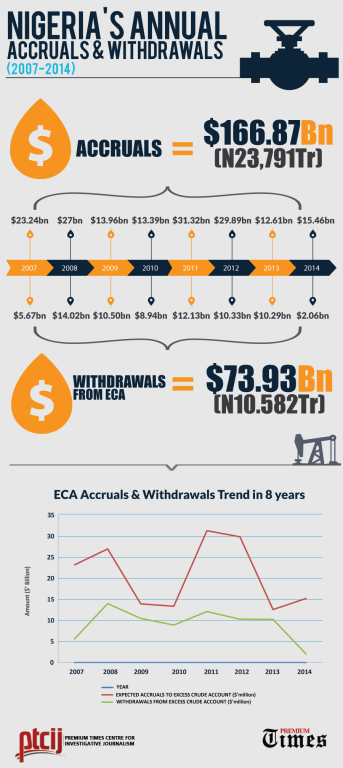
The discrepancies in reporting by the different agencies have been the most frustrating challenge on the ECA. Going by the NNPC report of actual oil production and monthly oil price within the period under review (2007- 2014), Nigeria is expected to have an inflow of 23.79 trillion ($166.87 billion).
In the same manner, the monthly FAAC reports by the Office of the Accountant General reported a total of 10.582 trillion ($73.93 billion) as withdrawals from the Excess crude account (ECA).
However, other reports indicate that the Federal and state governments agreed and made withdrawals of $8.425billion (1.308 trillion) as fund to implement National Integrated Power Project (NIPP) within the same period.
Cumulatively, total withdrawals of N11.89 trillion ($82.17 billion) was accounted for as withdrawals from ECA as FAAC distributions, funds for Sure P and NIPP.
Following this figures, the net expected balance in the ECA as at December 2014 should be 11.9 trillion ($84.52 billion).
However, the Ministry of Finance declared in May 2015 that the actual balance in the ECA as at December 2014 was $2,060,554,241 (344.85billion). If this figure is anything to go by, a difference of $82.46 billion (11.56 trillion) can be regarded as unaccounted amount expected to be in the Excess Crude Account.

FULL DETAILS OF UNREPORTED N11.56 TRILLION EXCESS CRUDE ACCRUALS

Annual Oil Production: Budgeted versus Actual Export
The annual benchmark values in barrels for crude oil production as indicated by appropriation laws during the period were 900million [2007], 882million [2008], 824.4million [2009] and 846 million [2010].
The benchmark estimate for the remaining years were: 828million barrels [2011], 892.8million [2012], 910.8million [2013] and 856.8million [2014].
However, the actual annual crude oil export as reported in the Nigerian National Petroleum Corporation (NNPC) monthly reports were 792million [2007], 724.5million [2008], 769million [2009] and 864.7million [2010].
The annual export for the remaining years were: 822million [2011], 830.8million [2012], 762milion [2013] and 796.7million [2014].
This is shown in the table below
YearBenchmark Oil Production (bbl)Actual Oil Production (bbl)
2007900,000,000791,826,519
2008882,000,000724,479,796
2009824,400,000769,195,205
2010846,000,000864,702,101
2011828,000,000822,082,224
2012892,800,000830,772,048
2013910,800,000762,045,201
2014856,800,000796,654,109
Total6,940,800,0006,361,757,203
Table 1: Annual Oil Production from 2007 to 2014
Annual Oil Price: Budgeted versus Actual
However, although the actual amounts of crude oil production were lesser than the benchmark value (except for 2010), the actual prices of crude oil were higher than the fiscalised (benchmarked) crude oil price making.
The benchmark prices set by the Federal government from 2007 to 2014 were $40, $53.83, $45, $67, $75, $72, $79 and $77.50 respectively.
Likewise, going by the data on monthly crude oil price by the Central Bank of Nigeria, the annual average price of oil were $74.48, $101.14, $63.9, and $80.92 for 2007 to 2010 while for 2011 to 2014, the average annual crude oil price stood at $113.76, $113.47, $110.99 and $100.35 respectively.
YearBenchmark Oil PriceActual Oil Price(Annual Average)
2007$40.00$74.48
2008$53.83$101.14
2009$45.00$63.90
2010$67.00$80.92
2011$75.00$113.76
2012$72.00$113.47
2013$79.00$110.99
2014$77.50$100.35
Table 2: Annual Oil Price from 2007 to 2=014
Annual Oil Revenue and Expected Accruals to ECA (in USD)
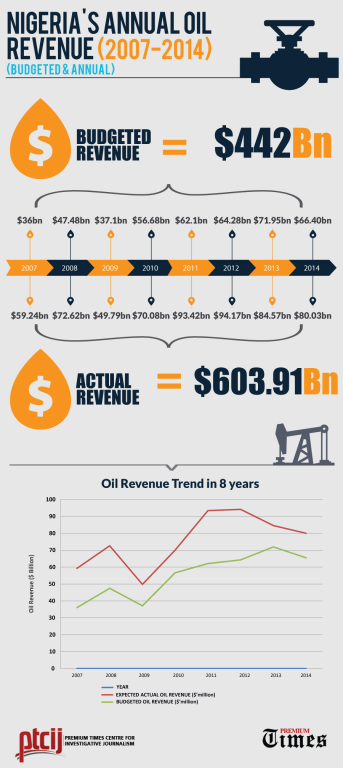
Going by the annual market prices, the benchmark (budgeted) prices and the annual oil production (Tables 2 & 3 above) the actual oil revenues were $59.24 billion [2007], $72.62 billion [2008], $49.79 billion [2009], and $70.08 billion [2010].
Also the actual oil revenue for 2011 to 2014 stood at $93.42 billion, $94.17 billion, $84.57 billion and $80.03 billion respectively.
In the same manner, the corresponding budgeted oil revenue for 2007 to 2010 were $36 billion, $47.48 billion, $37.1 billion, and $56.68 billion. For 2011 to 2014, the same revenue stood at $62.1 billion, 64.28 billion, $71.95 billion and $66.4 billion respectively.
With the figures stated above and in table 4 below, the total actual oil revenue for the eight-year period was $603.91 billion while the total budgeted oil price was $442 billion.
The annual excess crude proceeds (actual revenue minus budgeted revenue) are estimated to be $23.24 billion [2007], $27billion [2008], 13.96 billion [2009], and $13.39 billion [2010] respectively.
Also the annualized excess crude proceeds for 2011 to 2014 were estimated to be $31.32 billion [2011], $29.89 billion [2012], $12.61 billion [2013], and $15.46 billion [2014] respectively.
By these calculations, the Federal government, from 2007 to 2014 would have realised a sum difference of $166.87 billion as excess crude net expected balance in the ECA.
This is obtained as excess of actual revenue from crude oil ($603.91 billion) over the gross budgeted crude oil revenue ($442 billion).
This is shown in the table below.
YearActual Oil Revenue (a)Budgeted Oil Revenue (b)Excess Crude Account (c=a-b)
2007$59,239,738,446$36,000,000,000$23,239,738,446
2008$72,620,086,011$47,478,060,000$27,001,792,263
2009$49,790,735,102$37,098,000,000$13,955,741,897
2010$70,075,592,001$56,682,000,000$13,393,592,001
2011$93,420,769,109$62,100,000,000$31,320,769,109
2012$94,172,583,273$64,281,600,000$29,890,983,273
2013$84,565,187,083$71,953,200,000$12,611,987,083
2014$80,026,424,293$66,402,000,000$15,459,851,348
Total$603,911,115,318$441,994,860,000$166,874,455,420
Table 3: Annual Oil Revenue and Expected Accruals to ECA (in USD)
Annual Expected Inflow to Excess Crude Account (in U.S. Dollars and Nigeria Naira)
The Nigerian National Petroleum Corporation (NNPC) sells its crude in U.S. dollars, and also remits to the Central Bank of Nigeria (CBN) in dollars. This explains why revenue accrual and excess crude funds figures are usually provided in U.S. dollars.
However, CBN deposits the funds into the Federation allocation account in Naira, leaving room for another level of computation to get the actual NNPC remittances to CBN in Naira.
The annual average exchange rate of $1 to a Naira, going by the CBN monthly data on international foreign exchange market (IFEM), for the period of 2007 to 2014 stood at 123.93 [2007], 117 [2008], 146.82 [2009], 148.31 [2010], 151.83 [2011], 155.43 [2012], 155.25 [2013] and 156.45 [2014] respectively.
By computing the corresponding Naira value of the actual and budgeted revenue as given in dollars, it was revealed that a total of 23.79 trillion is the expected inflow into the ECA as at December 2014.
This is arrived at by the sum of expected inflow into the ECA from 2007 to 2014 as 2.848 trillion, 3.129 trillion, 2.066 trillion, 1.988 trillion 4.755 trillion, 4.646 trillion, 1.958 trillion and 2.4 trillion respectively.
Table 4 below shows detail of the figures
YearExchange Rate (USD)Expected Inflow to Excess Crude Account (USD)Expected Inflow to Excess Crude Account (NGN)
2007$123.93$23,239,738,4462,848,134,733,464
2008$117.00$27,001,792,2633,129,147,007,076
2009$146.82$13,955,741,8972,065,965,765,903
2010$148.31$13,393,592,0011,988,126,673,193
2011$151.83$31,320,769,1094,755,109,947,261
2012$155.43$29,890,983,2734,646,453,215,411
2013$155.25$12,611,987,0831,958,074,330,008
2014$156.45$15,459,851,3482,399,926,504,881
Total $166,874,455,42023,790,938,177,198
Table 4: Annual Expected Inflow into ECA
Net Expected Balance in ECA
The reports by the Office of the Accountant General (OAGF) as well as reports by the Federal and state governments agreed that withdrawals for the National Integrated Power Project (NIPP) in March 2013 revealed that the annual withdrawals from ECA (actual withdrawals) for 2007 to 2010 were 708.93 billion, 1.637 trillion, 1.546 trillion, and 1.325 trillion respectively.
Also, annual withdrawals for 2011 to 2014 were reported to be 1.841 trillion, 1.606 trillion, 2.905 trillion, and 320 billion respectively.
Cumulatively, total withdrawals of 11.89 trillion ($82.36 billion) was accounted for as withdrawals from ECA as FAAC distributions, funds for Sure P and NIPP.
Following this figures, the net expected balance in the ECA as at December 2014 should be 11.900 trillion ($84.52 billion).
Year Expected inflow to ECA(a) Withdrawals from ECA FAAC Distribution & NIPP (b) Net Expected Balance in ECA (c=a-b)
2007 ₦2,848,134,733,464 ₦708,934,242,999 ₦2,139,200,490,465
2008 ₦3,129,147,007,076 ₦1,637,019,253,447 ₦1,492,127,753,629
2009 ₦2,065,965,765,903 ₦1,546,424,383,686 ₦519,541,382,217
2010 ₦1,988,126,673,193 ₦1,325,445,268,663 ₦662,681,404,530
2011 ₦4,755,109,947,261 ₦1,841,078,872,301 ₦2,914,031,074,960
2012 ₦4,646,453,215,411 ₦1,606,412,995,298 ₦3,040,040,220,113
2013 ₦1,958,074,330,008 ₦2,905,100,000,590-₦947,025,670,582
2014₦2,399,926,504,881 ₦319,943,121,223₦2,079,983,383,658
Total₦23,790,938,177,197 ₦11,890,358,138,207 ₦11,900,580,038,990
Table 5: Net Expected Balance in ECA
Summary of Unaccounted Amount in the Excess Crude Funds
Ms. Okonjo-Iweala through the Ministry of Finance published summary information on transfer to excess crude account from 2011 to May 2015.
The Minister claimed in the publication that the actual balance in the Excess Crude Account, as at December to 2014, was $2,060,554,241, which by the CBN IFEM figures, stood at 344.85 billion (344,848,470,446) as shown in Table 6 below.
Recalling from Table 5 above, the expected net balance in the ECA as at December 2014 was 11.901 trillion.
By calculating the difference between the net expected balance in the ECA (11.901 trillion) and the actual balance in ECA as at December 2014 (344.85 billion) i.e (11,900,580,038,990 – 344,848,470,446), it is clear that for the period of 2007 to 2014, a total of N11.56 trillion (11,555,731,568,544) was unaccounted for.
USDNGN
1Total Expected Inflow to Excess Crude Account$166,874,455,42023,790,938,177,198a
Less:
Withdrawals from ECA (NIPP by March 2013)$8,425,000,000₦1,308,012,289,474
Withdrawals from ECA, (FAAC Distributions) to FG and States$73,930,904,08310,582,345,848,734
2Total Withdrawals from ECA: as FAAC Distributions + Sure P and NIPP$82,355,904,08311,890,358,138,208b
Net Expected Balance in ECA as at Dec 2014$84,518,551,33711,900,580,038,990c = a – b
Deduct:
Actual Balance in ECA as at Dec 2014$2,060,554,241344,848,470,446d
3Amount Unaccounted for in ECA$82,457,997,09711,555,731,568,544e = c – d
Table 6: Summary of Findings
Authenticity of Data and Verification of Estimated Value
PREMIUM TIMES investigation relied solely on data obtained from relevant government agencies such CBN, NNPC, OAGF, Budget Office and Ministry of Finance. Moreover, in order to further verify and validate the analyzed data, FOI request were made to CBN, Ministry of Finance Revenue Mobilization and Federation Account (RevFAC) and the NNPC.

None of the FOI request to the four agencies gave the requested details as at the time of this report.
As much as these figures were concerned, it is believed from interrogating the available data from the Office of the Accountant General (OAGF), that no concrete coordination existed between the Ministry of Finance and the OAGF.
As identified by the Nigeria Extractive Industry Transparency Initiative [NEITI] report, the five major ministries, departments and agencies – CBN, NNPC, RevFAC, OAGF and Ministry of Finance — consistently gave conflicting figures, thereby confusing the public the more.
Conclusion
So far, PREMIUM TIMES investigation has shown that 11.56trillion that should have accrued to the Excess Crude Account is unaccounted for.
It remains to be seen whether the various agencies involved in the management of the account would open up their books and let Nigerians understand how they handled and disbursed the funds on behalf of the Nigerian people.
See the infographics below for more information.
ECA-1
ECA-2ECA-3
ECA-4ECA-5

Speaker Dogara replies Oyegun, zones Majority Leader to North West


Speaker, House of Representatives, Yakubu Dogara 

HIS  FIRST PLENARY SESSION  AT THE FLOOR OF THE HOUSE OF REPRESENTATIVES 

IN ABUJA ON WEDNESDAY (10/6/15).
Speaker, House of Representatives, Yakubu Dogara HIS FIRST PLENARY SESSION AT THE FLOOR OF THE HOUSE OF REPRESENTATIVES IN ABUJA ON WEDNESDAY (10/6/15).
The Speaker of the House of Representatives, Yakubu Dogara, has replied a letter written by the national Chairman of the All Progressives Congress, APC, John Oyegun, to him on June 23, 2015, directing him to appoint party nominees as principal officers.
Mr. Dogara in his reply, dated July 16, 2015, recalled his earlier claim that a court case instituted by some members on the matter, made it impossible for him to make all necessary consultation on the chairman’s letter.
Mr. Dogara also informed Mr. Oyegun the need to respect Federal Character, and enumerated the tradition of the House of Representatives regarding how Principal officers are elected.
He then proposed to the APC Chairman a list of zoning of principal offices that would best reflect the spirit of Federal character.
He stated that The North East and South West have already produced the Speaker and his deputy. He therefore, proposed that the House Leader should come from the North West (with 86 APC members) Deputy House Leader, from the North Central (with 33 APC members), while Chief Whip and Deputy Chief Whip would come from the South South and South East respectively.
See Mr. Dogara’s full letter below:
July 16, 2015
The National Chairman,
All Progressives Congress (APC),
National Headquarters,
Abuja.

UPDATE ON ELECTION OF PRINCIPAL OFFICERS OF THE 8TH HOUSE OF REPRESENTATIVES

This is to formally acknowledge receipt of your letter Ref. No. APC/NHDQ/NAM/01/015/06 dated 23rd June, 2015.
2. After the letter was received but before I could make the necessary consultations concerning the letter because of its sensitive nature, I was served with Court processes on the subject matter filed by some Members of the House and other persons and groups from the North Central and South East Zones of Nigeria. The Rules of the House enjoin us to make a determination whether discussing a matter pending in Court in the House would be prejudicial to the Case.
3. However, before this determination could be made, on the 25th June, 2015, I took steps to discuss the matter in an Executive Session of the House which is open to only House Members and not the public. We were prevented from doing so by some House members who conducted themselves in a most unparliamentary manner. It is necessary to point out that the mechanism of Executive Session is resorted to in order to iron out controversial matters in an amicable way to preserve the unity and cohesion of the House.
4. Since then, efforts have been made by the Party, Progressive Governors and other interested persons to intervene and resolve the issues. We want to place on record, our unflinching loyalty and respect not only to you as an individual, considering your antecedents, but also to the party, APC, under whose platform we were elected to the House. We have no intention whatsoever of disobeying your directives or the party’s position on any matter. We would, of course, prefer a situation where we are consulted on matters concerning the House before directives are issued and made public.
5. We feel strongly, that the issue of federal character in the election or appointment of principal officers of the House is a cardinal legal, moral and constitutional principle that should be respected by our party. It is however obvious from the letter under reference that this principle was not taken into consideration. If the letter is enforced the way it was conveyed, it will lead to the following unjust result:
Speaker: North East:
Chief Whip: North East
Deputy Speaker: South West
House Leader: South West
Deputy House Leader: North West
Deputy Chief Whip: South South
This will totally and unfairly exclude the South East and North Central Zones in the distribution of these political offices and lead to undue concentration of some offices in the South West and North East Zones of Nigeria.
6. The House Rules provide that in filling the positions of Majority leadership of the House, namely, leader of the House, Chief Whip, Deputy Leader, Deputy Whip of the House, each candidate;
“shall be a member nominated from among the members in the majority party in the House”
Furthermore, Order 1, of the House Rules provides that
“In all cases not provided for hereinafter or by sessional or other orders, Precedents or practices of the House, the House shall by Resolution regulate its procedure”
It is evident that there are existing Precedents and Practices which the House has been following for a long time and in particular since 1999. Since 1999, Zonal Caucuses of a Party have been primarily responsible for nominating Principal Officers of the House, other than the Speaker and Deputy Speaker that are elected by the entire House.
In 1999, Principal Officers of the House were as follows:
1. Speaker: Rt. Hon. Salisu Buhari &
Rt. Hon. Ghali Umar Na’Abba -North West
2. Deputy Speaker: Rt. Hon. Chibudom Nwuche -South South
3. House Leader: Hon. Mohammed Wakil -North East
4. Chief Whip: Hon. Bawa Bwari -North Central
5. Deputy Leader: Hon. Mao Ohuabunwa -South East
6. Deputy Whip: Hon. Samuel Sadiq Anwo -South West
2003:
1. Speaker: Rt. Hon. Aminu Bello Masari -North West
2. Deputy Speaker: Rt. Hon. Austin Opara -South South
3. House Leader: Hon. Abdul Ningi -North East
4. Chief Whip: Hon. Bawa Bwari -North Central
5. Deputy Whip: Hon. Patricia Olubunmi Etteh -South West
6. Deputy Leader: Hon. Gilbert Nnaji -South East
2007:
1. Speaker: Rt. Hon.Patricia Olubunmi Etteh
& Rt. Hon. Dimeji Bankole -South West
2. Deputy Speaker: Rt. Hon. Nguruoje Babangida &
Rt. Hon. Bayero Usman Nafada -North East
3. House Leader: Hon. Akogun Tunde -South South
4. Chief Whip: Hon. Bethel Amadi &
Hon. Emeka Ihedioha -South East
5. Deputy Whip: Hon. Aminu Waziri Tambuwal -North West
6. Deputy Leader: Hon. Baba Shehu Agaie -North Central
2011:
1. Speaker: Rt. Hon. Aminu Waziri Tambuwal -North West
2. Deputy Speaker: Rt. Hon. Emeka Ihedioha -South East
3. House Leader: Hon. Mulikat Akande -South West
4. Chief Whip: Hon. Isiaka Bawa -North East
5. Deputy Whip: Hon. Muktar Mohammed -North Central
6. Deputy Leader: Hon. Leo Ogor -South South
2015:
1. Speaker: Rt. Hon. Yakubu Dogara -North East
2. Deputy Speaker: Rt. Hon. Lasun S. Yussuf -South West
3. House Leader ?
4. Chief Whip ?
5. Deputy Whip ?
6. Deputy Leader ?
These are clear Precedents and Practices for Majority leadership positions since 1999. They therefore, constitute precedents and practices of the House as enshrined in the Standing Orders of the House. We are bound by it by virtue of Provisions of Order 1 of our Standing Rules.
7. The issue of Federal character has very strong constitutional foundations. They are indeed mandatory provisions of the Constitution. For ease of reference, let us examine the following provisions:
a. S. 14(3)
“The composition of the Government of the Federation or any of its agencies and the conduct of its affairs shall be carried out in such manner as to reflect the federal character of Nigeria and the need to promote national unity, and also to command national loyalty thereby ensuring that there shall be no predominance of persons from a few States or from a few ethnic or other sectional groups in that government or in any of its agencies”
b. S. 147 provides for the appointment of Ministers by the President. However, under S. 147(3)
“Any appointment under subsection (2) of this section by the President shall be in conformity with the provisions of section 14(3) of this Constitution”
c. S. 223(1)(b) provides for observance of federal character by political parties, thus:
“The members of the Executive Committee or other governing body of the political party shall be deemed to reflect the federal character of Nigeria only if the members thereof belong to different states not being less in member than two-thirds of all the States comprising the Federation”
d. The Third Schedule, Part 1, C, especially Section 8 (b) and (c) enjoins the Federal Character Commission to:
“b.promote, monitor and enforce compliance with the principles of proportional sharing of all bureaucratic,, economic, media and political posts at all levels of government;
c.take such legal measures, including the prosecution of the head or staff of any Ministry or government body or agency which fails to comply with any federal character principle or formula prescribed or adopted by the Commission”
e. The Oath of office of Members of the National Assembly is contained in the 7th Schedule to the Constitution and every member swore to:
“Preserve the Fundamental Objectives and Directive Principles of State Policy contained in the Constitution of the Federal Republic of Nigeria, and ….. (to) preserve, protect and defend the Constitution of the Federal Republic of Nigeria”
To further underscore the seriousness with which the framers of the Constitution regarded the issue of Federal Character, the National Assembly was given exclusive jurisdiction to legislate in Item 60 of the Exclusive Legislative List, for:
“The establishment and regulation of authorities for the federation or any part thereof –
a.)To promote and enforce the observance of the fundamental objectives and Directive Principles of State Policy contained in the Constitution”
8. Our most respected Chairman, in the light of above and and in view of our Party’s unshakable commitment to Due Process and the Rule of Law, the present position is untenable. Therefore, insisting on it is only tantamount to compelling us to violate the Constitution or to betray the Oath of Office we solemnly swore to. This we believe is not what our Party and any of our principled National Leaders stand for.
Indeed, we expect that our great party, the APC, will ensure that “there shall be no predominance of persons from a few states or from a few ethnic or sectional groups in (the) government or in any of its agencies”
9. Consequently Sir, we propose the following zoning arrangement for the distribution of principal offices in the House of Representatives.
Speaker: Rt. Hon. Yakubu Dogara – North East
Deputy Speaker: Rt. Hon. Yusuf Sulaimon Lasun – South West
House Leader: North West (with 86 APC members)
Deputy House Leader: North Central
(with 33 APC members)
Chief Whip: South South
Deputy Chief Whip: South East
Above proposal satisfies the provisions of Order 1 of our Rules, the Constitutional provision on Federal Character and gives all parts of Nigeria a sense of belonging. The proposal will also obviate all pending Court cases filed by some Zonal Caucuses on the matter.
10. To resolve this problem, we had offered that some of the aggrieved members of our party, APC, who lost the election for the office of Presiding Officers, should produce some of the remaining Principal Officers for peace to reign. For emphasis, we have conceded the position of Leader of the House and Chief Whip to those aggrieved, as long as the persons should not come from the North East or South West Zones that have already produced the Speaker and Deputy Speaker. In any case, sir, I pledge as the Speaker of the House, to accommodate other colleagues of ours in the Party list, who may not be taken care of by this arrangement, with other commensurate appointments or other existing opportunities for service to the nation.
11. We owe a duty to lay the truth bare as we have done in this case. The Party in conjunction with Governors, National leaders and the APC Causes in the House may agree otherwise as the saying goes, “volenti non fit injuria”. Our Party must not have the undistinguished honour of setting a precedent outside of the provisions of the Constitution and the Rules of the House.
12. CONCLUSION
We most respectfully urge that our above proposal be considered on its merits and that efforts should be made to resolve this matter so that the House will resume its working recess in a peaceful atmosphere. There is no gainsaying the fact that a stable House is necessary to support the President and Commander in Chief of the Nigerian Armed Forces and the APC in fulfilling our electoral mandate of Change and Progress for the Nigerian people.
13. May I Sir, respectfully assure you of our continued loyalty and best wishes.
Rt. Hon. Dogara Yakubu
Speaker, House of Representatives
CC: President, Commander in Chief of the Armed Forces of the Federal Republic of Nigeria
CC: Governor Aminu Waziri Tambuwal (Progressive Governors’ forum mediator)
CC: Governor Rochas Okorocha, Chairman, Progressive Governors’ Forum
CC: Chairman, Forum of APC State Chairmen

Buhari’s ‘Missing’ Certificate: Ex-Service Chiefs To Be Investigated


Some of the Service Chiefs fired on Monday are to be investigated over some allegations, The Nation has learnt.
Among the allegations are:
•mismanagement of funds for operations; and
•alleged disappearance of the President’s Secondary School Certificate from military records.
Some retired military officers are said to be pushing for the revisit of the row over President Muhammadu Buhari’s certificate.
It was learnt that security reports indicated that some of the Service Chiefs were allegedly “reckless” in office.
One of the sacked military chiefs was noted for “enjoying himself to the fullest”. Another spent a fortune on wrist-watches and acquired property.
There has been some disquiet in military circles over the allegation that some of the military chiefs substantially benefited from an Abuja housing scheme meant for middle-level officers.
A unit of the houses costs about N7 million, which military officers were asked to pay under three months.
Since most of them could not raise the N7 million per unit, some Service Chiefs were said to have taken “undue advantage” to corner appreciable units.
According to sources, there was a  discreet preliminary investigation of the activities some of the Service Chiefs before they were asked to go on Monday.
The preliminary findings may set the stage for a comprehensive investigation, it was learnt.
 A highly-placed source said: “I think the government will certainly look into the activities of some Service Chiefs
“Among the former Service Chiefs, it was known to all that one of them used to buy wrist-watches worth about $300,000 to $500,000 at will for whoever he liked while in office.
“This is outside curious spending on unnecessary overhead. The situation was that bad. You can see why we are celebrating their exit in the barracks.
“As a matter of fact, one or two of the Service Chiefs indirectly funded the campaign activities of a party in their states through their proxies.
“In fact, there is a case of a former Service Chief who was ‘crazy’ with acquisition of property in Abuja for himself and his relations.”


 The Nation learnt that “a fresh lead” would force a revisit of the Buhari Secondary School Certificate row.
It was gathered that the alleged ‘dislocation’ of the certificate from the President’s file is likely to be investigated to give the public the “other side” of what really transpired just before the general elections when the then ruling Peoples Democratic Party (PDP) alleged that Buhari had no certificate.
A military source said: “Some respected but retired military officers are demanding a probe of the circumstances behind the certificate saga because it created a division in the military. These aggrieved officers have insisted that credentials of every military officer are always in their files.
“There is a fresh lead that the President’s file might have suffered some mutilation or misplacement. While some claimed that the certificate had been misplaced since the 1980s, others alleged mutilation as a result of some political factors.
“Some military officers alleged that the certificate might have got lost in transit when the military was relocating from Lagos to Abuja in the 1990s.
“The essence of the investigation is to set the records straight and put issues in the right perspective.

Wednesday, 15 July 2015

Former Petroleum Minister Diezani Alison-Madueke Has “No Reputation To Protect,” Lawsuit Asserts

Nigeria’s former Minister of Petroleum Resources, Mrs. Diezani Alison-Madueke has no reputation to protect, as the married woman has a notorious reputation and a penchant for adulterous affairs, a lawsuit claims.
Nigeria's former Minister of Petroleum Resources, Diezani Allison-Madueke
The suit, filed at the High Court of the Federal Capital Territory in Abuja by Moremi Publishing House Limited, publishers of Osun Defender, asserts that Alison-Madueke’s illicit affairs outside her marriage have been undertaken using the nation’s wealth upon which she sat as Minister of Petroleum.
The suit is a response toa libel suit filed by Alison-Madueke filed in june 2015
The defendants insist in their statement of defence that there is a treasure trove of documentation in the nation’s press as well as in various public investigations which include the reports of the audit firms KPMG and PriceWaterHouse Coopers on the Nigeria National Petroleum (NNPC), as well as that of the House of Representatives on the activities of Alison-Madueke.
Maintaining that they are “responsible corporate citizens of Nigeria with high ethical and professional standing” who would libel no one, the plaintiff inclusive, the defendants declared that they only publish “credible and verifiable” stories.
They cited a wide variety of published stories in different media outside of themselves which reflect a wide variety of corruption and collusion on the part of Alison-Madueke during her tenure as Minister.
Among others, the defendants asserted that under the Plaintiff’s watch as Minister for Petroleum Resources, 445,000 barrels of crude oil were stolen on a daily basis for about four years with no effort by Alison-Madueke to identify, initiate arrest or prosecute the criminals who were responsible for that huge theft and depletion of national wealth.
“The allegation of daily theft of crude oil was asserted by former President Goodluck Jonathan, Vice President Namadi Sambo and Minister for Finance, Ngozi Okonjo-Iweala on several occasions and which facts were never contradicted nor debunked by the Plaintiff and which led to the award of bogus contracts of pipeline monitoring and protection to rag-tag security formations of ex-militants and ethnic militias by the government under which the Plaintiff served as Minister,” they said.
They also recalled the House of Representatives’ investigation of Alison-Madueke for squandering about N10 billion of tax payers’ money on charter and maintenance of a Challenger 850 aircraft for unofficial use as was widely reported in the mass media.
“The Defendants aver that, at the trial of this suit, they shall rely on opinions of average Nigerians about the Plaintiff to buttress the fact that the Plaintiff has no reputation to protect save in the coterie of her corrupt associates,” for which they underlined they will rely on various publications to prove their point.
Text of the statement of claim: 
In the High Court of the Federal Capital Territory
In the Abuja Judicial Division
Holden at Abuja
                                                         Suit No: FCT/HC/CV/1712/2015
Between                      
Mrs. Diezani Alison Madueke                                         …Plaintiff
  And
  Moremi Publishing House Ltd.                                     …1st Defendant
Kola Olabisi                                                                …2nd Defendant
  Statement of Defence
  Save and except as is hereinafter expressly admitted, the Defendants deny each and every allegation of facts contained in the Statement of Claim as if same were herein set out and denied seriatim.
1.  The 1st Defendant admits paragraph 1 of the Statement of Claim to the extent that the Plaintiff was at the relevant time of filing this action the Minister for Petroleum Resources of the Federal Republic of Nigeria.
2.  The Defendants admit paragraphs 2 and 3 of the Statement of Claim but deny that the said publications were defamatory of the Plaintiff contrary to the allegation in paragraph 4 of the Statement of Claim as the statements made in the publications are true.
3.  Contrary to paragraphs 9 and 10 of the Statement of Claim, the Defendants say that:
3.1.   no independent investigation has been conducted by anybody, whether the Senate of the Federal Republic of Nigeria or PriceWaterhouseCoopers, that exonerated the Plaintiff contrary to the Plaintiff’s contention;
3.2.   rather, PriceWaterhouseCoopers (hereinafter referred to as PWC) in its audit report on the accounts of Nigerian National Petroleum Corporation (NNPC), a corporation under the Ministry of Petroleum Resources presided over by the Plaintiff between April 2010 and May 2015, indicates that
a.  the Nigerian Petroleum Development Company (NPDC) and the Central Bank of Nigeria (CBN) refused to open their financial statement to PWC and hence the latter could not have access to NPDC’s full accounts and records;
b.  no supporting documents were provided by the NPDC for the $0.25 billion claimed by the NPDC as Nigerian Port Authority charges;
c.   a sum totaling $10,257,161.07 could not be substantiated due to insufficient documents which ought to be provided by the NPDC;
d.  a total of $59,324,737.01 ($59.3) Million on Charter Hire Services could not be substantiated due to lack of supporting documents which ought to be provided by the NPDC;
e.  out of the $17,767,683.54 claimed as payments for manning and management fee of MT Tuma and MT Oloibiri, the sum of $6,658,588.74 could not be ascertained due to lack of supporting documents which ought to be supplied by NPDC;
f.   the total claim of $5,457,006.98 out of the total claim $46,265,215.13 could not be substantiated due to lack of supporting documents. NNPC claimed the sum of $46,265,215.13 as crude transport payments during the review period, (which fell in between the Plaintiff’s service as Minister for Petroleum Resources) which was incurred on crude oil transportation from Escravos terminals to Warri refinery jetty using marine vessels;
g.  the sum of $6,707,826.05 could not be substantiated due to lack of supporting documents. This forms part of the expenses allegedly incurred on marine throughput by the NNPC under the management of the Plaintiff;
h.  on capital expenditure, the sum of $24,179,005.48 could not be substantiated due to insufficient supporting documents which were supposed to be provided by NPDC and NNPC under the Ministry of the Plaintiff;
i.   no amount whatsoever was substantiated for the total claim on Pipeline Vandalism and Repair Cost of $11,896,654.71 and on Management Charge out Rate claim of $59,712,530.83 as no supporting documents were provided for the costs;
j.   while there were documentary evidence that the President of the Federal Republic of Nigeria had ordered that subsidy on DPK be stopped and the Executive Secretary PPPRA to the CBN Governor confirmed that PPPRA had ceased granting subsidy on Kerosene and no appropriation was made in the nation’s budget in 2012 and 2013, NNPC, under the Ministry of the Plaintiff claimed they spent $9.9 billion on kerosene without budgetary allocation;
k.  whereas the sale of kerosene has been deregulated and average common man takes no benefit of the subsidy payments, yet the Plaintiff supervised the payment of huge sums of money for payment of subsidy on a deregulated product for more than two years in her ministry, the amounts paid has never been recovered and the Plaintiff did not finger any recipient of the funds for prosecution by the relevant agencies;
l.    in January 2015, investigators discovered that the various NNPC (55%) portion of Oil leases (OMLs) involved in the Shell Divestments related to eight OMLs were transferred to NPDC for aggregate sum of US$1.85 billion. So far, only the sum of US$100 million had been remitted in relation to these assets and the sum of US$1.75 billion remains unremitted while the Plaintiff presides over the affairs of the Ministry of Petroleum Resources. In addition, the said assets were sold for less their commercial value;
m. the total amount remitted from the sale of domestic crude amounted to $14.5 billion which is just half the total amount of $28,215,731,691 claimed by NNPC to have accrued from the total revenue generated from domestic crude sales;
n.  rather than allowing the House of Representatives Committee to complete its investigation, the Plaintiff went to court and obtained an order preventing the Committee from proceeding on its investigation and the said suit is still pending till the time of filing this defence.
4.  The Defendants say that, further to and in clarification of paragraph 3 above, the NNPC is a wholly-owned outfit of the Federal Government of Nigeria (FGN) which operates through its subsidiary, NPDC, in direct petroleum exploration and production operations and the affairs of all these bodies were superintended over by the Plaintiff as the Minister for Petroleum Resources. For paragraph 3 above, the Defendants shall rely on the PWC Audit Report as reported in an on-line tabloid, Nigeria News Headline Today on Tuesday, April 28, 2015 at http://www.newsheadlines.com.ng/latest- news/2015/04/28/highlights-pwc-audit-of-nnpc-accounts/ and accessed on 6/5/15 at 8:19 pm. Notice is hereby issued to the Plaintiff to produce the original of the report of PWC which is in her possession at the trial of this suit.
5.  A report in The Guardian online edition on May 14 2014 confirmed that “PWC audit report confirms that $18.5 bn was diverted from NNPC account”. The Defendants shall rely on this report accessed at http://www.ngrguardiannews.com/2015/05/pwc-audit-report-confirms-18-5bn-was-diverted-from-nnpc-account-says-sanusi on Friday 5 June 2015.
6.  The Defendants further aver that under the Plaintiff’s watch as Minister for Petroleum Resources, 445,000 barrels of crude oil were stolen on a daily basis for about four years without efforts by the Plaintiff to identify, initiate arrest or prosecute the criminals who were responsible for this huge theft and depletion of national wealth. The allegation of daily theft of crude oil was asserted by former President Goodluck Jonathan, Vice President Namadi Sambo and Minister for Finance, Ngozi Okonjo-Iweala on several occasions and which facts were never contradicted nor debunked by the Plaintiff and which led to the award of bogus contracts of pipeline monitoring and protection to rag-tag security formations of ex-militants and ethnic militias by the government under which the Plaintiff served as Minister.
7.  The Defendants aver that, contrary to paragraphs 11 and 12 of the Statement of Claim, the statements contained in the said publications are true and the Plaintiff has no such reputation that can be damaged as the accounts of the Plaintiff’s stewardships in the Ministry of Transportation, Ministry of Mines and Steel Development and, later, Ministry of Petroleum Resources, are a catalogue of unscrupulous and indecent practices characterized by profligacy, self-aggrandisement, serial scandals and wanton embezzlement.
8.  The Defendants shall, in justification, rely on the House of Representatives’ investigation of the Plaintiff for squandering about 10 billion Naira of tax payers’ money on charter and maintenance of a Challenger 850 aircraft for unofficial use as reported by
i.         Newswatch Times of May 9, 2014 in a report titled “Reps Probe Diezani’s N10bn Aircraft, Jonathan Media Chat” at http://www.mynewswatchtimesng.com/reps-probe-diezanis-10bn-aircraft and accessed on 6/18/15 at 2:21 pm;
ii.       Premium Times report titled “House of Reps orders probe of Alison-Madueke for allegedly spending N10 billion on private jet” reported at http://www.premiumtimesng.com/news/157135-house-reps-orders-probe-of-alison-madueke-for -allegedly-spending-n10billion-on-private-jet/ accessed on 6/18/15 at 2:26 pm;
iii.     Punch newspapers online report of March 27 2014 titled “Diezani’s jet scandal: Reps panel under pressure, uncovers third aircraft” reported at http://www.punchng.com/news/diezanis-jet-scandal-reps-panel-under-pressure-uncovers-third-aircraft/ accessed on 6/18/15 at 2:28 pm; and
iv.      Encomium Magazine online report titled “Inside Diezani Alison Madueke’s N5.1 billion Bombardier Challenger jet” reported at http://encomium.ng/inside-diezani-alison-maduekes-n5-1-billion-bombardier-challenger-jet/ accessed on 6/18/15 at 4:38 pm.
9.  The Defendants further aver that the Plaintiff has been a subject of several reports of shady deals and dirty transactions relating to sale of oil blocks belonging to the Federation. The Defendants shall rely on
a.        online reports of The Icon titled “Shady allocation of oil blocks: Alison-Madueke has a case to answer” reported at http://www/theiconng.com/shady-allocation-of-oil-blocks-alison-madueke-has-a-case-to-answer/ and accessed on 6/5/15 at 7:29 pm which transaction the House of Representatives of the Federal Republic of Nigeria is still investigating as at present;
b.        Punch newspapers online report of 06 March 2015 titled “Petroleum minister summoned over sale of oil blocks” reported at http://www.news24.com.ng/National/News/Petroleum-minister-summoned-over-sale-of-oil-blocks-20150306.
10.     The Defendants further state that the Plaintiff, a married woman, is a personage of notorious reputation and penchant for illicit affairs which have been sustained by the nation’s oil wealth. The Defendants shall rely on the following publications to this effect:
a.        an online blog, called Amazing Stories Around the World, published on Sunday 8 December 2013 a report titled “Kola Aluko’s Romance with Diezani, Omokore Exposed” which detailed the lavish lifestyle of one Kola Aluko who, according to reports, abandoned the Plaintiff after a sizzling romantic relationship and opted for the British model, Naomi Campbell. The said report is on http://amazingstoriesaroundtheworld.blogspot.com/2013/12/kola-alukos-romance-with-diezani.html and accessed on 6/5/15 at 8:49 pm;
b.        a November 24, 2013 online report titled “The Dirty Secret Between Kola Aluko and Petroleum Minister, Allison Madueke Exposed” published by abusidiqu.com which details how the relationship between the Plaintiff and the said Kola Aluko went sour the latter having escaped with billions of dollars which were profits made from illegal oil deals involving the Plaintiff. The said story is on http://abusidiqu.com/dirty-secret-kola-aluko-petroleum-minister-allison-madueke-exposed/ accessed on June 6, 2015 at 12:28 pm;
c.         a Wednesday November 13, 2013 online report published by NewsRescue titled “Diezani’s Hustler, Kola Aluko, his Super Yatch, Naomi Campbell and His $Billions Wealth Status” which details the expansive wealth of the said Kola Aluko and how same was made from the relationship with the Plaintiff. The said report is at http://newsrescue.com/diezanis-hustler-kola-aluko-super-yatch-naomi-campbell-billions-wealth-status/ accessed on 6/5/15 at 8:51 pm;
d.        a report by Sahara Reporters on August 19, 2013 titled “Petroleum Minister, Diezani Allison-Madueke, Accused of Blowing N2 Billion on Private Jets” detailing how the Plaintiff had been wasting Nigeria’s resources in mind-boggling and satanic splendor published at http://saharareporters.com/2013/08/19/petroleum-minister-diezani-allison-madueke-accused-blowing-n2-billion-private-jets accessed on 6/5/15 at 7:17 pm;
e.        a May 26, 2015 online report published by The Icon titled “N1bn Libel Suit: Allison-Madueke and agents evading service” in which the Plaintiff was alleged to be evading service of court process in Suit No. CV/1679/15 at the FCT High Court for libel and unauthorized use of the name of one Simon Imobo-Tswan and his platform, Network of Progressive Activists as well as his GSM number to launder the Plaintiff’s image in the media via news-stories and advertorial which report was accessed at http://www.theiconng.com/n1bn-libel-suit-alison-madueke-and-agents-evading-service/.
11.     The Defendants aver that, at the trial of this suit, they shall rely on opinions of average Nigerians about the Plaintiff to buttress the fact that the Plaintiff has no reputation to protect save in the coterie of her corrupt associates and shall rely on the following publications:
a.        an article published online by Sahara Reporters on April 19, 2015 titled “Ten Reasons Why Diezani Alison-Madueke Must Go To Prison” by Churchill Okonkwo and accessed at http://secure.saharareporters.com/2015/04/19/ten-reasons-why-diezani-alison-madueke-must-go-prison-churchill-okonkwo on 6/5/15 at 7:59 pm;
b.        an article published online by Premium Times on April 28, 2015 titled “Why the Federal Government Should Prosecute Mrs. Diezani Alison-Madueke” by Femi Akinfolarin and accessed at http://blogs.premiumtimesng.com on 6/5/15 at 7:55 pm;
c.        the publication by Sahara Reporters of January 27, 2014 titled “Anti-Corruption Coalition Wants Nigeria’s Petroleum Minister, Alison-Madueke, Removed As Alternate President of OPEC”, a report of a petition by Civil Society Network Against Corruption which detailed a number of corrupt practices of the Plaintiff as the Minister for Transportation, Minister of Mines and Steel Development, and later, Minister for  Petroleum Resources, all between 2007 - 2015. The said publication is on http://saharareporters.com/2014/01/27/anti-corruption-coalition-wants-nigeria%E2%80%99s-petroleum-minister-alison-madueke-removed and accessed on 6/24/15 at 11.43 am;
d.        the KPMG report on the sleaze that characterized the Plaintiff’s stewardship in the Ministry of Petroleum Resources which report described NNPC as a “House of Fraud” but was brought to public attention by Premium Times of February 1, 2012 in a write-up titled “KPMG report: 20 Nigerians EFCC should interrogate” - accessed at http://www.premiumtimesng.com/news/3636-kpmg-report-20-nigeriana-efcc-should-interrogate.html on 6/24/15 at 11:58 am. The Plaintiff is hereby given notice to produce the report of KPMG which was submitted to her but was covered up for a long time until unearthed by Premium Times;
e.        the editorial opinion of Punch Newspapers published online on April 1, 2014 titled “Mr President, Alison-Madueke’s cup is full” at http://www.punchng.com/editorials/mr-president-alison-madueke’s-cup-is-full and accessed on 6/24/15 at 12:54 pm.
12.     The Defendants maintain that they are responsible corporate citizens of Nigeria with high ethical and professional standing and shall not libel anybody, the Plaintiff inclusive, but only publish real, credible and verifiable stories.
13.     The Defendants shall rely on the defence of justification in this case as the Plaintiff has no reputation to protect.
14.     The Defendants shall also rely on the defence of qualified privilege at the trial of this suit as it is part of their duties to inform the public.
15.     Whereof the Defendants pray for the dismissal of the Claimant’s action with punitive and substantial costs as the said action is frivolous, vexatious and completely lacking in merit.
  Dated this                 day of June, 2015                       
                                                                               __________________
ü R. A. O. Adegoke,
Dare Oketade,                                                
 M. A. Banire & Associates,
 Defendants’ Counsel,
c/o Olujinmi & Akeredolu & Co.,
5th Floor, NICON Plaza,
Muhammadu Buhari Way,
Central Area, Abuja.
+234-802-449-6925
info@mabandassociates.com
For Service On:
The Plaintiff,
c/o her counsel,
Dr. Chike Amobi,
Chike Amobi & Co.,
Ambassador Albert I Osakwe House,
1473, Inner Block Road, Suit 203,
Central Business District,
Abuja.

EFCC begins probe of Uduaghan administration

Fidelis Soriwei
Delta State Governor, Emmanuel Uduaghan
The Economic and Financial Crimes Commission has commenced an investigation into the administration of Delta State Governor, Dr. Emmanuel Uduaghan.
Investigations on Wednesday revealed that a team of operatives attached to the Economic Governance Unit of the commission was entrusted with the responsibility of looking into the account books of the Delta State Government under Uduaghan.
A reliable source disclosed to our correspondent that some officials of the state government would appear before the commission to answer questions in relation with alleged economic crimes next week.
It was learnt that some former commissioners and principal officers of the state’s seventh House of Assembly would be invited by the commission for interrogation.
The source said that one of the principal officers of the House was at the commission’s headquarters last week.
It was gathered that the team investigating the immediate past Delta State administration had not invited the former governor.
It was gathered that Uduaghan’s invitation would be determined by the outcome of the investigation of the invited officials.
“It is not true that Uduaghan and his aides were quizzed by the commission. Even his aides have not even been quizzed. The commission has invited some of the officials who served under the former governor. Some of them are commissioners and others are principal officers of the House of Assembly.
“Only one of the principal officers (name withheld) has appeared and left. The others are expected next week. The governor was not invited. He can only be invited after the interrogation of the officials involved. For now, he is out of it.”
When our correspondent contacted the Head, Media and Publicity, EFCC, Mr. Wilson Uwujaren, to comment on the story, he said he had not been briefed about the said investigation.
Uduaghan had in May denied an allegation by a group which accused him of embezzling over N200bn which was appropriated to the Delta State Oil Producing Areas Development Commission.
The group, under the aegis of the Delta Youths for Good Governance and Anti-Corruption and Integrity Forum had alleged that the governor had embezzled the money and was speeding up plans to scrap the commission before leaving office on May 29, 2015.
The leader of the forum, Prince Kpokpogri, alleged that some members of the state seventh House of Assembly connived with the governor to secure N40bn bond.
Speaking through his Communications Manager, Paul Odili, Uduaghan, had, however, said the allegations were false and mischievous.
Odili said, “People are just heaping all kinds of allegations against the person of the governor. How can the governor take such a huge amount of money? It is cheap blackmail because the governor has the interest of Deltans at heart and he cannot do that. That allegation is ridiculous and from an ignorant mind.”
Copyright PUNCH.