Monday, 20 July 2015
Nigeria committed to good governance and fighting terror
Muhammadu Buhari is president of Nigeria.
This month, the world moved a step closer to the defeat of Boko Haram, the jihadist group that has terrorized hundreds of thousands in the northern states of Nigeria. In one of my first acts since taking office as president six weeks ago, I have replaced the heads of Nigeria’s army, navy and air force. Our new military leadership has not been chosen because of their familiarity with those in government, as was too often the case in the past, but on their track records and qualifications alone.
These new military leaders will be based in Borno State in northern Nigeria, where the headquarters of the armed services has been relocated. This shift of resources and command directly to the front line, in addition to the replacement of the head of the State Security Service, Nigeria’s intelligence organization, and a new emphasis on working in partnership with our neighbors, has equipped us to take the fight directly to Boko Haram.
Already we are beginning to see a degrading of Boko Haram’s capabilities as a fighting force. In recent weeks, it appears to have shifted away from confronting the military directly to an increase in attacks on civilian areas, as we saw only last week when an elderly woman and 10-year-old girl blew themselves up at a Muslim prayer gathering in northeastern Nigeria. We should not be confused by this change, hateful as it is: It does not mean that Boko Haram is succeeding in its aims — it shows that it is losing.
While we work to defeat the terrorists, I ask the people of Nigeria and the world for resolve and fortitude. The campaign we will wage will not be easy; it may not be swift. We should expect stages of success and also moments when it may appear that our advances have been checked. But no one should have any doubt as to the strength of our collective will or my commitment to rid this nation of terror and bring back peace and normalcy to all affected areas.
Similarly, my determination should not be underestimated in other matters. This includes instilling good governance and tackling the scourge of corruption that has held Nigeria back for too long.
Advertisement
As I meet with President Obama today — the first time a president of the United States will encounter a Nigerian counterpart following the peaceful transfer of power in a contested election in our history — I will be discussing my plans for critical reforms. So, too, will I discuss why the formation of my administration is taking time and, crucially, why it must. Already there are voices saying these changes are taking too long — even though only six weeks have passed since my inauguration. I hear such calls, but this task cannot and should not be rushed.
When cabinet ministers are appointed in September, it will be some months after I took the oath of office. It is worth noting that Obama himself did not have his full Cabinet in place for several months after first taking office; the United States did not cease to function in the interim. In Nigeria’s case, it would neither be prudent nor serve the interests of sound government to have made these appointments immediately on my elevation to the presidency; instead, Nigeria must first put new rules of conduct and good governance in place.
I cannot stress how important it is to ensure that this process is carried out correctly, just as it has been crucial to first install the correct leadership of the military and security services before we fully take the fight to Boko Haram.
There are too few examples in the history of Nigeria since independence where it can be said that good management and governance were instituted at a national level. This lack of a governance framework has allowed many of those in charge, devoid of any real checks and balances, to plunder. The fact that I now seek Obama’s assistance in locating and returning $150 billion in funds stolen in the past decade and held in foreign bank accounts on behalf of former, corrupt officials is testament to how badly Nigeria has been run. This way of conducting our affairs cannot continue.
Indeed, the failure of governance, it can be argued, has been as much a factor in Nigeria’s inability thus far to defeat Boko Haram as have been issues with the military campaign itself.
So the path we must take is simple, even if it is not easy: First, instill rules and good governance; second, install officials who are experienced and capable of managing state agencies and ministries; and third, seek to recover funds stolen under previous regimes so that this money can be invested in Nigeria for the benefit of all of our citizens.
Advertisement
We seek the support and partnership of the United States in these tasks. The importance of the fight against terrorism and corruption in Nigeria, Africa’s most powerful economy and largest populace, cannot be underestimated. Our allies can provide much-needed military training and intelligence as our soldiers take the war effort to Boko Haram. Similarly, we look to U.S. businesses as well as the Obama administration to help develop governance initiatives that can ensure that Nigeria’s wealth benefits all its people, not just a few. By taking these steps, we will be positioned to benefit from increased investment — particularly in energy and electricity — from the United States.
I was elected on a platform of change. I know this is what the people of Nigeria desire more than anything else. I know they are impatient for action. I realize the world waits to see evidence that my administration will be different from all those that came before. Yet reforming my country after so many years of abuse cannot be achieved overnight. In our campaigns against both Boko Haram and corruption, we should remain steadfast and remember, as it is said: “Have patience. All things become difficult before they become easy.”
The WashingtonPost

Tinubu, “Nigeria’s Machiavelli”- Financial Times of London Hails The Soul Of APC
By Tobiloba
One of the most respected economic and business daily newspapers in the World, The Financial Times of London has hailed Asiwaju Bola Ahmed Tinubu as “Nigeria’s Machiavelli” in honour of the political prowess of the man whose strategizing produced the President Elect of the country, Muhammadu Buhari.
The feature subtitled ‘How a political godfather helped bring down a president’ features in the Monday April 6th edition of the publication.
From his redoubt on Bourdillon road in upmarket Lagos, a man popularly known as the Jagaban cemented his reputation this week as a political Svengali with the role he played helping to orchestrate the downfall of Nigeria’s sitting president, Goodluck Jonathan.
Bola Ahmed Tinubu, whose name comes from a chieftaincy title bestowed on him by the town of Borgu, in Nigeria’s north, was from 1999 to 2007 the provincial governor of the country’s economic engine, the coastal state and megacity of Lagos.
Read the full article here
N'Assembly Crisis: APC Govs, Lawmakers in Make-or-Mar Meeting Friday

APC Govs
• Tambuwal, Oshiomhole c’ttees to submit reports
Omololu Ogunmade in Abuja
Ahead of the National Assembly’s resumption on July 28, governors on the platform of All Progressives Congress (APC) will meet with all senators and House of Representatives’ members in Abuja with a view to ending the protracted crisis rocking the APC caucus in the federal parliament.
• Tambuwal, Oshiomhole c’ttees to submit reports
Omololu Ogunmade in Abuja
Ahead of the National Assembly’s resumption on July 28, governors on the platform of All Progressives Congress (APC) will meet with all senators and House of Representatives’ members in Abuja with a view to ending the protracted crisis rocking the APC caucus in the federal parliament.
One of the senators told THISDAY in confidence at the weekend that all APC senators and House members have been asked to make it a date with history, as the two committees headed by the Governor of Edo State, Adams Oshiomhole, and his Sokoto State counterpart, Aminu Tambuwal, would also be expected to present their reports at the meeting.
At the last meeting of the governors with the combatant lawmakers on July 4 at the Imo governor’s lodge, Asokoro, Abuja, the Tambuwal committee was mandated to come up with a suitable solution to the crisis while the peace committee headed by Oshiomhole was tasked with drawing up a reconciliation plan for the warring lawmakers in both chambers of the National Assembly.
The senator told THISDAY that the objective of the meeting is to ensure that the protracted crisis rocking the APC caucus is nipped in the bud once and for all to enable all APC lawmakers in the National Assembly sheath their swords and simultaneously forge a sense of unity that would enable them to move forward as members of one fold without prejudice.
He said: “Our resumption had been postponed from July 21 to July 28. The APC governors will meet with us on July 25. They have asked all of us to come so that we can sort things out. The Tambuwal and Oshiomhole committees will report to the House.
“We need to sit down and solve our problems so that we can do the confirmation of the service chiefs and later the confirmation of ministerial nominees and move ahead.”
The source also said the introduction of Order 3(2iv) into the Senate Standing Rules which provides that chairmanship positions should be shared on the basis of geopolitical zones would be carefully looked into to avoid jeopardising the interest of APC which he said holds the majority in the Senate.
He added that even though the committees would be shared with Peoples Democratic Party (PDP) senators on a geographical basis, the latter would likely be assigned to head less influential committees with only very few strong ones conceded to them while the APC would mainly preside over the productive committees.
“We will know how to share the committees. We will look at the committees and look at the ones that should go to them without jeopardising the chances of our party. We have to be very careful. We have to look at those things. We have to look at the strong committees that we can give to them. What is happening is democracy in action. It will make us stronger,” he said.
However, the thinking among pundits is that it will take divine intervention for the lawmakers to come out of the meeting on July 25 beaming with smiles, as each of the factions has held on to its positions without conceding an inch.
For instance, the Senate Unity Forum has refused to be pacified over its loss of the Senate presidency to the rival Senators of Like Minds, as well as the refusal of Senate President Bukola Saraki to accede to the nominations of his rivals, Senator Ahmad Lawan and Senator George Akume, by the party as Senate Leader and Deputy Senate Leader respectively.
The Unity Forum, which is also pursuing the allegation of forgery of 2015 Senate Standing Orders which it said helped Saraki and his Deputy, Ike Ekweremadu, to emerge at the June 9 election of the Senate President and Deputy Senate President with the intention of declaring the elections illegal, has also vowed to resist the sudden introduction of Order (2iv) which offers PDP controlled zones the opportunity to occupy equal chairmanship positions with APC into the Senate Rules.
In the same vein, Speaker of the House of Representatives, Hon. Yakubu Dogara, has insisted that he will not accept the nomination of Hon. Femi Gbajabiamila as House Leader because the South-west where Gbajabiamila hails from, has already produced the Deputy Speaker.
On the other hand, Gbajabiamila’s camp has insisted that it is either the speaker accedes to the party’s nominations or nothing.
Against this background, it is left to be seen how the July 25 meeting will end this seeming irreconcilable differences.
Asiwaju Bola Ahmed Tinubu: At last, the Jagaban breaks his silence

Tinubu
Obviously, the dinner with the president was held to further the peace initiatives by the ruling party to reconcile the warring factions in the National Assembly.
It would be recalled that the APC lawmakers in both chambers of the national assembly have been at loggerheads since the elections last month that threw up Senator Bukola Saraki as Senate President and Hon. Yakubu Dogara as Speaker of the House of Representatives. Their election was in defiance of the preferred nominees of the party for the two positions.
Loyalists of Tinubu lost in the race for the leadership of the national assembly and since then, he has refused to speak on the issue either in the open or in public.
After the breaking of fast with Mr President, hordes of journalists who have been looking for an opportunity to get Tinubu’s response to the crisis in the national assembly bombarded him right there in the Villa.
Tinubu, while talking to them was evasive in his response, stating: “that is an area where I am very cautious of my position and my utterances. I still want to keep my side of the interpretation or analysis to be able to achieve a resolution of the matter as quickly as possible.”
He stated that he was in support of what the president had carefully enumerated and articulated to the party on the issue, adding: “the party is supreme. The party must have disciplined leadership and followers. The party’s process must be respected because that is the confidence and the trust of the people.
“However, in every environment, we could have conflicts and conflict resolution mechanisms would be applied to resolve all the problems so we are there.
“There is honour in every struggle and every competition; there must be honour in victory too.”
Tinubu also used the opportunity to deny the claims by some of his antagonists that he has been making demands from President Muhammadu Buhari, as to who the latter should appoint to his government.
He said he respects Buhari and remains loyal to him.
He said: “I have no demands. If you understand what party politics and leadership is all about, it is about loyalty and commitment to the values, which the leadership believes in.
“I believe in what the president believes in. I respect him and I stand firmly loyal to his cause. So you can go to any length of speculation that you might want, I have not responded to all of that because I understand the president and the president understands me clearly.”
He further called on Nigerians to ignore the claims by the Peoples Democratic Party, PDP, that, Buhari was too slow, saying that the President could not be expected to clean up the mess left behind by the PDP’s 16 years of bad governance in 30 days.
“We are different, we cannot be PDP, we are APC, and we will not repeat their mistakes. We know their mistakes, errors, we understand what Nigeria wanted and Nigerians gave this party victory because of our manifesto,” he said.
“We are pro-people, we are progressives. We have had a conservative government in the last 16 years; this is a progressive party, just coming in barely 30 days.
“We understand the hopes of Nigerians, we understand the expectations of Nigerians, we believe in that expectation and in our promise of prosperity to the people. We will not change that,” he said.
Tinubu described the APC as armoured personnel carrier, APC, saying it represented the diversity of Nigeria.
While thanking Buhari for the opportunity to break fast with him and for bringing together people from different background regardless of religious affiliations, he said: “We believe this diversity will continue to propel us for economic growth under your leadership.
“This is the first Ramadan after the election, we thank God for cutting down the opponents’ 60 years of fake promises to 16 years.
“I heard them say we are slow. Yes, we didn’t campaign to be fire fighters, but planners and meticulous ones at that. A latrine of 16 years can’t be cleaned up in 30 days because the mess is much.
“Mr. President, you started well, you hit the ground running. You promised Nigerians that you will address security and your first meeting with the Economic Community of West African States ( ECOWAS) presidents, was on security because we cannot fight it alone.
“You have been to other places; if they think it is a game of Ludo, we will say it is serious business. If they forgot G7, we will remind them.
“We have faith in you Mr. President; we have faith in your capacity and uprightness. I’m here filled up and not fed up.
“We promise to continue to be with you and support you, no matter what they are saying we are not re-running the election until four years time.
“We pray to God to give us four more years of this month and pray to Him to forgive our misdeeds and for peace and stability.
Senator Bola Ahmed Tinubu was born on March 29, 1952, in Lagos . He attended St. John’s Primary School, Aroloya, Lagos, and Children’s Home School in Ibadan . Tinubu went to the United States in 1975, where he studied first at Richard J. Dailey College in Chicago, Illinois , and then at Chicago State University . He graduated in 1979 with a Bachelor of Science degree in Accounting.
His political career began in 1992, when he was elected to the Nigerian Senate representing the Lagos West constituency in the short-lived Nigerian Third Republic. After the results of the June 12, 1993 presidential elections were annulled, Tinubu became a founding member of the pro-democracy movement, the National Democratic Coalition, NADECO, which mobilized support for the restoration of democracy and recognition of the 12 June results. He went into exile in 1994 and returned to the country in 1998, after the death of military dictator, Gen Sani Abacha, which ushered in a new democratic order.
In April 1999, he stood for the position of Executive Governor of Lagos State on the platform of Alliance for Democracy, AD, as the party’s governorship candidate .He won the gubernatorial election.
Tinubu completed his second term tenure as Lagos State Governor on May 29, 2007.
After the expiration of his tenure , the Jagaban Borgu , as he is fondly called by his admires, handed over to his political godson, Mr. Babatunde Raji Fashola (SAN) of the Action Congress (AC) . Before then,. Fashola had been Chief of Staff to Bola Tinubu
An Afternoon with President Buhari.

PENDULUM BY DELE MOMODU, Email: dele.momodu@thisdaylive.com
Fellow Nigerians, let me confess that in over 30 years of writing no President has ever reacted directly or positively to my constant admonitions, lamentations or commendations. Rather, most of the time, their aides, cronies and acolytes used to fire darts and barbs at us from every direction. We were called unprintable names that our parents did not give us and by now we are so used to being abused and harassed by those who can never learn useful lessons from the past. You can thus fathom a guess as to how I must have felt when Femi Adesina’s call sneaked in on me like a thief in the night.
I had written an article titled “A Desperate Memo to President Buhari” in which I tried to let the President feel the pulse of the people, especially those who felt he was being too sluggish about running the affairs of state. This memo to the President came on the heels of an earlier intervention titled “In Search of Patience” which unfortunately failed to achieve its objective. My mission had been to persuade my fellow citizens about giving the President some time to settle in before they start complaining about the pace and tempo of governance. I soon realised that rather than the dust settling down matters actually got exacerbated. In the desperate memo, I then attempted to tell the President some home truth about the things he could do urgently and without much ado. I took that chance because of the fact that I knew him to be a voracious reader of news, especially if it pertained to him. The gamble certainly paid off.
The President and his key aides read the “Desperate memo” which had gone viral. A particular online newspaper chose to sensationalise and slant the story in a manner I never intended or envisaged. Their version was garnished with salt and pepper by exhuming an old picture of mine in which I had cried for my mentor, Chief Moshood Abiola, and it was now tilted and titled “Dele Momodu Weeps for President Buhari”. If the idea was to draw a wedge between me and the Presidency, it actually backfired and failed woefully to paint me as someone who has dumped President Buhari within weeks of attaining power. One influential man in the Presidential villa, Nura Rimi, actually saw the post and felt sufficiently alarmed that a key supporter like me should not be allowed to turn his back on the Presidency. He mentioned his fears to Special Adviser Media, Femi Adesina, a childhood friend and brother from our early days at Ife. They decided to intimate the President on the necessity to reach out to me immediately. The President gave his instant approval.
I was away from the country when I received Femi Adesina’s call. My initial reaction before answering was that he was going to complain and grumble like most of his predecessors who only called whenever they felt you had written an unsavoury piece about their principal. At the very best, they would engage you in meaningless rigmarole, or issue veiled threats, by accusing you of being paid by their enemies. But Femi was refreshingly different. After exchanging pleasantries, he said “Bob Dee, the President would want to have a one-on-one meeting with you after reading your latest article.” The message sounded too unusual to be true because I had always seen Nigerian Presidents as the most unreachable human beings on earth. I told Femi I would be more than happy to head back to Nigeria to meet a man who has restored hope and dignity to every Nigerian.
The only problem was how to find a slot to squeeze me into the President’s over-tight schedule. I waited for about a week without an appointment and then suddenly I got a text from State Protocol: “Good morning sir. A window for you to see Mr President on Wednesday 15th July between 14.45 and 15.00hrs in his office has been created. Kindly note accordingly… SCOP” A similar text was also forwarded to me from Femi. I was pleasantly surprised when I received a written notice of audience from Permanent Secretary, State House, Engineer Nebolisa O. Emodi. Subsequent follow-up calls were made to my Lagos office as reminders to me.
The level of professionalism and efficiency displayed was commendable. It was a radical departure from the past when I met a previous Nigerian President in London and was invited to meet him in Abuja. I came for the appointment at the scheduled time but was unable to see him for days. The Chief Security Officer at the time was not so friendly. He took me into his office and lectured me on all the no-go areas of discussion in the Presidential Villa, which rendered my visit totally useless.
The Aso Rock I returned to last Wednesday was virtually transfigured. All the security checks were professionally handled. The guys were strict but friendly about it. Some even joked about following me on social media. In a matter of minutes, I was welcomed into Femi Adesina’s office by Senior Special Assistant, Media and Information, Garba Shehu. It was a happy reunion for the three of us old friends and I felt very much at home. I told Femi I wanted to pay courtesy call on the State House correspondents before meeting the President. I always give priority to my colleagues no matter how junior and went round shaking hands with most of those on duty. I promised to address them after meeting the President.
The day was made extra-special by the presence of the iconic diplomat and former Secretary-General of The Commonwealth, Chief Emeka Anyaoku, whose appointment to see the President was just ahead of mine. A great fan of my column, he came into the waiting lounge and he spoke for a couple of minutes with Femi and I. He inspired me as usual with his oratorical skills. “Dele, I continue to read your column with relish” he said matter-of-factly!
Thereafter, I was soon invited to climb the stairs leading to the President’s office. Since there was no prior agenda sent about the topic of discussion, I had visualised the likely scenario and rehearsed accordingly. I also jotted down some salient points because I was determined to maximise the 15 minutes allotted to me without overstaying my welcome. For me, it was a rare honour and privilege to sit down all by myself with the President of Africa’s greatest nation. It was important to pour out the boisterous content of my soul in a jiffy.
As time ticked away while I waited, I engaged myself in an interior monologue, otherwise known as stream-of-consciousness in Literary Appreciation. Then came the appointed time and I was ushered into the President’s room. I was stunned to see the President already waiting for me by the door. Though we had met on two previous occasions, I didn’t quite know how this particular meeting was going to pan out because on those occasions he was still a co-contestant at first and an aspirant/candidate on the latter visit in London.
As time ticked away while I waited, I engaged myself in an interior monologue, otherwise known as stream-of-consciousness in Literary Appreciation. Then came the appointed time and I was ushered into the President’s room. I was stunned to see the President already waiting for me by the door. Though we had met on two previous occasions, I didn’t quite know how this particular meeting was going to pan out because on those occasions he was still a co-contestant at first and an aspirant/candidate on the latter visit in London.
I’ve met several Presidents in and out of power but the aura is never the same. The Buhari I met at his holiday apartment in London about four months ago, after his speech at Chatham House, was not the Buhari I met and discussed with last Wednesday. The new Buhari has the power to do and undo. As the aphorism goes, he can turn a certified and certificated pauper into an instant billionaire with a mere stroke of the pen, and vice versa. More importantly, the destiny of nearly 200 million complex beings resides within his palms. Yet here was the powerful man himself welcoming and leading me to a chair very close to him.
President Buhari fired the first shot right from the second I walked through the door: “Let me tell the truth that I was forced to see you by your friends here…” Wow, he would rather give credit to his aides. That was uncommon in our clime. The President was not yet done on the issue because as soon as I sat down, he fired another salvo: “I don’t know if I should tell you this but I suspect Femi is working for you!” and we both exploded raucously. I’m loving this man more and more, I told myself. By then, he had inadvertently relaxed me totally and we were like two old buddies. I had been told endlessly about his supposed taciturnity; that you could sit with him for hours doing all the talking while the President would respond in only a few words. But to my biggest bewilderment and pleasant surprise, the President actually opened up to me and responded to my suggestions. In short we had a dialogue rather than the monologue I had programmed myself to expect in a worst case situation.
I was glad he had allowed two wonderful photographers, Bayo Omoboriowo and Sunday Aghaeze, to join us, as well as a cameraman from NTA. It would have been sad to tell the world the cordial nature of my meeting with the President without solid evidence. This is because he had asked everyone out after the photo-opportunities were comprehensively dealt with. I seized the opportunity to present a copy of my forthcoming book, PENDULUM: A Book of Prophesies, which is a compilation of some of my landmark essays in the last five years or thereabout. Not only did he show some excitement, he actually requested for my autograph: “Please, sign it for me so that people could see I got the original copy from you…” he said with that inimitable tinge of childlike innocence. I couldn’t believe this was the same over-demonised Buhari who had been superfluously described in lurid colours by political opponents. If he was play-acting before me, then he must be a damn-good-actor, I thought to myself coolly.
We went into our discussions proper after the general interlocutions. I told him why I wrote the “Desperate Memo” to him; Nigerians were getting restless and impatient; they expect an instant miracle; the momentum he gained during the election was nose-diving and affecting his super-brand; the opposition was already creeping in and trying to take advantage… and so on. The President said he was aware of people’s expectations but they should exercise some patience as they would realise his vision and mission as events he was directing begin to unfold. He sounded like a man who knows what most of us don’t know. He’s the man in the driver’s seat and only he can see the blind spots.
I told him it is important to us that he succeeds because our opponents don’t believe things can be done better. I reiterated my belief that he cannot hand over Nigeria to typical politicians to run because they will wreck the entire process. I’m certain his Party is going to witness another combustion soon when he begins to assemble his team because political leaders prefer their lackeys to competent professionals. In spite of Party supremacy, he should not allow them to dump some garbage at his doorstep. He must insist on nominations that meet his avowed standards.
I suggested he should involve Nigerian academics in governance like he did as Head of State when he appointed Tam David-West, Ibrahim Gambari and others as Ministers before President Ibrahim Babangida repeated the same style by appointing Wole Soyinka, Olikoye Ransome-Kuti, Bolaji Akinyemi, Tai Solarin, Sunday Olagunju, Sam Oyovbaire, and others in various capacities. I theorised that the relative success of INEC is attributable to the fact that Professor Jega brought in many Professors who did not have the propensity for accumulation of wealth.
I told the President that he should do everything possible to carry the youths along. I suggested he could move a few of his important public functions from campus to campus. I mentioned how American Presidential debates and major Presidential interactions are often held in a university community with students in attendance. I observed that this helps to inspire the youths in no small measure. Any government that has the youths behind it will ultimately succeed.
The aspect of my submission that gave the President amusement amidst the seriousness was when I spoke about the importance of searching for bright women to bring on board: “Sir, I think women are better managers of people and resources for several reasons…” I posited that a woman cannot marry two or three men simultaneously but a man can have four wives and ten concubines at a go and this would encourage corruption. I also elaborated further by stating that women are more afraid of going to prison than men. The President was filled with mirth and exploded in laughter whilst acknowledging the sense and sagacity of my words.
The President confided in me that his three biggest worries are insecurity, corruption and power. He spoke a bit about how he planned to address these issues. Finally, as he saw me off to the door, he spoke about his efforts at combating crime and terrorism and had kind words for the Chadians in particular. He felt proud about Chadian interventions on behalf of Nigeria. He would love to see such cooperation from other African countries.
On the whole, I had spent more than my allotted time of 15 minutes but I believe both of us concluded that we had a good and fruitful discourse. Before I departed, I promised the President my support and assured him that I would always alert him of sensitive developments needing his immediate attention through my articles and Column.
May God grant our President favour to do that which he fervently desires for Nigerians and Nigeria! God bless our nation.
Sacked Service Chiefs took loyalty to Jonathan too far -General Don Idada Ikpomwen
Simon Ebegbulem, Benin City
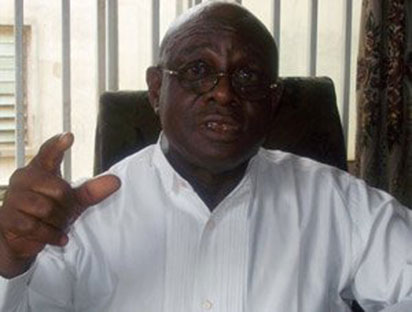
Brig. General Don Idada Ikponmwen is a former Provost Marshal of the Nigerian Army and also its former Director, Legal Services. Idada, who was involved in several legal battles in the Army, including the prosecution of three admirals over the missing African Pride oil tanker in 2003, expresses shock over the Federal High Court’s recent declaration which stripped the President of the sole power to appoint Service Chiefs.
 He notes, in this interview, that the declaration would not stand the test of time, just as he believes the step would politicise the armed forces and threaten the security of the nation. The erstwhile Army chief also speaks on the sack of Service Chiefs by President Muhammadu Buhari and the dismantling of military road blocks across the country.
Excerpts:
You condemned the comment by President Muhammadu Buhari that the names of the new Service Chiefs will be sent to the Senate for confirmation, but there is a court ruling on the issue which seems to strip the President of the sole power to appoint Service Chiefs?
I am displeased with such a declaration because it tends to turn the Constitution upside down. It is even more shocking that the court agreed with the argument that the Armed Forces Act, which was enacted during the military administration of General Abdulsalami Abubakar and was a replica of the 1993 Armed Forces Decree, was declared to be a law not in the category of the existing laws in Nigeria. The decision cannot stand the test of time. I don’t think we have seen the end of the matter. My worry is that many people, especially those who would not take the pain to read the Constitution in all its ramifications, may just get the impression that it is the position of our Constitution. I feel very disappointed about that judgement, and I think this is one of the reasons some people believe
there is lack k of thoroughness, lack of expertise amongst some of our judges.

What really makes you feel the court was wrong in its judgement?
The provisions of our Constitution with regard to the powers of the President in terms of appointments to high public offices including that of the Service Chiefs are very clear. Wherever the Constitution intends to have conditions placed on the President like the need to consult, have a nomination from certain bodies or the need for confirmation by the Senate, it is very clear on those points. Even a casual look at the provisions of Section 147 dealing with the appointment of Ministers, the provision of Sections 230 and 238 will show that the Constitution is not silent on the conditions necessary to appoint top officials to federal executive positions. Section 147 in particular, which deals with the appointment of Ministers, makes it clear that confirmation by the Senate is a pre-requisite.
Nobody becomes a Minister unless the Senate has approved the nomination. The same way with the appointment of the Chief Justice of the Federation. Section 230, Sub Section 1 requires not only that there will be a nomination from the Judicial Service Commission, but also that the nomination made by the President must be sent to the Senate for approval and confirmation. Same applies to the appointment of the President of the Court of Appeal.
On the nature of our Presidency, Section 130(1) says “There shall be for the Federation a President” and proceeds to add in 130(2): “The President shall be the Head of State, The Chief Executive of the Federation and Commander-in-Chief of the Armed Forces of the Federation.” On the strength of these provisions, it is clear that the President is not a mere figure-head or ceremonial President. Added to this is the fact that he is elected from all the constituencies of the Federation and is thereby vested with grassroots support, which is greater than the mandate of all legislators put together. Sections 133 and 134 of the Constitution explain the power exercisable by the President and Commander-In-Chief. Section 218(1) says: “The Power of the President as the Commander-in-Chief of the Armed Forces of the Federation shall include power to determine the operational use of the Armed Forces of the Federation” The provision that is directly relevant to the appointment of the Service Chiefs is Section 218(2) which says: “The power conferred on the President by Subsection (1) of this Section shall include power to appoint the Chief of Defence Staff, the Chief of Army Staff, the Chief of Naval Staff, the Chief of Air Staff and Heads of any other branches of the Armed Forces of the Federation as may be established by an Act of the National Assembly.” From the foregoing, it is clear that the power vested in the President to appoint Service Chiefs is in no way fettered. If the Constitution had intended to place any restriction or condition, it would have said so unequivocally as it has done with regard to other positions created by the Constitution; for example Sections 230(1) relating to the Chief Justice and Justices of the Supreme Court of the Federation and the President of the Court of Appeal. In all these Sections, the Constitution, in no uncertain terms, spells out when either consultation with the Council of State or nomination from some other bodies or confirmation by the Senate is required. Section 218(2) is therefore unambiguous and does not lend itself open to any unwarranted debate or academic exercise.
Section 154(1) provides, in general terms, that the appointment to the above listed positions shall need the confirmation of the Senate in deserving and specific positions; whereas Section 154(2) proceeds to specify where confirmation shall not be required. Such positions not needing the confirmation of the Senate include: the Council of State, National Defense Council or the National Security Council. Section 154(3) states clearly that in the appointment of persons to the position of Chairman/Members of the Independent National Electoral Commission, the National Judicial Council, the Federal Judicial Service Commission and the National Population Commission, the President shall be required to consult the Council of State and no more. From these provisions and others earlier cited, it becomes obvious, on invocation of the doctrine of expressio unius exclusio alterius, that it is improper to drag in the requirement of confirmation from the Senate or even
consultation with any other body for the appointment of Service Chiefs in the Federation of Nigeria. Having come this far, it becomes necessary to take a look at the existing laws to see whether, indeed, the relevant portions of the Armed Forces Act, AFA, are in consonance with the Constitution.
What about the issue of existing laws?
In its ordinary meaning, the concept of existing law carries the meaning of any law, any enactment or instrument whatsoever which was in force before the promulgation of the Constitution. The Armed Forces Act, which was enacted as Armed Forces Decree (1993) during the military era, existed before the promulgation of the 1999 Constitution. The fact that CAP A20, Laws of the Federation of Nigeria (2004) altered the name of that law, with little or no modification, does not take that law outside the scope of existing laws under the 1999 Constitution. It is noteworthy that unlike the NYSC Decree 1993, the Public Complaints Commission Act, the National Security Agency Act and the Land Use Act, the Armed forces Decree/Act was not listed as one of the laws to be carried over in 1999 so as to enjoy the status of Constitutional provisions. On the strength of both Section 315(2) and 1(3) of the Constitution, which is the supremacy clause, the aforementioned
provisions of the Armed Forces Act, in so far as they are not consistent with the provision of Section 218(2), must be null and void to the extent of the inconsistency. Section 1(3) provides: “If any other law is inconsistent with the provisions of the Constitution, the Constitution shall prevail and that other law, shall, to the extent of the inconsistency, be void”. Whereas Section 218(2) empowers the President to appoint his Service Chiefs at his discretion, the Armed Forces Act, which, on the contrary, places restrictions on the exercise of the same power vide Section 18(1) and (2) of the AFA, makes the latter clearly inconsistent with the Constitution.
I am not aware of the provision of Section 218(4) (a) and (b) which provides that the National Assembly shall make laws for the regulation of the powers exercisable by the President as the Commander-in-Chief of the Armed Forces and for the appointment and disciplinary control of members of the Armed Forces of the Federation. It is seriously contended that the provisions in Section 218(4) (a) and (b) are general provisions aimed at ensuring that laws are made to guide against arbitrariness and abuse of power. While pointing out that even the National Assembly has never made any such regulatory laws, it must be emphasised that the general provisions in Section 218(4) cannot override the specific power granted the President in the same Section to appoint Service Chiefs without any restraint. We practised the presidential system from 1979, then there was a military administration again. If you add Shagari’s regime to the regimes we have had after Abdulsalami
handed over to civilians, you have a total of 18 years that we have practised the presidential system wherein the National Assembly is expected to pass laws to regulate the powers of the President in his exercise of powers as Commander of the Armed Forces. But there has never been such a law. So the discretion of the President is the law as far as appointment is concerned. However, because the President is a politician, his powers need to be regulated in terms of the use of the Armed Forces. That is the area that should be of concern to the National Assembly. But the National Assembly has not even passed a single law in all these years. From the foregoing analysis, the provisions of Sections 218(4) (a), (b) and 219 cannot constitute any justification to deny the President the discretion availed him by the same Constitution with regard to the appointment of Service Chiefs.
Politicizing the appointments of Service Chiefs
The declaration to the effect that the President cannot appoint his Service Chiefs without the confirmation of the Senate is manifestly wrong and dangerous for our nation as it will, inevitably, lead to negation of discipline, coherence in command and control of the armed forces which are predicated upon the existence of a unified command. The issue of command of the armed forces is a very serious, professional military issue which has very serious implications for the efficiency, efficacy and virility of the armed forces. Let me emphasize that the efficiency of the Armed Forces thrives on what we call unity of command. Discipline, promotion, deployment, everything that has to do with the armed forces must come under a unified Command where there can be no ambiguities, no conflicts as to responsibility, and this must be so because of strategic reasons. The moment you divide command in the armed forces, you divide loyalty and loyalty is supposed to be 100
per cent to the command of the armed forces. The command of the armed forces revolves around the Commander in Chief and officers commissioned into the armed forces that hold positions from time to time.
The moment you break or negate this unity of command, you don’t have an army. You will have a bunch of people who, for selfish reasons, are running from pillar to post, from senator to senator, trying to butter their own bread. Therefore, you cannot afford to make appointments in the armed forces an all- comers affair, and when I say all comers, it includes the National Assembly. The duty of the National Assembly is to make laws, conduct oversight functions and regulate. An attempt has also been made to highlight that a substantial part of the reason for the collapse of the First Republic was the absence of a powerful and clearly discernable leader, and that this phenomenon accounted for the choice of the presidential system. In the same breath, the point has been emphasised that the Command and control of the Armed Forces must not be allowed to be compromised on the altar of politics. This compromise would inevitably arise when the
Command of the Armed Forces, particularly in terms of appointment, becomes an issue for the National Assembly.
But don’t you think this will make the President dictatorial?
Let me tell you that where we are today, by virtue of the type of Constitution or the system we are running, is not by accident. This country was used to a parliamentary system of government for many years – both before and after independence, particularly after independence. We were running a Westminster type of government for five years before the military struck and pulled down the First Republic. What was the reason? I want to emphasize that one of the reasons why the parliamentary system was dumped in this country is because it was too amorphous, cumbersome, it lacked an identifiable leader who commanded the followership and support of the generality of Nigerians. It lacked grassroots support. It was bedeviled by the concept of collective responsibility. That is why Nigeria opted in 1979 for a President that will be powerful, who can make quick decisions, consult when it is necessary. So the President is deliberately a powerful
man by our structure. But that is not the end of the story. That is why you find Section 218, Sub section 4 talking about powers to regulate the powers of the President. The National Assembly is supposed to use its laws to regulate such powers, but like I said before, no such regulations have been made. In other words, the President, by default of the National Assembly, remains a man whose executive powers are not restricted to just the appointment of Service Chiefs, but the entire armed forces are at his discretion.
Do you think the recent change of the Service Chiefs will bring to the end of the Boko Haram insurgency?
Certainly, everybody in Nigeria knowns now that from what we saw in the greater part of the last administration that the military establishment has been very seriously compromised. It was obvious that, like most other public appointment holders, their loyalty was to the former President and his aides and it was also very clear that they were doing everything to sustain the former administration and to prevent change. The certificate issue was just only one of the measures that showed that bias and compromise became the name of the game. Besides this business of bias, incompetence and inherent corruption manifested in the way the fight against Boko Haram was carried out, most inefficiently, most unsuccessfully. The failure was so obvious that people were asking, is it that the military was not properly equipped or motivated? Some traced it to lack of equipment, soldiers were running away to face the enemies that were reasonably well equipped. Hundreds of soldiers were being court-martialed for unwillingness to fight because the officers believed they were on suicide mission. The Jonathan administration sent our soldiers on suicide mission because there were no equipment despite so much money being expended. It was also clear that the Minister of Defense had become nothing but a figure head with no powers, whereas it was the Service Chiefs and the NSA office that were spending the money contrary to existing rules and procedures. I don’t think the military had ever experienced this terrible situation in our history. And all of these were due to undue politicization of the military and corruption at the top level.
So obviously the change that was made a few days ago was the most desirable change, it is over due given the mood of the nation. I knew it will come and even the Service Chiefs knew they had to go, it was not a surprise to anybody. I honestly believe that changing the Service Chiefs is just the beginning of the re-organization and repositioning and re-orientation of our military. It is necessary at this stage to start making the military professional again and to redefine the concept of loyalty properly. That loyalty must be to the Constitution not necessarily to the individual ruler. When the leader is good, like I believe President Buhari is, there will be no problem or dichotomy, it will mean that loyalty to the President is the same thing as loyalty to the nation. Those who have been appointed are very well groomed, well trained officers. I believe they will be able to fashion out their policies and their modus operandi in line with the deals the President represents.
Fighting Boko Haram with new strategy
The way Boko Haram is going now, the group has resorted to guerilla tactics. It is obvious they are no more in the position to hold territories, they now run here and there, it is obvious that they are fast losing. Unless this trend is properly checked with the right methods, it could stay on for a long time, resulting in more damage of lives and property in this country. This time around, our strategies must change to emphasis on cooperation and support of the local populace and also give bite to intelligence gathering and speedy dissemination of information and intelligence. With tat, insurgents can be dealt with in their hide outs, in the areas where they assemble and manufacture their bombs; it will also be easy to identify who are their supporters and sponsors. We must also ensure that the welfare of the security operatives is enhanced, they must be motivated even as we are negating the propaganda of the
insurgents. Because the insurgents propaganda is saying that this government is bad, government must also make sure that they re-orientate our people to know that what these people are saying is not true. So the National Orientation Agency, the Ministry of Information must make sure that we turn our people against these terrorists. Public opinion must change in favour of our military and government and against the insurgents. And of course the military must be properly funded to meet their task.
Abolition of military check points
I have always said that the Constitutional role of the armed forces is not routine policing. We don’t want to turn our soldiers into traffic police and warders, there must be strategic and tactical value as regards to their deployment. Therefore if we must see road blocks mounted by the military, it must be areas where we have insurgency or serious insecurity.
Brig. General Don Idada Ikponmwen is a former Provost Marshal of the Nigerian Army and also its former Director, Legal Services. Idada, who was involved in several legal battles in the Army, including the prosecution of three admirals over the missing African Pride oil tanker in 2003, expresses shock over the Federal High Court’s recent declaration which stripped the President of the sole power to appoint Service Chiefs.
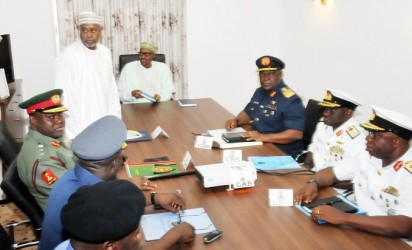
FILE: PRESIDENT MUHAMMADU BUHARI WITH SERVICE CHIEFS DURING A MEETING AT THE DEFENCE GUEST HOUSE IN ABUJA ON TUESDAY
Excerpts:
You condemned the comment by President Muhammadu Buhari that the names of the new Service Chiefs will be sent to the Senate for confirmation, but there is a court ruling on the issue which seems to strip the President of the sole power to appoint Service Chiefs?
I am displeased with such a declaration because it tends to turn the Constitution upside down. It is even more shocking that the court agreed with the argument that the Armed Forces Act, which was enacted during the military administration of General Abdulsalami Abubakar and was a replica of the 1993 Armed Forces Decree, was declared to be a law not in the category of the existing laws in Nigeria. The decision cannot stand the test of time. I don’t think we have seen the end of the matter. My worry is that many people, especially those who would not take the pain to read the Constitution in all its ramifications, may just get the impression that it is the position of our Constitution. I feel very disappointed about that judgement, and I think this is one of the reasons some people believe
there is lack k of thoroughness, lack of expertise amongst some of our judges.
What really makes you feel the court was wrong in its judgement?
The provisions of our Constitution with regard to the powers of the President in terms of appointments to high public offices including that of the Service Chiefs are very clear. Wherever the Constitution intends to have conditions placed on the President like the need to consult, have a nomination from certain bodies or the need for confirmation by the Senate, it is very clear on those points. Even a casual look at the provisions of Section 147 dealing with the appointment of Ministers, the provision of Sections 230 and 238 will show that the Constitution is not silent on the conditions necessary to appoint top officials to federal executive positions. Section 147 in particular, which deals with the appointment of Ministers, makes it clear that confirmation by the Senate is a pre-requisite.
Nobody becomes a Minister unless the Senate has approved the nomination. The same way with the appointment of the Chief Justice of the Federation. Section 230, Sub Section 1 requires not only that there will be a nomination from the Judicial Service Commission, but also that the nomination made by the President must be sent to the Senate for approval and confirmation. Same applies to the appointment of the President of the Court of Appeal.
On the nature of our Presidency, Section 130(1) says “There shall be for the Federation a President” and proceeds to add in 130(2): “The President shall be the Head of State, The Chief Executive of the Federation and Commander-in-Chief of the Armed Forces of the Federation.” On the strength of these provisions, it is clear that the President is not a mere figure-head or ceremonial President. Added to this is the fact that he is elected from all the constituencies of the Federation and is thereby vested with grassroots support, which is greater than the mandate of all legislators put together. Sections 133 and 134 of the Constitution explain the power exercisable by the President and Commander-In-Chief. Section 218(1) says: “The Power of the President as the Commander-in-Chief of the Armed Forces of the Federation shall include power to determine the operational use of the Armed Forces of the Federation” The provision that is directly relevant to the appointment of the Service Chiefs is Section 218(2) which says: “The power conferred on the President by Subsection (1) of this Section shall include power to appoint the Chief of Defence Staff, the Chief of Army Staff, the Chief of Naval Staff, the Chief of Air Staff and Heads of any other branches of the Armed Forces of the Federation as may be established by an Act of the National Assembly.” From the foregoing, it is clear that the power vested in the President to appoint Service Chiefs is in no way fettered. If the Constitution had intended to place any restriction or condition, it would have said so unequivocally as it has done with regard to other positions created by the Constitution; for example Sections 230(1) relating to the Chief Justice and Justices of the Supreme Court of the Federation and the President of the Court of Appeal. In all these Sections, the Constitution, in no uncertain terms, spells out when either consultation with the Council of State or nomination from some other bodies or confirmation by the Senate is required. Section 218(2) is therefore unambiguous and does not lend itself open to any unwarranted debate or academic exercise.
Section 154(1) provides, in general terms, that the appointment to the above listed positions shall need the confirmation of the Senate in deserving and specific positions; whereas Section 154(2) proceeds to specify where confirmation shall not be required. Such positions not needing the confirmation of the Senate include: the Council of State, National Defense Council or the National Security Council. Section 154(3) states clearly that in the appointment of persons to the position of Chairman/Members of the Independent National Electoral Commission, the National Judicial Council, the Federal Judicial Service Commission and the National Population Commission, the President shall be required to consult the Council of State and no more. From these provisions and others earlier cited, it becomes obvious, on invocation of the doctrine of expressio unius exclusio alterius, that it is improper to drag in the requirement of confirmation from the Senate or even
consultation with any other body for the appointment of Service Chiefs in the Federation of Nigeria. Having come this far, it becomes necessary to take a look at the existing laws to see whether, indeed, the relevant portions of the Armed Forces Act, AFA, are in consonance with the Constitution.
What about the issue of existing laws?
In its ordinary meaning, the concept of existing law carries the meaning of any law, any enactment or instrument whatsoever which was in force before the promulgation of the Constitution. The Armed Forces Act, which was enacted as Armed Forces Decree (1993) during the military era, existed before the promulgation of the 1999 Constitution. The fact that CAP A20, Laws of the Federation of Nigeria (2004) altered the name of that law, with little or no modification, does not take that law outside the scope of existing laws under the 1999 Constitution. It is noteworthy that unlike the NYSC Decree 1993, the Public Complaints Commission Act, the National Security Agency Act and the Land Use Act, the Armed forces Decree/Act was not listed as one of the laws to be carried over in 1999 so as to enjoy the status of Constitutional provisions. On the strength of both Section 315(2) and 1(3) of the Constitution, which is the supremacy clause, the aforementioned
provisions of the Armed Forces Act, in so far as they are not consistent with the provision of Section 218(2), must be null and void to the extent of the inconsistency. Section 1(3) provides: “If any other law is inconsistent with the provisions of the Constitution, the Constitution shall prevail and that other law, shall, to the extent of the inconsistency, be void”. Whereas Section 218(2) empowers the President to appoint his Service Chiefs at his discretion, the Armed Forces Act, which, on the contrary, places restrictions on the exercise of the same power vide Section 18(1) and (2) of the AFA, makes the latter clearly inconsistent with the Constitution.
I am not aware of the provision of Section 218(4) (a) and (b) which provides that the National Assembly shall make laws for the regulation of the powers exercisable by the President as the Commander-in-Chief of the Armed Forces and for the appointment and disciplinary control of members of the Armed Forces of the Federation. It is seriously contended that the provisions in Section 218(4) (a) and (b) are general provisions aimed at ensuring that laws are made to guide against arbitrariness and abuse of power. While pointing out that even the National Assembly has never made any such regulatory laws, it must be emphasised that the general provisions in Section 218(4) cannot override the specific power granted the President in the same Section to appoint Service Chiefs without any restraint. We practised the presidential system from 1979, then there was a military administration again. If you add Shagari’s regime to the regimes we have had after Abdulsalami
handed over to civilians, you have a total of 18 years that we have practised the presidential system wherein the National Assembly is expected to pass laws to regulate the powers of the President in his exercise of powers as Commander of the Armed Forces. But there has never been such a law. So the discretion of the President is the law as far as appointment is concerned. However, because the President is a politician, his powers need to be regulated in terms of the use of the Armed Forces. That is the area that should be of concern to the National Assembly. But the National Assembly has not even passed a single law in all these years. From the foregoing analysis, the provisions of Sections 218(4) (a), (b) and 219 cannot constitute any justification to deny the President the discretion availed him by the same Constitution with regard to the appointment of Service Chiefs.
Politicizing the appointments of Service Chiefs
The declaration to the effect that the President cannot appoint his Service Chiefs without the confirmation of the Senate is manifestly wrong and dangerous for our nation as it will, inevitably, lead to negation of discipline, coherence in command and control of the armed forces which are predicated upon the existence of a unified command. The issue of command of the armed forces is a very serious, professional military issue which has very serious implications for the efficiency, efficacy and virility of the armed forces. Let me emphasize that the efficiency of the Armed Forces thrives on what we call unity of command. Discipline, promotion, deployment, everything that has to do with the armed forces must come under a unified Command where there can be no ambiguities, no conflicts as to responsibility, and this must be so because of strategic reasons. The moment you divide command in the armed forces, you divide loyalty and loyalty is supposed to be 100
per cent to the command of the armed forces. The command of the armed forces revolves around the Commander in Chief and officers commissioned into the armed forces that hold positions from time to time.
The moment you break or negate this unity of command, you don’t have an army. You will have a bunch of people who, for selfish reasons, are running from pillar to post, from senator to senator, trying to butter their own bread. Therefore, you cannot afford to make appointments in the armed forces an all- comers affair, and when I say all comers, it includes the National Assembly. The duty of the National Assembly is to make laws, conduct oversight functions and regulate. An attempt has also been made to highlight that a substantial part of the reason for the collapse of the First Republic was the absence of a powerful and clearly discernable leader, and that this phenomenon accounted for the choice of the presidential system. In the same breath, the point has been emphasised that the Command and control of the Armed Forces must not be allowed to be compromised on the altar of politics. This compromise would inevitably arise when the
Command of the Armed Forces, particularly in terms of appointment, becomes an issue for the National Assembly.
But don’t you think this will make the President dictatorial?
Let me tell you that where we are today, by virtue of the type of Constitution or the system we are running, is not by accident. This country was used to a parliamentary system of government for many years – both before and after independence, particularly after independence. We were running a Westminster type of government for five years before the military struck and pulled down the First Republic. What was the reason? I want to emphasize that one of the reasons why the parliamentary system was dumped in this country is because it was too amorphous, cumbersome, it lacked an identifiable leader who commanded the followership and support of the generality of Nigerians. It lacked grassroots support. It was bedeviled by the concept of collective responsibility. That is why Nigeria opted in 1979 for a President that will be powerful, who can make quick decisions, consult when it is necessary. So the President is deliberately a powerful
man by our structure. But that is not the end of the story. That is why you find Section 218, Sub section 4 talking about powers to regulate the powers of the President. The National Assembly is supposed to use its laws to regulate such powers, but like I said before, no such regulations have been made. In other words, the President, by default of the National Assembly, remains a man whose executive powers are not restricted to just the appointment of Service Chiefs, but the entire armed forces are at his discretion.
Do you think the recent change of the Service Chiefs will bring to the end of the Boko Haram insurgency?
Certainly, everybody in Nigeria knowns now that from what we saw in the greater part of the last administration that the military establishment has been very seriously compromised. It was obvious that, like most other public appointment holders, their loyalty was to the former President and his aides and it was also very clear that they were doing everything to sustain the former administration and to prevent change. The certificate issue was just only one of the measures that showed that bias and compromise became the name of the game. Besides this business of bias, incompetence and inherent corruption manifested in the way the fight against Boko Haram was carried out, most inefficiently, most unsuccessfully. The failure was so obvious that people were asking, is it that the military was not properly equipped or motivated? Some traced it to lack of equipment, soldiers were running away to face the enemies that were reasonably well equipped. Hundreds of soldiers were being court-martialed for unwillingness to fight because the officers believed they were on suicide mission. The Jonathan administration sent our soldiers on suicide mission because there were no equipment despite so much money being expended. It was also clear that the Minister of Defense had become nothing but a figure head with no powers, whereas it was the Service Chiefs and the NSA office that were spending the money contrary to existing rules and procedures. I don’t think the military had ever experienced this terrible situation in our history. And all of these were due to undue politicization of the military and corruption at the top level.
So obviously the change that was made a few days ago was the most desirable change, it is over due given the mood of the nation. I knew it will come and even the Service Chiefs knew they had to go, it was not a surprise to anybody. I honestly believe that changing the Service Chiefs is just the beginning of the re-organization and repositioning and re-orientation of our military. It is necessary at this stage to start making the military professional again and to redefine the concept of loyalty properly. That loyalty must be to the Constitution not necessarily to the individual ruler. When the leader is good, like I believe President Buhari is, there will be no problem or dichotomy, it will mean that loyalty to the President is the same thing as loyalty to the nation. Those who have been appointed are very well groomed, well trained officers. I believe they will be able to fashion out their policies and their modus operandi in line with the deals the President represents.
Fighting Boko Haram with new strategy
The way Boko Haram is going now, the group has resorted to guerilla tactics. It is obvious they are no more in the position to hold territories, they now run here and there, it is obvious that they are fast losing. Unless this trend is properly checked with the right methods, it could stay on for a long time, resulting in more damage of lives and property in this country. This time around, our strategies must change to emphasis on cooperation and support of the local populace and also give bite to intelligence gathering and speedy dissemination of information and intelligence. With tat, insurgents can be dealt with in their hide outs, in the areas where they assemble and manufacture their bombs; it will also be easy to identify who are their supporters and sponsors. We must also ensure that the welfare of the security operatives is enhanced, they must be motivated even as we are negating the propaganda of the
insurgents. Because the insurgents propaganda is saying that this government is bad, government must also make sure that they re-orientate our people to know that what these people are saying is not true. So the National Orientation Agency, the Ministry of Information must make sure that we turn our people against these terrorists. Public opinion must change in favour of our military and government and against the insurgents. And of course the military must be properly funded to meet their task.
Abolition of military check points
I have always said that the Constitutional role of the armed forces is not routine policing. We don’t want to turn our soldiers into traffic police and warders, there must be strategic and tactical value as regards to their deployment. Therefore if we must see road blocks mounted by the military, it must be areas where we have insurgency or serious insecurity.
Sunday, 19 July 2015
Buhari will probe Jonathan’s govt – Presidency
By Levinus Nwabughiogu
There are many questions Nigerians are craving answers to concerning the Buhari administration. For instance, why hasn’t the government appointed Ministers six weeks after it was inaugurated? Why would President Muhammadu Buhari, as the leader of All Progressives Congress, APC, not intervene in the free- for- all at the National Assembly? Is he disappointing the South-West zone which massively voted for him at the polls?
 Is the President anti-Igbo by leaving them out in the appointment of Service Chiefs? Will he probe past government officials? Is he corrupt himself? Why is he going to the United States of America, USA, when there is terrorism war raging in his backyard? From his office at the State House in the Presidential Villa, to a hotel room in Wuse 2, Abuja, I was able to finally, after two weeks, get hold of the workaholic Mr. Femi Adesina, Special Adviser to President Mohammadu Buhari on Media and Publicity and a staunch believer in the President’s cause, to provide answers to these questions during an interview on Thursday night. Excerpts:
It has been more than 30 days since the new administration was inaugurated. How do you assess it?
Well, I think that is a little bit unfair because you know how I will assess the administration since I work with the President. But then to be fair and impartial, I will say, yes, the President is on the right course, maybe because there are also some facts that are previously unknown, but I just know that the President is laying a foundation for a new Nigeria. If he can continue on the wind of change that he rode on to office and continue building on the same foundation, definitely change will come. But he is laying a completely new foundation and, when that foundation is fully laid and the country continues, you will see that change is truly here.
When you were announced to be the Special Adviser, how did you feel? Did you see it coming or you never expected it?
I was announced May 31, but if you remember, on May 20, ThisDay had speculated the story. The moment ThisDay speculated it, anything could happen. So, it was just a question of, will it happen or not? Since ThisDay speculated it, we knew anything could happen, but, before then, no. It could have gone either way anyway.
How does it feel settling down to work with President Muhammadu Buhari in this capacity?
It is a rare opportunity. Out of 170 million people you have been called to work for your country, it is a rare opportunity, and I will say it feels good. I have left positions that are eminent. I have been the Editor-in-Chief of a national newspaper, President, Nigerian Guild of Editors. I was satisfied in those positions, but then, coming to serve your country can’t be compared with anything. So that is why I left those positions to come and serve because I believe in the President. If it was another administration led by someone that I don’t believe in, I wouldn’t come, but I came because I had always believed in President Buhari.
Were you prepared for this assignment irrespective of the fact that you have occupied other positions?
If you had spent 29 years in journalism like I have done, then you are prepared for a lot of things including this assignment. If that is the question, yes, I have a background that prepared me for this assignment. But if your question means did I think it was going to come, I will say no, I didn’t think it was going to come. My mind didn’t go to it and I have always supported President Buhari since he was a military Head of State. I had admired him. In fact, the day he was overthrown was one of the worst days of my life. I felt very sad for Nigeria; very sad for him and his family, very sad about everything. I didn’t think that government should have been toppled. If that government had lasted, Nigeria wouldn’t have been where it is today. So, when he attempted to come through the ballot box since 2003, I had always supported him and, even when it seemed like he stood no chance, I still believed he was the best candidate. In 2011, I had always said we needed a correlation in order to get PDP out. So when that correlation came through the emergence of All Progressives Congress, APC, I felt there was a good chance in 2015 and it has happened. But to think that I was going to work for him, no, it didn’t cross my mind.
What are the attributes that really drew you to the President?
The first one is his simplicity. I just love his simplicity. He is a very simple man. Then I like the fact that he is very straight forward. I like people who know where they stand with anybody. It is either yes or no. When he says yes, it is yes; when he says no, it is no. Then, of course, integrity, to me, counts a lot. The fact that every man can testify that he is a man of integrity gets me because I love integrity and then transparency and accountability. A country like Nigeria where anything goes and then you see a man that has chosen to be transparent and accountable. Look at all the positions he has held in this country, yet he remains a simple man. I love that kind of person. Why can’t I support him? Why can’t I point Nigeria to that kind of person? He is good for our county? So that is why I did it.
But many Nigerians don’t really share these ideas. Some will be quick to dismiss all these, saying that beyond the facade, you may discover many others things when you dig deep.
Well, if they say that, they have a right to their own opinion but then we want to see the evidence to justify that. You don’t need to look far. Just look at the positions the President has held: governor of North-Eastern State, which is now six states: Borno, Yobe, Bauchi, Gombe, Adamawa and Taraba. Then he went on to become the Minister of Petroleum Resources and held that position for three and a half years. Can you hold such position and not have oil blocks? If anybody thinks President Buhari has an oil block, let him show it to us? After that, he became Head of State and he was there for 20 months; after that, he was Chairman, Petroleum Trust Fund, PTF, and we know all the achievements he made in that position and then today President. Not many Nigerians have this kind of pedigree and who are not going to be stinkingly rich. I am not saying President Buhari is a poor man, but then I don’t think he is stinkingly rich when he held all those positions. He should be stinkingly rich and it is only a very rare Nigerian that will not be stinkingly rich after holding those positions.
You said when he was toppled you were truly sad. Now he has another opportunity! What do you crave for? Or do you say he has changed from who he used to be and perhaps may not realize those things that he would have truly accomplished if his government then had continued?
Whether he has changed, yes, I would say he has changed in some areas and, in some areas, he remains the same. You know that age tempers a man. Age has tempered him but for good. Remember, after he was inaugurated, some officials of the former administration were about travelling out and the security officials and agencies were stopping them and, you will recall that a statement was issued that they shouldn’t be stopped. That shows you that the man is really temperate now rather the old Buhari. The military man would have packed all of them immediately he was inaugurated and they would be heading for jail and then you would be sifting the weeds from the shaft there after. So, that already shows that he is a different man, a more mature person, a more reflective person, a more contemplative person and that can only come with age. Again, you would see what played out in the National Assembly. You know he is a man who wants to respect the Constitution. That shows he is already different from the soldier that ruled this country. If he was a person that didn’t want to respect the Constitution, he would have interfered in the selection or the election of the leadership of the two chambers, but he left them and said anybody that emerged, he will work with. What he didn’t know is that not everybody was going to respect the rules and we saw what played out. In terms of whether he is a changed man, yes, he is a changed man. He is a true democrat now. There are so many things that have come up in just six weeks of the administration that show you that this is a man that respects the Constitution and will continue to respect it. So, he is a changed man in those areas, but then there are some areas like accountability, transparency, integrity; of course you know that he will never change in those areas and that is the reason he was elected. Imagine a man who was a military leader 30 years earlier getting elected just on the basis of integrity, transparency and accountability; you know that kind of man will never change that.
Some persons argue that if this man doesn’t exercise his authority, things might still go wrong because a leader is a leader. Being the President of Nigeria, he is the leader of the party in all ramifications. There is a proverb in my place that an elder doesn’t sit idly while the goat dies in tethers. He can’t be sitting while things are going wrong.
If you also permit me to quote another proverb or a saying that a tiger doesn’t proclaim its tigress. A tiger doesn’t need to come out and say ‘I am a tiger’. When he does that, go and check properly, he can be a cat, but when you see a tiger, you know it is a tiger. So, he doesn’t need to ride over everybody before they know that he is a leader and indeed he is a leader. He has the traits, the characteristics and all the potentials. He has everything it takes to be a leader. He doesn’t need to throw his weight around before everyone knows he is a leader.
Let me take you back a little to the issue of allowing the last government officials to travel. Does that mean that he has hands on probity, assuming there was something to probe?
He has said it that money in billions of dollars will be recovered. But you know the world is too small a place for anybody to hide if you are running from justice. The world is too small a place to hide. You will be fished out. So, there is no need that you say they should not be heading for jail if eventually the law goes after them. Very few countries can they hide in and how long will they hide? So, it doesn’t mean that anybody that has ill gotten wealth will not regurgitate it. They will. Remember when he went to Germany for the G7 summit, he met with President Obama and Obama told him to just give us information on where the loot is hidden and we will help you recover it and the government has been working on that. So, that shows that looters will never go free.
Is he going backwards? I mean where is he going to start to probe?
He can’t afford to go too deep into the past or else it will be destructive for his administration. There are some things you can’t close your eyes to while you don’t want to shine the torchlight into the dark recesses of our past; immediate past where things are evident. The Yoruba have a saying that the corpse we buried, the leg is sticking out and, if you bury a corpse and the leg is sticking out, you can’t pretend. When there are trails all over of the monies in billions and trillions, then a responsible government can’t close its eyes to that.
Let’s look at insecurity. In the last two weeks, the bombings have increased. People have expressed fear that the government’s efforts in the past one month and two weeks haven’t really paid off because I know that the President, immediately he was sworn-in, travelled to places and there was this assurance. But then it does appear much hasn’t been done in that direction?
Let me draw an analogy. One day, the world woke up to hear that Osama bin Laden had been killed by the US Navy Seals. But did you know how long it took to plan that operation? It took 24 months of painstaking planning. Drills, simulations, all that happened until they got him. I am not saying it is going to take 24 months before this government breaks the back of Boko Haram. I am just telling you that planning needs to be carefully done and that is what is being done. In his very first week in office, he went to Niger, Chad and why did he go? Because of this Boko Haram thing and one major reason he went to G7 is because of the Boko Haram issue because the leaders of G7 said ‘come and let us know what we can do to help’. After that, the leaders of Chad, Niger, Benin Republic, Defence Minister of Cameroon also came here under the Lake Chad Basin Commission. They are planning. Before the end of this month, after he comes back from America, he is going to Cameroon and why is he going there? Still on Boko Haram and you know there is a multinational task force they are contributing to and Nigeria has released 21 million dollars for the joint task force. That is money Nigeria can use in other areas but it has invested 21 million dollars in that joint task force. That shows seriousness and I think July 21 has been picked as a date for that force to swing into action. Nobody can fairly accuse this government of not doing anything about Boko Haram. It is doing a lot and, eventually, we will see the end of insurgency.
Let’s also look at the appointments so far made by the Buhari government. The government has been accused of lopsiding the appointments. It has been people from the North. That’s the impression out there.
Those people from the North, are they Nigerians? So, if they are Nigerians, they have the right to be appointed and then I am sure there could be up to 500 appointments still ahead. Federal Boards that just got dissolved alone had 601 appointments. They are going to be filled. The cabinet is going to be constituted. Other persons and aides are going to be appointed. As at the time they began to talk, only nine appointments had been made and they said eight northerners and one southerner. They forget that some of those appointments are statutory, the next in rank. They just have to be the ones that will take those positions and some of those again are security chiefs. Security is an area where you take the very best. It is not something you subject to emotional considerations or other primordial sentiments. Take the very best who can deliver particularly at a critical time like this. So those who have started counting, I think it is premature. There about 500 appointments left to be made and, when those appointments are made, that is when they can begin to analysis. Doing it after nine appointments, I think that is hasty and fault-line in our country. Nigerians are too suspicious of leadership, other ethnic groups, too suspicious of many things. If we are less suspicious, then this wouldn’t have come up yet.
There are still these feelings from the members of the public that President Buhari and his political allies in the South-West, people like Asiwaju Bola Tinubu, have fallen apart; that, in fact, the President has disappointed the South-West that massively voted for him at the polls. How do you address this sentiment?
I am glad that you used the word “these feelings” which is different from reality. Just a couple of days ago, Bola Tinubu himself came out to say there was no rift between him and the President. I think things that are unfolding are part of our political experience, political development. You will see that in the next dispensation, most of the things that happened now will not happen because the actors would have learnt. If the President in the next dispensation wants to leave the leadership of the chambers of National Assembly to elect their own leaders as President Buhari has done, the party will need to play its own part. Everybody involved will play his or her own part so that what has happened now will not happen again. It is part of the learning curve, but for anybody to say the West is disappointed, it is not true. A lot of people who voted for President Buhari in the West have been loyal to him. Even those who didn’t vote for him are beginning to see that he is a leader worthy of their support and they are giving their support.
Do you really believe in the Presidency of Mr. Buhari to radically move this country away from what it used to be, judging from the fact that he is an old man now? Won’t his age really affect him?
You have heard the saying that old wines are tastier. Buhari is like a wine that gets better with age. I said this earlier and, I repeat again, he gets better with age; sound, sober, contemplative, not rash. You see what is happening now, Boards have been dissolved. There are terminations and new appointments. You know he could have done that in the very first week and then he could have made mistakes, but this is the sixth week and he is doing all those things and I think, at the end of it, all Nigerians will be glad that they elected him. I don’t foresee failure; no, it will not happen, but it will demand that Nigerians will give him support and work with him but I believe in the change that was promised to this country.
Just before current appointments, you were a practising journalist and, ordinarily, you would have been worried that this government, after six weeks, hasn’t appointed even the Chief of Staff. We are talking about the time it has taken, yet no Chief of Staff, let alone Secretary to the Government of the Federation, SGF, and then Ministers. But I remember, before now, they repeatedly said they will hit the ground running after inauguration. What has happened?
One thing is clear, it is constitutional to have a cabinet because the Constitution says there must be a Federal Executive Council and Ministers must be appointed from at least one state each. I said earlier that the President respects the Constitution. So, that shows you that he is going to constitute a cabinet. Now, you can’t compare one administration with another.
Obasanjo appointed his Ministers in July. Yar’Adua also in July, but that is not a reason for any other government not to appoint earlier than July or even later than July. Each government responds to the situation and circumstances in which it finds itself. What this administration met on ground is an Augean stable and it needs to be cleaned up. I can tell you that Nigeria was left in a mess by the last administration and it needs some clean up and, without a clean up, you continue to build on a wobbly foundation and, one day, that structure will come down. So, why don’t you then take your time to lay a fresh foundation and build up on that foundation that is what President Buhari is doing.
The cabinet has not come but it will come and, when it comes, it will be building on a freshly laid foundation. You see that in the past few weeks, he has been taking briefings from Permanent Secretaries in different ministries. When the Permanent Secretaries conclude their own, chief executives of parastatals and agencies will also come to brief, so that we have a complete picture of what is happening in government and then, after that, anything can happen. When the Ministers themselves come, they will be glad that they are coming into a system that is cleaned up for them. If they had come immediately, this house cleaning won’t have been done because they would have occupied space and continued in the old fashion. So, let Nigerians, who trusted this President and gave him their mandate, continue to trust him that he is working for them and he is doing the best for them.
Some people in the South-East aren’t happy at the appointments of Service Chiefs because they feel that none of their sons was there. If we are talking of engaging the best hands, couldn’t you have found some of the best hands in the South-East?
Mark the word of Mr. President, all the Service Chiefs he appointed he never met anyone of them except the Chief of Army Staff that he met casually in Chad. He was the Commander of the Multinational Joint Task Force. So, all of them got appointed based on their service records. Now, are we going to say that we will subject efficiency to ethnic and regional balances? I am not saying that it is not constitutional. There is federal character in our Constitution, but there are some areas where you can’t sacrifice efficiency for ethnic or regional balancing. Get the very best that can do the job particularly at a time of crisis like we have in security. So, I don’t think it would have been proper shopping for people to fill positions as critical as Service Chiefs if they aren’t the very best we can get.
The President is going to the U.S. Let me say it is the mother of all visits. What should Nigerians expect from that trip?
Three key things are going to be on the table in America. They are more than three but these three will be key. First is the fight against insecurity. Nigeria is going to be asking for America’s assistance in terms of intelligence and in terms of equipment. If this succeeds and we get all that we want of course, we know it is going to make an impact on the war against insurgency; so that would be a key achievement of that trip. Again, something that would be on the table in America is the anti-corruption war. If we have money outside in billions of dollars, you know what that means in Naira. That is more than an annual budget.
If we recover that money, it is to the benefit of our country. Then the third thing will be the Nigerian economy. America used to buy 30 percent of Nigeria’s oil. Now, it is less than five percent because they discovered Shale oil and gas. So, in what way can America boost our economy? This will be a major thing and, at the end of it all, this will be to the benefit of Nigerians and, of course, a visit to America, like you said, is the mother of all visits and the fact that the American President has invited our President shows that they believe in what is happening in Nigeria. Don’t forget that the same Obama came to neighbouring Ghana and never came to Nigeria. The fact that he invited the Nigerian President shows that the acceptability rate of Nigeria has gone up in the international community.
There are many questions Nigerians are craving answers to concerning the Buhari administration. For instance, why hasn’t the government appointed Ministers six weeks after it was inaugurated? Why would President Muhammadu Buhari, as the leader of All Progressives Congress, APC, not intervene in the free- for- all at the National Assembly? Is he disappointing the South-West zone which massively voted for him at the polls?

Femi Adesina
It has been more than 30 days since the new administration was inaugurated. How do you assess it?
Well, I think that is a little bit unfair because you know how I will assess the administration since I work with the President. But then to be fair and impartial, I will say, yes, the President is on the right course, maybe because there are also some facts that are previously unknown, but I just know that the President is laying a foundation for a new Nigeria. If he can continue on the wind of change that he rode on to office and continue building on the same foundation, definitely change will come. But he is laying a completely new foundation and, when that foundation is fully laid and the country continues, you will see that change is truly here.
When you were announced to be the Special Adviser, how did you feel? Did you see it coming or you never expected it?
I was announced May 31, but if you remember, on May 20, ThisDay had speculated the story. The moment ThisDay speculated it, anything could happen. So, it was just a question of, will it happen or not? Since ThisDay speculated it, we knew anything could happen, but, before then, no. It could have gone either way anyway.
How does it feel settling down to work with President Muhammadu Buhari in this capacity?
It is a rare opportunity. Out of 170 million people you have been called to work for your country, it is a rare opportunity, and I will say it feels good. I have left positions that are eminent. I have been the Editor-in-Chief of a national newspaper, President, Nigerian Guild of Editors. I was satisfied in those positions, but then, coming to serve your country can’t be compared with anything. So that is why I left those positions to come and serve because I believe in the President. If it was another administration led by someone that I don’t believe in, I wouldn’t come, but I came because I had always believed in President Buhari.
Were you prepared for this assignment irrespective of the fact that you have occupied other positions?
If you had spent 29 years in journalism like I have done, then you are prepared for a lot of things including this assignment. If that is the question, yes, I have a background that prepared me for this assignment. But if your question means did I think it was going to come, I will say no, I didn’t think it was going to come. My mind didn’t go to it and I have always supported President Buhari since he was a military Head of State. I had admired him. In fact, the day he was overthrown was one of the worst days of my life. I felt very sad for Nigeria; very sad for him and his family, very sad about everything. I didn’t think that government should have been toppled. If that government had lasted, Nigeria wouldn’t have been where it is today. So, when he attempted to come through the ballot box since 2003, I had always supported him and, even when it seemed like he stood no chance, I still believed he was the best candidate. In 2011, I had always said we needed a correlation in order to get PDP out. So when that correlation came through the emergence of All Progressives Congress, APC, I felt there was a good chance in 2015 and it has happened. But to think that I was going to work for him, no, it didn’t cross my mind.
What are the attributes that really drew you to the President?
The first one is his simplicity. I just love his simplicity. He is a very simple man. Then I like the fact that he is very straight forward. I like people who know where they stand with anybody. It is either yes or no. When he says yes, it is yes; when he says no, it is no. Then, of course, integrity, to me, counts a lot. The fact that every man can testify that he is a man of integrity gets me because I love integrity and then transparency and accountability. A country like Nigeria where anything goes and then you see a man that has chosen to be transparent and accountable. Look at all the positions he has held in this country, yet he remains a simple man. I love that kind of person. Why can’t I support him? Why can’t I point Nigeria to that kind of person? He is good for our county? So that is why I did it.
But many Nigerians don’t really share these ideas. Some will be quick to dismiss all these, saying that beyond the facade, you may discover many others things when you dig deep.
Well, if they say that, they have a right to their own opinion but then we want to see the evidence to justify that. You don’t need to look far. Just look at the positions the President has held: governor of North-Eastern State, which is now six states: Borno, Yobe, Bauchi, Gombe, Adamawa and Taraba. Then he went on to become the Minister of Petroleum Resources and held that position for three and a half years. Can you hold such position and not have oil blocks? If anybody thinks President Buhari has an oil block, let him show it to us? After that, he became Head of State and he was there for 20 months; after that, he was Chairman, Petroleum Trust Fund, PTF, and we know all the achievements he made in that position and then today President. Not many Nigerians have this kind of pedigree and who are not going to be stinkingly rich. I am not saying President Buhari is a poor man, but then I don’t think he is stinkingly rich when he held all those positions. He should be stinkingly rich and it is only a very rare Nigerian that will not be stinkingly rich after holding those positions.
You said when he was toppled you were truly sad. Now he has another opportunity! What do you crave for? Or do you say he has changed from who he used to be and perhaps may not realize those things that he would have truly accomplished if his government then had continued?
Whether he has changed, yes, I would say he has changed in some areas and, in some areas, he remains the same. You know that age tempers a man. Age has tempered him but for good. Remember, after he was inaugurated, some officials of the former administration were about travelling out and the security officials and agencies were stopping them and, you will recall that a statement was issued that they shouldn’t be stopped. That shows you that the man is really temperate now rather the old Buhari. The military man would have packed all of them immediately he was inaugurated and they would be heading for jail and then you would be sifting the weeds from the shaft there after. So, that already shows that he is a different man, a more mature person, a more reflective person, a more contemplative person and that can only come with age. Again, you would see what played out in the National Assembly. You know he is a man who wants to respect the Constitution. That shows he is already different from the soldier that ruled this country. If he was a person that didn’t want to respect the Constitution, he would have interfered in the selection or the election of the leadership of the two chambers, but he left them and said anybody that emerged, he will work with. What he didn’t know is that not everybody was going to respect the rules and we saw what played out. In terms of whether he is a changed man, yes, he is a changed man. He is a true democrat now. There are so many things that have come up in just six weeks of the administration that show you that this is a man that respects the Constitution and will continue to respect it. So, he is a changed man in those areas, but then there are some areas like accountability, transparency, integrity; of course you know that he will never change in those areas and that is the reason he was elected. Imagine a man who was a military leader 30 years earlier getting elected just on the basis of integrity, transparency and accountability; you know that kind of man will never change that.
Some persons argue that if this man doesn’t exercise his authority, things might still go wrong because a leader is a leader. Being the President of Nigeria, he is the leader of the party in all ramifications. There is a proverb in my place that an elder doesn’t sit idly while the goat dies in tethers. He can’t be sitting while things are going wrong.
If you also permit me to quote another proverb or a saying that a tiger doesn’t proclaim its tigress. A tiger doesn’t need to come out and say ‘I am a tiger’. When he does that, go and check properly, he can be a cat, but when you see a tiger, you know it is a tiger. So, he doesn’t need to ride over everybody before they know that he is a leader and indeed he is a leader. He has the traits, the characteristics and all the potentials. He has everything it takes to be a leader. He doesn’t need to throw his weight around before everyone knows he is a leader.
Let me take you back a little to the issue of allowing the last government officials to travel. Does that mean that he has hands on probity, assuming there was something to probe?
He has said it that money in billions of dollars will be recovered. But you know the world is too small a place for anybody to hide if you are running from justice. The world is too small a place to hide. You will be fished out. So, there is no need that you say they should not be heading for jail if eventually the law goes after them. Very few countries can they hide in and how long will they hide? So, it doesn’t mean that anybody that has ill gotten wealth will not regurgitate it. They will. Remember when he went to Germany for the G7 summit, he met with President Obama and Obama told him to just give us information on where the loot is hidden and we will help you recover it and the government has been working on that. So, that shows that looters will never go free.
Is he going backwards? I mean where is he going to start to probe?
He can’t afford to go too deep into the past or else it will be destructive for his administration. There are some things you can’t close your eyes to while you don’t want to shine the torchlight into the dark recesses of our past; immediate past where things are evident. The Yoruba have a saying that the corpse we buried, the leg is sticking out and, if you bury a corpse and the leg is sticking out, you can’t pretend. When there are trails all over of the monies in billions and trillions, then a responsible government can’t close its eyes to that.
Let’s look at insecurity. In the last two weeks, the bombings have increased. People have expressed fear that the government’s efforts in the past one month and two weeks haven’t really paid off because I know that the President, immediately he was sworn-in, travelled to places and there was this assurance. But then it does appear much hasn’t been done in that direction?
Let me draw an analogy. One day, the world woke up to hear that Osama bin Laden had been killed by the US Navy Seals. But did you know how long it took to plan that operation? It took 24 months of painstaking planning. Drills, simulations, all that happened until they got him. I am not saying it is going to take 24 months before this government breaks the back of Boko Haram. I am just telling you that planning needs to be carefully done and that is what is being done. In his very first week in office, he went to Niger, Chad and why did he go? Because of this Boko Haram thing and one major reason he went to G7 is because of the Boko Haram issue because the leaders of G7 said ‘come and let us know what we can do to help’. After that, the leaders of Chad, Niger, Benin Republic, Defence Minister of Cameroon also came here under the Lake Chad Basin Commission. They are planning. Before the end of this month, after he comes back from America, he is going to Cameroon and why is he going there? Still on Boko Haram and you know there is a multinational task force they are contributing to and Nigeria has released 21 million dollars for the joint task force. That is money Nigeria can use in other areas but it has invested 21 million dollars in that joint task force. That shows seriousness and I think July 21 has been picked as a date for that force to swing into action. Nobody can fairly accuse this government of not doing anything about Boko Haram. It is doing a lot and, eventually, we will see the end of insurgency.
Let’s also look at the appointments so far made by the Buhari government. The government has been accused of lopsiding the appointments. It has been people from the North. That’s the impression out there.
Those people from the North, are they Nigerians? So, if they are Nigerians, they have the right to be appointed and then I am sure there could be up to 500 appointments still ahead. Federal Boards that just got dissolved alone had 601 appointments. They are going to be filled. The cabinet is going to be constituted. Other persons and aides are going to be appointed. As at the time they began to talk, only nine appointments had been made and they said eight northerners and one southerner. They forget that some of those appointments are statutory, the next in rank. They just have to be the ones that will take those positions and some of those again are security chiefs. Security is an area where you take the very best. It is not something you subject to emotional considerations or other primordial sentiments. Take the very best who can deliver particularly at a critical time like this. So those who have started counting, I think it is premature. There about 500 appointments left to be made and, when those appointments are made, that is when they can begin to analysis. Doing it after nine appointments, I think that is hasty and fault-line in our country. Nigerians are too suspicious of leadership, other ethnic groups, too suspicious of many things. If we are less suspicious, then this wouldn’t have come up yet.
There are still these feelings from the members of the public that President Buhari and his political allies in the South-West, people like Asiwaju Bola Tinubu, have fallen apart; that, in fact, the President has disappointed the South-West that massively voted for him at the polls. How do you address this sentiment?
I am glad that you used the word “these feelings” which is different from reality. Just a couple of days ago, Bola Tinubu himself came out to say there was no rift between him and the President. I think things that are unfolding are part of our political experience, political development. You will see that in the next dispensation, most of the things that happened now will not happen because the actors would have learnt. If the President in the next dispensation wants to leave the leadership of the chambers of National Assembly to elect their own leaders as President Buhari has done, the party will need to play its own part. Everybody involved will play his or her own part so that what has happened now will not happen again. It is part of the learning curve, but for anybody to say the West is disappointed, it is not true. A lot of people who voted for President Buhari in the West have been loyal to him. Even those who didn’t vote for him are beginning to see that he is a leader worthy of their support and they are giving their support.
Do you really believe in the Presidency of Mr. Buhari to radically move this country away from what it used to be, judging from the fact that he is an old man now? Won’t his age really affect him?
You have heard the saying that old wines are tastier. Buhari is like a wine that gets better with age. I said this earlier and, I repeat again, he gets better with age; sound, sober, contemplative, not rash. You see what is happening now, Boards have been dissolved. There are terminations and new appointments. You know he could have done that in the very first week and then he could have made mistakes, but this is the sixth week and he is doing all those things and I think, at the end of it, all Nigerians will be glad that they elected him. I don’t foresee failure; no, it will not happen, but it will demand that Nigerians will give him support and work with him but I believe in the change that was promised to this country.
Just before current appointments, you were a practising journalist and, ordinarily, you would have been worried that this government, after six weeks, hasn’t appointed even the Chief of Staff. We are talking about the time it has taken, yet no Chief of Staff, let alone Secretary to the Government of the Federation, SGF, and then Ministers. But I remember, before now, they repeatedly said they will hit the ground running after inauguration. What has happened?
One thing is clear, it is constitutional to have a cabinet because the Constitution says there must be a Federal Executive Council and Ministers must be appointed from at least one state each. I said earlier that the President respects the Constitution. So, that shows you that he is going to constitute a cabinet. Now, you can’t compare one administration with another.
Obasanjo appointed his Ministers in July. Yar’Adua also in July, but that is not a reason for any other government not to appoint earlier than July or even later than July. Each government responds to the situation and circumstances in which it finds itself. What this administration met on ground is an Augean stable and it needs to be cleaned up. I can tell you that Nigeria was left in a mess by the last administration and it needs some clean up and, without a clean up, you continue to build on a wobbly foundation and, one day, that structure will come down. So, why don’t you then take your time to lay a fresh foundation and build up on that foundation that is what President Buhari is doing.
The cabinet has not come but it will come and, when it comes, it will be building on a freshly laid foundation. You see that in the past few weeks, he has been taking briefings from Permanent Secretaries in different ministries. When the Permanent Secretaries conclude their own, chief executives of parastatals and agencies will also come to brief, so that we have a complete picture of what is happening in government and then, after that, anything can happen. When the Ministers themselves come, they will be glad that they are coming into a system that is cleaned up for them. If they had come immediately, this house cleaning won’t have been done because they would have occupied space and continued in the old fashion. So, let Nigerians, who trusted this President and gave him their mandate, continue to trust him that he is working for them and he is doing the best for them.
Some people in the South-East aren’t happy at the appointments of Service Chiefs because they feel that none of their sons was there. If we are talking of engaging the best hands, couldn’t you have found some of the best hands in the South-East?
Mark the word of Mr. President, all the Service Chiefs he appointed he never met anyone of them except the Chief of Army Staff that he met casually in Chad. He was the Commander of the Multinational Joint Task Force. So, all of them got appointed based on their service records. Now, are we going to say that we will subject efficiency to ethnic and regional balances? I am not saying that it is not constitutional. There is federal character in our Constitution, but there are some areas where you can’t sacrifice efficiency for ethnic or regional balancing. Get the very best that can do the job particularly at a time of crisis like we have in security. So, I don’t think it would have been proper shopping for people to fill positions as critical as Service Chiefs if they aren’t the very best we can get.
The President is going to the U.S. Let me say it is the mother of all visits. What should Nigerians expect from that trip?
Three key things are going to be on the table in America. They are more than three but these three will be key. First is the fight against insecurity. Nigeria is going to be asking for America’s assistance in terms of intelligence and in terms of equipment. If this succeeds and we get all that we want of course, we know it is going to make an impact on the war against insurgency; so that would be a key achievement of that trip. Again, something that would be on the table in America is the anti-corruption war. If we have money outside in billions of dollars, you know what that means in Naira. That is more than an annual budget.
If we recover that money, it is to the benefit of our country. Then the third thing will be the Nigerian economy. America used to buy 30 percent of Nigeria’s oil. Now, it is less than five percent because they discovered Shale oil and gas. So, in what way can America boost our economy? This will be a major thing and, at the end of it all, this will be to the benefit of Nigerians and, of course, a visit to America, like you said, is the mother of all visits and the fact that the American President has invited our President shows that they believe in what is happening in Nigeria. Don’t forget that the same Obama came to neighbouring Ghana and never came to Nigeria. The fact that he invited the Nigerian President shows that the acceptability rate of Nigeria has gone up in the international community.
Subscribe to:
Posts (Atom)