Wednesday, 27 June 2012

19 Northern Governors: The Certified Parasites!- Salihu Tank Yakasai


  • 2
     
    Share


February 26th, 2012
NewsRescue- Northern Nigerians, visibly perturbed with the state of events up North, including its recent global branding as a terrorist epicenter, with Boko Haram terror group committing uncontrollable attacks and bombings of Church and Mosque alike, have began to vent their frustration at the state of the North in passionate write-ups. Last week, a famous writer, Ms Zainab Usman in her well composed article, assessed the North as a region in terminal decline. Describing the North, she said: ‘the most obvious problem is the serious leadership deficit in the North’. On Saturday, New York Times released a piece in which it attributed Boko Haram’s survival to some ‘support’ they got, due to the poverty level and inequality up North, which enabled Boko assume a role as an enemies enemy to some.
Below is a piece from Salihu Tank Yakasai, doing further justice to the sentiments held and throwing square blame on Northern leaders for the ‘failure’ of the Northern region:

19 Northern Governors: The Real Certified Parasites

Salihu Tank Yakasai
By simple definition, a parasite means; an organism that benefits at the expense of another, the host! Taken into account this simple definition, I wonder how an average northerner can be termed one by my southern counterparts, especially from the Oil Producing region in Nigeria, My Country!
Let me give u a simple example with my household! I work with a radio station in Kano as a Presentation Assistant, and on the days I have morning shifts, I wake up as early as 4am and by 5am am in the office! While the days that I have night shift, sometimes I don’t come back home till 1am! My wife works as a teacher, (mind you, she’s also a wife and a mother of 2 and each of these is a full-time job on its own) then let’s move on to my 1st son, 5yrs old! He goes to school at 7am to 3pm and very soon he’ll start Islamic School from 4pm to 6pm Monday to Friday! I am not a civil servant, and neither is my wife! My kids were born in private hospital and still go to one and my son is in private school! Because going to a government owned is tantamount to suicide!
Majority of our average northern families are hard working people trying to make ends meet on a daily basis! This is the case for majority of us in the north, whether middle class or poor and some of the rich ones not in government! As such, we do not come in contact with the allocation money from the federation account!
The real parasites are our northern Governors! They are demons, blood sucking vampires, they are mosquitoes that feed on us! They receive billions of Naira as grant from the federal Government! Majority of the people do not even know how much exactly they receive, only what they tell them! Most of these states are still backwards in terms of infrastructure, and apart from salaries, (which some go months without paying) there’s nothing to write home about! They mismanaged these resources, inflate contracts to exorbitant figures, some without even doing the job still, then end up at the Senate for Immunity against prosecution when they leave office! They’ve perfected their looting and pen-robbery! En massing so much wealth which can be equal to the budget of a poorer African country! Yet, the word parasite has become synonymous with northerners in this country!
New York Times on Boko
At the beginning of this democratic dispensation in 1999, when The Northern Governors Forum was formed, one will assume that the 1st thing they’ll do, is to collectively declare a state of emergency on education, especially in the core north where our level of education is one of the poorest not only in the country, but all over the world! Or on farming which used to be the major source of revenue generation in Nigeria, before “their oil” was discovered! or massive unemployment as a result of factories that are closing everyday in the region, and so many other life-saving issues that can change the lives of ordinary northerners! Even if they felt that, somehow these are not important issues that demand their outright response, one will assume the current insecurity in the region will make them sit up, come together and strategize on how to arrest this endless attacks by Boko Haram, may be have a meeting with all the heads of security outfits in the country or something like that! But for where, its not even on their plate! Sometimes I can’t help but wonder what’s in their head, cos its surely not brains! At a point I thought may be saw dust, but then again even that is more useful than their brains and I came to the conclusion that, their heads are just EMPTY!!!
Economically, the story isn’t any better! Before independence agriculture was the most important sector of the economy and accounted for more than 50% of the nations GDP and more than 75% of export earnings. That was then, now we can’t even feed the region, let alone the nation and talkless of exporting! There is about 3.14 million hectres of land that can be used for irrigation which only 7percent is currently being utilized. Kano State alone, has about 13 Dams, most of them were constructed specifically for irrigation purposes that are just sitting idle and wasted! Even the amount of fishing that can be done with these dams is enough to make a huge difference! Don’t even get me started on factories and manufacturing industries that have virtually become extinct! Yet with all these potentials, the north shamefully boast of highest rate of poverty, unemployment and so on and so forth!
To sum it up, the ordinary northerner is blessed and cursed at the same time! While we have all it takes to not only stand on our own, but we have the potential to significantly contribute to the nation, and generate enough revenue that will turn us into the Dubai of Africa if you like! God has blessed us with population, which results into not only enough manpower, but a huge market as well! You can take China, India or Brazil as a case study on how numbers are blessings! On the other hand, we are cursed with these clueless rotten leaders, From the Governors, down to counsillors! Every time, the former are better than the current ones, it just keeps getting worst, and worst, and worst!
This is a dilemma we, ordinary northerners have to deal with, our southern brothers and sisters hit us on the head consistently, attacking us verbally on the evil perpetrated by our leaders in the North, and at the same time we (just like them in the south) are also victims of bad leaders that have continued to subject us to all sorts of hardship! But I am more than certain that this will NOT go on for life! Where there is injustice, there will not be peace! The people are awakening, for the 1st time in the history of Kano, on 3rd of January, we came out to protest PEACEFULLY, which motivated the whole nation to come out and occupy! If am a political office holder anywhere in this country, I will be sleeping with one eye open! Gone are the days when the people will remain silent! We say to our leaders, ENOUGH IS ENOUGH! You either change your styles, or face the music and DANCE! We in the North, have taken enough insults on their behalf! Its about time we turn the heat on THE CERTIFIED PARASITES!!!

Chimamanda Adichie: Nigeria’s Problem is Crises of Governance, not Sectarianism


  • 0
     
    Share


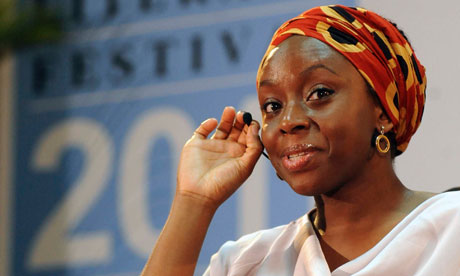
Chimamanda Adichie {Photograph: Ishara S Kodikara/AFP/Getty}
January, 2012
Celebrated Nigerian writer Chimamanda Ngozi Adichie has called on religious leaders to quell rising sectarian tensions in the country as it wrestles with a national strike and tit-for-tat violence by Islamist and Christian groups.
A wave of deadly attacks against churches, carried out by members of extremist Islamist group Boko Haram, has resulted in retaliation by Christians, including the burning of a mosque and school in the southern city of Benin.
“Christian leaders must continue to preach peace and togetherness so that Christians do not retaliate,” Adichie told the Guardian.
“Muslim leaders must strongly and repeatedly condemn the violence against Christians and make it clear that Boko Haram does not represent Nigerian Islam,” she said.
Related: NewsRescue- The Solution for Boko
Her Orange prize-winning book, Half of a Yellow Sun, documented the Biafran war of 1967-1970, which killed more than a million civilians through both fighting and starvation.
Boko Haram, whose name means “western education is forbidden”, emerged in Maiduguri, in Nigeria’s north-east, in 2002. Since then it has mainly carried out attacks on Christians in northern or “middle belt” states.
The organisation remains mysterious, but in an interview with the BBC in 2009 its leader, Mohammed Yusuf, who was subsequently killed by Nigeria’s security services, expressed a number of unorthodox theological views.
He said “western-style education”, which ran contrary to Islamic teaching, included the idea that the Earth was a sphere and that rain was a result of evaporation and condensation.
Boko Haram operates against a wider background of sectarian strife in Nigeria, whose Muslim population is concentrated in its north. The middle belt city of Jos, where various ethnic and religious groups merge, has experienced some of the country’s worst religious violence.
In November 2008 about 700 people were killed in riots following disputed local elections which degenerated along sectarian lines. See: The End of Boko Haram
“Of course I completely understand the rage and pain of Christian southerners whose relatives are murdered in the north, and whose shock and mourning are worsened by the weakness of the government’s response,” said Adichie. “But the vast majority of northerners are as horrified by the killings as anyone else and have nothing to do with them.”
Related: NewsRescue- The Middle Belt holds Nigeria Together; Middle Belt holds ‘Security Summit’
Nigeria’s president, Goodluck Jonathan, said in a speech on 8 January that “the situation we have in our hands is even worse than the civil [Biafran] war”.
In the same speech, he revealed that he thought Boko Haram had sympathisers in various arms of government and the judiciary.
Responding to his comments on the war, Adichie said: “I think that is a mere rhetorical flourish. What matters to me is that our president has publicly said that Boko Haram has backers and supporters in the national assembly. If he has this knowledge, why has nothing been done to and about these supporters of terrorism?”
Related: NewsRescue- Nigeria Targeted For Destruction: Gordon Duff, US
Nigerian workers took to the streets on Friday for a fifth day of strikes over the lifting of the fuel subsidy, after trade unions broke off talks with Jonathan and said they would not restart until Saturday.
The government scrapped subsidies on petrol imports at the beginning of the year, more than doubling the pump price to about 150 naira (60p) a litre, and sparking bitter protests across the country. {NewsRescue- IMF Forces African Nations to Remove Fuel Subsidies}
Pressure is mounting on Jonathan to reach a deal. Nigeria’s main oil union has threatened to shut down output from Africa’s biggest crude producer from Sunday if the government does not reinstate the subsidy.
Niger Delta MEND group
Adichie believes the root of Nigeria’s problems is not sectarianism, but a crisis of governance.
“Right now, all over Nigeria, from Kano in the north to Port Harcourt in the south, people are protesting the same things: the increase in fuel prices and the lack of basic government services.
“Nigerians have divisions but they are largely united in their dissatisfaction with and distrust of their government.

Read more: http://www.newsrescue.com/2012/02/chimamanda-ngozi-adichie-nigerias-problem-is-crises-of-governance-not-sectarianism/#ixzz1z2Tqpsav

MISGOVERNMENT 101

“Governments Never Learn. Only People Learn.”`
(Milton Friedman, 1912 – 2006).

Students of politics are often told that democracy is government of the people, for the people, by the people. Sadly many of them believe it. They also mouth it so often, that millions of people untutored in the nature and dynamics of power believe it as well. The tragedy, as billions of people who live under systems they believe are democratic have found out, is that democracy is very often just a means of changing leaders who do more or less the same things to the people. Leaders emerge from elections which may or may not be credible; and they exercise mandates within the limitations of their personal capacities, and the demands of the very few who influence what they do. The only time people are substantially involved in democracies is during elections, and even these are so choreographed or fixed that they successively alienate more of the electorate at every successive election.
President Goodluck Jonathan is re-writing the basic rules of leadership, such that established theories, strategies and ideas about governance, accountability and competence will have to be re-evaluated. On the face of it, you would think that he has read the late British statesman, C.R Atlee (1883 – 1967), who said: “Democracy means government by discussion, but it is only effective if you can stop people talking”. Or that he has literally taken the view of P.S. Buck (1892 – 1973), the American writer who said, “People on the whole are very simple-minded, and in whatever country one finds them. They are so simple as to take literally, more than not, the things leaders tell them”. Perhaps his long-term vision on the outcome of his contest with the Nigerian people over the fuel subsidy is informed by the insight of August Bebel, (1840 – 1913) the German politician who said that “All political questions, all matters of right, are at the bottom only questions of might.” If he believes that brawn alone will win him this battle, he clearly has not read Machiavelli, who said that a good leader should be both a fox and a lion, because a fox is defenseless against lions, and a lion is defenseless against traps.
If President Jonathan has a strategy for victory against all the battles he is currently engaged in, it is possible that at its heart is the assumption that the more problems you take on at the same time, the better your chances of victory. And the bigger the problem, the more you are likely to succeed against it. Just when he is being swamped by the insurgency of Boko Haram and a nation demanding that he acts decisively against security failures all over the nation, President Jonathan lights another fire around fuel subsidy. He abandons his “consultations with stakeholders” – please note that these are not defined as the Nigerian people – on his plans to remove subsidy, and decides to go it alone. Convinced of the validity of his position, he repudiates the position of the National Assembly, labour, civil society organizations, mothers, young people, the unemployed, the wealthy and the urban poor and just about everyone else. He obviously disagreed with Milton Friedman (1912 – 2006) the American economist who said that “The government solution to a problem is usually as bad as the problem”. Perhaps he paid little attention to history, and the experiences of his predecessors, virtually all of whom burnt their fingers very badly when they tinkered with pump prices.  
Or perhaps he had read Hegel (1770 – 1831) the German philosopher who said, “But what experience and history teach is this, that peoples and government have never learned anything from history”. Alone and isolated, he stands against a torrent of hostility from a nation which cannot understand or forgive him for serious miscalculations and serial ineptitude on vital issues around governance. Perhaps his advisers have convinced him that Andrew Jackson (1974 – 1826), a former US President was right when he said, “One man with courage makes a majority”. His economic advisers who sold him the dummy on subsidy removal as beneficial in the long run may have ignored John Maynard Keynes (1883 – 1946) who said, “This long run is a misleading guide to current affairs. In the long run we are all dead. Economists set themselves too easy, too useless a task if in tempestuous seasons they can only tell us that when the storm is long past the ocean is flat again.”
The multitudes of challenges which President Jonathan has chosen to deal with at the same time are making him new enemies by the day. Book Haram makes Christians and Muslims feel he is not protecting them enough. Christians particularly feel vulnerable when they are attacked by a group that says all Nigerian Christians are guilty of the mass murders of Muslims in Plateau, Kaduna, Bauchi and Lagos, and they and their churches will be attacked at every opportunity. Muslims are angry that they are being blamed and made responsible for everything Boko Haram does by both the government and many other Christians. Security agencies are stretched and stressed, and it would not help their morale much when the Commander-In-Chief says they are infiltrated by Boko Haram sleepers. By his utterances and actions, President Jonathan has united former foes, adversaries and irritants into a formidable enemy. He has ignored Machiavelli’s advise, when he said, “All well-governed states and wise princes have taken care not to reduce the nobility to despair, nor the people to discontent.”
In the next few weeks, the nation will know whether President Jonathan has succeeded in transforming the live of Nigerians by making sure that everything they buy costs a lot more. Or the nation would be relieved that it does not have to go through this type of transformation. Either way, there will be a loser. Jonathan will do well to learn the lessons of dealing with enemies which Machiavelli put forward: “Men are either crushed, or pampered. They can get revenge for minor injuries, but not for fatal ones.” If he yields ground on the subsidy issue, his adversaries will punish him over and over for his weakness. If he sticks his ground, he may break the back of the popular resistance, but his opposition will warn Nigerians about their lives in the same manner Neil Kinnock, the former labour opposition leader in Britain warned his countrymen over Margaret Thatcher: “If Margaret Thatcher wins – I warn you not to be ordinary. I warn you not to be young. I warn you not to fall ill. I warn you not to get old,”
Students of power have great opportunities to re-visit conventional wisdom under current developments. They may reach the same conclusions about the PDP and did Baron de Montesquieu (1689 – 1755) who said, “when a government lasts a long time, it deteriorates by insensible degrees.” If they seek to find an answer to the riddle that Jonathan says he is removing subsidy because of corruption, they will be further confounded by Jonathan Swift (1667 – 1745) the British writer who said, “Politics, as the word is understood, are nothing but corruptions.” When we are faced with a choice of supporting the retention of the subsidy (and, Jonathan’s people will say, supporting the “cabal”) or supporting Jonathan, we could be further confused by the humor of George Carlin who said, “Politics is so corrupt, even the dishonest people get screwed.” Perhaps all Nigerians are coming to terms with the leadership which they elected to govern them. Henry Youngman, a comedian said, “Personally, I’m against political jokes. Too often they get elected to office.”

Towards Economic Development of the North


  • 0
    Share


Sa’ad A. Jijji
In July 2007, I published an article titled ‘Poverty in the North’ wherein I attempted to draw the attention of policy makers, politicians and members of the public to the alarming poverty situation in the North. Citing statistics from various sources, I attempted to amplify the obvious – that there is huge economic disparity between the Northern and Southern parts of Nigeria and that such disparity constitutes a drag on the progress of the nation. In the aftermath of the publication of that and other articles, a series of conferences were organized. Leadership Newspapers organised a conference on ‘De-Industrialisation of Northern Nigeria’ in March 2008 while the Conference of Northern States Chamber of Commerce organised a ‘Northern Nigeria Economic and Investment Summit’ in October, 2008. These two events provided me with a sense of what our leaders think of the current situation and what, if anything, is currently been done on the situation. I shall start by clarifying certain misconceptions I picked.
First, some Northerners (including some prominent ones) do not seem to fully appreciate the level of abject poverty in the North. They argue that the Northern economy is very informal as such levels of bank deposits is not a good measure of our level of economic activity. The argument is that the Northern economy is largely a cash-based. However, according to CBN 2008 Annual report, only 9.7% of Nigeria’s ‘Broad Money Supply’ – M2 (Economists jargon for total currency notes, coins and bank deposits in an economy) is outside the banking system. This reality is what made some bank executives conclude that overall bank deposit growth has peaked in Nigeria. The 23 million bank accounts currently in Nigeria simply account for the bulk of Nigeria’s money. It is not difficult to see this when you appreciate the amounts of money daily being pooled by the GSM companies. In today’s modern economy, physical cash cannot be a sign of strength. Furthermore, in 2007, an Economic Consultancy firm ‘Economic Associates’ published the first state by state decomposition of Nigeria’s Gross Domestic Product (GDP).  In that analysis, crop and livestock production, the major economic activities in the North, contribute only 31% of Nigeria’s GDP. The entire 19 states of the North (with 78% of Nigeria’s Landmass and 53% of the population) account for only 23% Nigeria’s GDP. According to that report, Kano state, which predictably led other northern states, constitute only 3.3% of Nigeria’s GDP. Taraba State led the rear with 0.25%. In contrast, 3 states in the South (Delta, Rivers and Lagos) constitute 36% of Nigeria’s GDP. On a per capita basis, the associated Annual Gross State Product of each indigene of Adamawa (N12,625), Plateau (N45,615) and Kaduna (N60,001) pales in comparison to the corresponding figure for Lagos (N188,716), Rivers (N409,997) and Bayelsa (N833,647). If you are thinking that crude oil production is skewing these numbers, then let’s look at revenue sharing. Using Federation Allocation Accounts Committee figures for June 2009 (shared in July) as released by the Federal Ministry of Finance, lets follow the flow of Nigeria’s wealth. June 2009 is useful because ‘Excess Crude Savings’ was also shared during the month. Let’s look at the allocation to states and local governments. In July, the entire 19 states of the North (with 53% of the population) collected a total of N44.6 billion or 39% of the allocation due to states. However, four states in the South (Rivers, Delta, Akwa Ibom and Lagos), with 16% of Nigeria’s population, collected approximately N33.4 billion or 30% of the federal allocation to states. The old Rivers State (now Rivers and Bayelsa states) collected 12% of the total allocation, same as the collection of the entire 6 states of the North East region. Akwa Ibom, same population as Niger, collected N9.8 billion which is approximately the same as the combined amount collected by Niger, Kano, Taraba and Benue states.  What this figures translate to is that while Governor Shekarau, in July 2009, collected on behalf of each indigene of Kano state the sum of N323, Governor Sylva, collected N2,613 for each Bayelsa indigene. You have to add up 5 indigenes of Kastina (N469) to get one indigene of Delta (N2,187). Even when you add up the share of local governments to that of the states, Kano State (N7.7b), with 44 LGAs and the largest population in the country is still 5th in share behind Akwa Ibom (N12.1b), Rivers (N12.1b), Delta (N10.5b) and Lagos (N10.1b). The LGA with the highest revenue share in the North (Nassarawa – Kano state) collected N188.9mill. which is roughly half of the N378.1mill. collected by Alimosho LGA in Lagos. Also useful to put in perspective that, Niger Delta Development Commission’s 2009 budget of N128.4 bill. is more than Kano state’s N108.7 bill. So when the former CBN Gov, Prof. Soludo, said that the entire 19 Northern states have less bank deposit than the South-South region alone, you may begin to appreciate the source of that disparity.
Related: NewsRescue- Poverty in the North – A “Mayday” Call
Second, some Northerners are convinced that the government of former President Obasanjo and the Banking consolidation program under the former CBN governor somehow accounts for the poverty in North. This is a rather simplistic argument. Poverty in the North predates Obasanjo’s and will outlive Yar’adua’s government. The problem is far more fundamental. Alhaji Falalu Bello in his excellent paper at the Leadership Conference believes the Northern economy ‘’…..as a consequence of various reforms introduced has been totally grounded…’. It may be true that President Obasanjo’s government has benefited more Southern elites than their Northern counterparts but looking at the fortunes of the average Nigerian, you are unlikely to tell the difference. It is fair to say that President Obasanjo’s government did not help the Northern poor, but then who has? Implicit in this blame game is the false assumption that if a Northerner is in power, the fortunes of the average Northerner will improve. Nothing in our history to support this. If political leadership leads to economic success, the North would have been the richest region in the country. Infact, Kastina state, with its enviable political, civil service and military fortunes, should have been the richest state. To illustrate the fallacy of this argument, let’s take one federal position that has been dominated by Northerners. Since the creation of the FCT in 1976, with the exception of the first Minister for Special Duties (Abuja), Late Ajose Adeogun, the leadership of the FCT Abuja has been monopolised by Northerners from John Kadiya to Adamu Aleiro. Yet as at February 2007, indigenes of the 5 South Eastern states of Nigeria own 73% of the allocated land in Abuja. As reported by This Day Newspaper on May 21, 2007, Nasir El-Rufai, the former FCT minister, gave these figures even as he emphasised that at the point of allocation, 68% of the land was allocated to indigenes of the 19 Northern states. We all know what happened in between.
There are many negatives to be said about Prof. Soludo’s consolidation program but it is simplistic to say he killed banking in the North. Even before consolidation, the so called ‘Northern Banks’ had the bulk of their private sector credit business in the South even as the chase FAAC and State/LGA joint accounts in the North. It is elementary economics that banking is not about who owns the bank or has the largest deposit but who gets the largest credit. Paucity of private capital, and the unproductive use of the little available, is one of the major causes of our under-development in the North. Notwithstanding the fact that you need only N20 million capital to start a Micro Finance Bank (MFB) in Nigeria, of the 899 MFBs licensed by CBN, Lagos has 211, Anambra – 84, Osun – 36 while Katsina has 5, Nassarawa – 4 and Yobe – 1. The North needs more MFBs than big Banks to build private capital. The present CBN Governor, Sanusi Lamido Sanusi, is unlikely to change, in any sustainable way, the banking fortunes of North just as the longest serving CBN governor (late Abdulkadir Ahmed) did not. That task can only be done by Northerners our selves. It is very important for Northerners to moderate their expectations of political leadership.

What the Federal Government can do

In my previous article, I focused mainly on what states government can do to alleviate poverty in the North. I deliberately left the federal government because I felt, President Ya’adua was himself a former governor and that his government was new and needed to get its bearing. Two years after it is time to look back.
In analysing the economic situation of the North, there are two important things to consider. First, Northern Nigeria, taken as a nation, is a landlocked nation. With no access to international coastline, the North faces a peculiar challenge. The disadvantage of the hinterland compared to the coast is obvious even in today’s egalitarian China. To spur economic development in the North, the Federal government must open up the region. It is in this regard that the recent flagging of the dredging of the River Niger from Warri to Baro  is an important milestone. However, the effect of this will be limited as the effect of the Lagos coastline has been on Nigeria – namely Niger state will benefit more from the dredging than Zamfara state. What will really open up the North is an efficient railway system. When the former government of President Obasanjo initiated the $8.3 billion rail modernisation process, I was excited by the prospects it has for the region. However, I am alarmed by the fact that more than two years in to this administration all we have achieved is the cancellation of that contract and talk about a ‘Patch-Patch’ arrangement similar to the one done under General Abacha. The award of the Chinese railway contract may have been badly handled but to jettison the modernisation project for the current project is to lose a golden moment for the North. If Nigeria is unable to undertake a railway modernisation when crude oil is selling for $70/barrel, pray when Nigeria will ever to this. More than anything else, the greatest thing than this government can do to impact the lives of the average Northerner is the modernisation of the railway system. The fact that every imported item in Nigeria, from petrol to sugar is cheaper in the richer part of Nigeria (south) than the poorer part of Nigeria (North) means that the North’s disadvantage is been further compounded. It does not make sense for any manufacturer to site his factory in Kastina or Yobe if he cannot easily move his goods to markets in the south or for export. President Yar’adua’s administration must learn from the mistakes of the Abacha administration and as a matter of urgency discard those palliative measures and adopt a wholesale modernization of the railway. What the current minister of Transport should realise is that no private sector participant will be interested in investing in a 35km/hour railway grid that was designed by our colonial masters to transport groundnut from Kano and hide from Maiduguri. Government should stay away from buying engines and rolling stock and just concentrate on the rail network.
Agriculture provides the major source of employment for the vast majority of Northerners and presents the quickest way of reducing poverty in the region. The Yar’adua administration has been taking some encouraging steps. The government’s renewed emphasis on commercial agriculture, the ongoing review of the land tenure system, the ‘Buyer of last resort’ program, Silos expansion projects, massive importation of fertilizer in 2008 and the N200 billion agricultural credit scheme are all steps in the right direction.

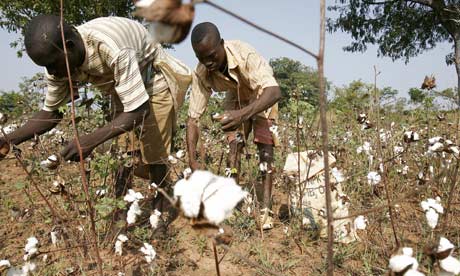
Cotton farmers {guardianUK}
However, there is still room for improvement. Listening to the Kwara State’s ‘Zimbabwean farmers’ and Governor Murtala Nyako, during the break-out session on Agriculture at the Northern Nigeria Economic Summit, you get a sense that the major issues facing commercial agriculture are basically access to low cost finance, land tenure system and low productivity. Infact, Governor Nyako listed fertilizer and tractors, the usual suspects, as number 13 and 14 amongst the issues facing agriculture in Nigeria. Tackling the major issues affecting agriculture requires more than just money. It requires fresh thinking and innovative solutions. With regards to finance, the federal government’s recent N200 billion intervention is commendable. However, as with most government policies, the devil in the details. The guidelines for the Commercial Agriculture Credit Scheme (CACS) as released by the CBN and Federal Ministry of Agriculture requires that for a farm to access part of the loan (from UBA / First Bank), it is required to have assets of not less than N200 million. Clearly, this is targeted at existing large scale farmers and not at younger and more promising farmers. Although the interest rate is designed to be less than 9%, the reality is that only few farmers in the whole North can qualify for this loan. The government needs to realise that commercial agriculture in its infancy stage in the North. More than just finance, we need to find a way to encourage young people to go into commercial agriculture through a more comprehensive incentive scheme. For instance, I will expect the federal government to outline a policy that target’s young graduates or mid career workers with a whole package of easy land acquisition, access to fertilizer and mentorship program with domestic and foreign commercial farmers. I have spent 2 months in a commercial ranch in Northern Kenya and I know more than money, there are many other things required to make commercial agriculture a success. The sad reality is that the incentive structure provided by Kwara state government to the ‘Zimbabwean Farmers’ under the ‘Shonga Project’ is simply not available to ordinary Nigerians in their own country. We need to move commercial agriculture from being the hobby of retired people to an enduring profession that is attractive to young people to make it sustainable.
The land tenure reform is already part of the government’s 7 point agenda but sadly more than half way in to the tenure of this admistration; this laudable reform is nothing more than a proposed bill gathering dust in the National assembly. I hope the National assembly will realise the importance of this reform and work on the bill. Lastly, Governor Nyako listed low productivity as the number one factor affecting farming in Nigeria. Now, Governor Nyako should know because he probably has one of the best managed farms in Nigeria.
Chief Audu Ogbe, at the Leadership conference, gave the example that ‘…a Ugandan widow with one cow earns more than a Fulani man with 10 cows…’.But productivity is ‘catch-all-phrase’ that encompasses several factors including quality of seedling (or embryo), mechanisation, farming methods and a host of other factors. This is again one of the reasons why young people should be encouraged to take up commercial farming. Young people are more likely to employ new farming methods and techniques that can boost productivity. The mentorship scheme I mentioned above will also expose promising commercial farmers to some of the latest farming methods from our research institutes and commercial farmers. The fact that young Zimbabwean farmers are achieving 3 times productivity per hectare in cassava production compared to their neighbouring local farmers in Kwara shows how important younger and modern farmers are to commercial farming.
The efforts of the Small and Medium Enterprise Development Agency (SMEDAN) are commendable but needs to be steeped up and possibly a venture capital outfit be set up to provide equity participation. The Federal Government’s intervention in the textile sector should go beyond money. The federal government should realise that the Nigerian Custom Service has an important role to play in reviving this industry. We hope the Federal Minister of Finance will use his good office to ensure that atleast a government agency enforces government directives. I need not discuss about the power situation in Northern Nigeria. We all await for December 2009.
The federal government also needs to help in mitigating the destructive effect of politics in the North. Politics is badly affecting our incentive structure. Politics has become the most lucrative profession in the North, luring away our some of our best (and worst) brains from other productive ventures. The young man in the South will likely find career role models in many professional bankers, businessmen or workers in the oil industry. To the young person in the North, the ultimate ambition will be to join politics. The Federal government must through real and symbolic gestures recognize and encourage young men to take up ‘productive’ ventures while political office holders should realise the destructive effects of their flagrant display of wealth and power.
Finally, every northerner should realise that the economic prosperity of a community is the direct result of individual initiatives and effort. Our fatalistic attitude to life is nothing more than an abdication of individual responsibility. In the long run, no amount of privilege or patronage can take the place of initiative, hard work and perseverance. Nobody will, or should, improve a society that deliberately decides to undermine itself.

Poverty in the North – A “Mayday” Call


  • 0
     
    Share


By Sa’adu A. Jijji
Now that the elections are over and our newly elected (?) leaders are getting ready to assume their new responsibilities, it is perhaps an opportune time to reflect on a critical aspect of governance. Chapter 11 of the 1999 Constitution under the heading “Fundamental Objectives and Directive Principles of State Policy’ avers that ‘…security and welfare of the people shall be the primary purpose of government….’. Consequently, the alleviation of extreme poverty across Nigeria is a major responsibility of government. This paper seeks to highlight, once more, the prevalent high level of poverty in Nigeria with particular emphasis on the pathetic situation in the North. The aim of this paper is to further draw the attention of political leaders, policy makers, economic actors and the general public to the ‘Poverty Crisis’ currently facing the North and the urgent need to tackle the issue before it explodes with consequences beyond the confines of the region.

The North East region has the highest level of poverty in Nigeria.

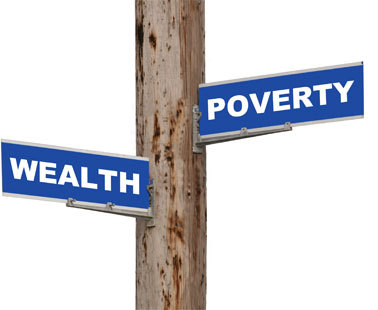
Wealth Poverty {NigeriaVillageSquare}
Starting with the UNDP “Human Development Index’ report 2006 released last year to a recent paper presented by Professor Chukwuma Soludo at a People Democratic Party (PDP) retreat for it’s nominated candidates, the issue of high levels of poverty in the North has suddenly being brought to the front burner of national discourse.
Summarily, the UNDP report and Professor Soludo’s paper titled “Preserving Stability and Accelerating Growth’ highlighted the well known fact that poverty is more prevalent in the Northern than in the Southern part of Nigeria. What many may not have known, and which seems to be the crux of Professor Soludo’s paper, is the magnitude of the disparity between the North and the South.
To put the issue in perspective, the UNDP report cited above ranks Nigeria number 159 out of a total of 177 countries measured on the aggregate index. Nigeria (with a score of 0.448) compares unfavorably to Norway (0.965) but better than Niger (0.311).  According to the report, Nigerians born today are, on the average, more likely to die before their 45th birthday – Japanese born today are more likely to die around the same time with the children of their Nigerian age mates.
To measure poverty, the report uses a much more complex ‘Human Poverty Index’ in place of the simplified ‘less than $1 dollar a day’ measure. The index attempts to measure not just deprivation but the quality of life available to the citizens of the country. Using the Index, Nigeria (with a score of 40.6) ranks 76th with the same points as Yemen, slightly better than Burundi (40.7) but well below Uruguay (3.3) which placed 1st in the 155 country list.
In the paper presented to PDP nominees on January 16, 2007, Professor Chukwuma Soludo, the Central Bank of Nigeria Governor, presented in graphic terms what any traveler across Nigeria can attest to. According to his figures, although the average poverty incidence for Nigeria stands at 54% of the total population, the three regions in the North, account for a disproportionate share of that average.
With a poverty prevalence of 72.2%, the North East region has the highest level of poverty in Nigeria. The region is followed closely by North West (71.1%) and North Central (67.0%). On the contrary, South East (26.6%) has the lowest level of poverty of poverty in Nigeria followed by South/South (35.1%) and South West (43.05%).
However, compared to actual poverty prevalence, most Nigerians, irrespective of their regions, considered themselves much poorer than they actually are. In fact, more residents of the South East (77.6%) and South/South (74.85%) considered themselves poor compared to residents of the North/West (71.9%). This irony is best explained by other sociological factors as contentment and lack exposure to comparative levels of poverty – issues beyond the contemplation of this article. On a state by state basis, the picture is even gloomier for the North.
According to the professor’s paper, the 10 states with the highest level of poverty in Nigeria are all in the North. Jigawa (95.0%), Kebbi (89.7%) and Kogi (88.6%) top the list. Conversely, all the 10 states with the lowest level of poverty are in the South. Bayelsa (20.0%), Anambra (20.1%) and Abia (22.3%) top the list. These numbers are what led Professor Soludo to rightly conclude that “very high level of poverty is essentially a Northern Phenomenon”. Furthermore, the Professor informed his distinguished audience that the 3 zones in the North (excluding FCT) collectively have less bank deposit than the South/South zone alone.
In fact, the entire North accounts for a paltry 10.75% of bank deposits and a meager 8.5% of bank loans. If adjustments are made for state and local government bank deposits and loans, the picture in the North would be more frightening as the FCT alone accounts for more than 16% of all bank deposits.
Interestingly, Lagos still accounts for 48% of deposits and nearly 70% of all bank loans. Summarily, what these numbers tell us is that were the six geopolitical zones  distinct countries, the Northwest and Northeast ‘Countries’ would be in the same league with Niger Republic, Chad and Mali while the South East ‘Country’ will be nearer to China and Korea.
Infact, using the poverty index alone, Jigawa and Kebbi states, with 9 out of every 10 residents considered poor, are no better than Eritrea, Bangladesh or Somalia.

Why is there such a level of poverty up North?

Having laid the background, I shall now return to the more important issues as to why the North has such levels of poverty, the possible reasons for the sustained disparity in poverty levels between the North and South and attempt to proffer suggestions on what can be done to alleviate the situation.
Unfortunately, Professor Soludo’s brilliant paper is short on diagnosis and completely absent on prescriptions. As the then ‘Acting Economic Adviser’ to the President, Professor Soludo could have taken the presentation beyond an academic level.
Considering the politician audience at the event, I wish the distinguished professor had gone ahead to explain to some of the Northern Governors (or would-be Governors) how some of their actions/inactions may have led to the present situation and what could be done improve the situation.
I strongly believe only a handful of the distinguished audience at the presentation still remember the crux of Professor Soludo’s presentation or even bother to keep copies of the paper (which by the way I got from CBN’s website). So why do we have such comparatively high levels of poverty in the North? Some commentators have attempted to explain this phenomenon citing historical, geographical and sociological factors.
For example, it is a known fact that most coastal areas of the world tend to be more affluent that their adjoining hinterland. Likewise, higher levels of atmospheric temperatures seem to correlate with high levels of poverty – with oil rich Arab countries as obvious exceptions.
Ironically, with the exception of Borno state, all the five states with the highest level of atmospheric temperature in Nigeria are in Professor Soludo’s Bottom 10. Some commentators have even gone ahead to cite as evidence to support the ‘Geography theory’ the fact that the ‘Equator’, the imaginary line that divides the earth into Southern and Northern hemispheres, passes through only poor countries from Gabon, Kenya to Ecuador. Could the reason for such high levels of poverty be historical?
Praying for Prosperity
Colonization, and subsequently modernization and westernization, came to Nigeria through the South. Politically (in the sense of organized societies) the North may have been ahead of the south at the end of the 19th century but the impact of colonization at the turn of the 20th century was to have a defining effect on the south.
Western education, trading opportunities, literacy and access to western technologies and innovations seem to have conspired to give the Southern Part of Nigeria a head start in economic and social development. The ‘Indirect rule’ policy Lord Lugard adopted in the North which, in part was in admiration of the advanced political system of the region, also meant that traditional institutions and practices that could also act to stifle economic growth and development were left to flourish.
The concomitant effect of this was that from the onset, the Northern region was simply on a ‘catching’ game with the south. Now in any race where one participant has an initial advantage over the other, there are only two ways that the other party can catch up. First, the lagging party accelerates his speed not only beyond his current level but also in excess of the speed of the leading party who presumably is not stationary. Second, the leading party slows down (or is made to slow down) to allow the lagging party to catch up with him.
In Nigeria’s economic development, it appears the neither the Northern states nor the Federal government seem to be pursuing either of these policies. In actual fact, the disparity in levels of economic development between the south and the North seems to be widening with time.
In a report compiled in 2000 by Ben E. Aigbokhan for the African Economic Research Consortium based in Nairobi Kenya, the author conclusively showed that even though poverty levels have been on the increase in Nigeria from 1985 (38%) to 1996 (47%), the growth in poverty was actually accounted for the deterioration in the North which actually wiped out the relative gains recorded in the South during the same period.
In that report, Bauchi, Jigawa and Yobe states accounted for the highest level of poverty in Nigeria. According Professor Soludo’s paper, by 1980, the difference, in percentage basis points, of the poverty prevalence rate between the richest region (South East) and the poorest region (North West) was 24 points. By 2004, the difference between the same regions has widened to 44 points.  What this translates to is that at current trends, the North has no real chance of bridging the gap talk less of catching up with the South.
Other commentators have attempted a sociological explanation to the high levels of poverty in the North. They contend that Northerners are generally laid back, less adventurous, less frugal, less educated, tend to be polygamous and generally mistake complacency for contentment. Proponents of this school contend that high level of poverty prevalent in the North is directly the result of this attitudinal problem. They cite the relatively low economic level of the average Northerners resident in the South (mostly petty traders, security men and beggars) and the relative affluence of the some southerners (mostly Igbos) resident in the North as justification that geography and history cannot fully explain this persistent disparity.
The major argument against this school is that compared to his counterpart that stays back in the North, the average Northerner that emigrates to the South (even as a beggar) is still better off simply because of the opportunities provided by the level of economic activities in his host region.
Related: NewsRescue- Boko Haram and the deadly crises in North Nigeria- 400+ dead

Differential opportunities, not promoted

In my view, several factors have conspired to lead to the present situation. According to the ‘Global Poverty Report’ submitted to members of the G8 group of industrialized countries at their meeting in Okinawa in July, 2000, ‘……The main causes of poverty in Africa are the low levels of productivity and production technology, especially in the agricultural sector which provides most of the employment and a large share of the GDP………”. By its agrarian and landlocked nature, the North has competitive advantage in basically three economic activities.
Agriculture, Agro-Allied Industries and Extractive based industries. It is difficult to see any coherent and consistent plan for boosting agricultural production in the Northern region. A plan aimed at, for instance, doubling the production of Maize, Beans, Groundnut, Wheat or Cotton in the short / medium term. While states like Kwara and Kebbi see the need to bring in foreign large scale farmers from Zimbabwe and China, other states like Kano think fertilizer is the major issue with farming in the state. Jigawa state even has this ingenious idea of promoting the farming of snakes and frogs for export to Asia in addition to cultivating sugar cane for the production of ethanol. Other states like Bauchi, Niger and Yobe simply appear at a loss on what policy to pursue.
The net effect is that whatever gains are achieved in a particular state are difficult to sustain beyond a particular administration or is consumed by the inertia of the neighboring states.  Certainly this state of affairs is not helped by the seeming lack of direction from the Federal Government. Considering the major role of agriculture in the economy of Northern Nigeria and its potential for alleviating poverty in the region, you sometimes wonder why lip service is still paid to this sector in the North.
Nigeria's Northern Beggars {pmnews}
The inability of the Northern region to develop or sustain any competitive advantage in the region based on Agro- Allied industries is best exemplified by the current situation in the textile industry.
Most of the textile industries in the North which provide direct employment to thousands of Northerners and indirect employment to millions through cotton farming have simply closed down. Either because of a cloudy policy direction or insufficient political will, political leaders in the North have been unable to bring any pressure to bear on the Federal Government to enforce its ban on textile imports into Nigeria and grant other concessions to textile manufacturers. In fact, more textile firms have closed since the president launched his “Cotton Farming Initiative’ in Kaduna in 2005.
Ironically, many of the Northern governors attend the “Northern Governors Forum’ clad in attires made from these banned textile materials to discuss the state of textile industries in the region. In the 70s/80s, Funtua, Gombe and Gusau were centres of cotton activities with many flourishing ginneries. Today, most of these ginneries have closed down rendering thousands without any income and exacerbating the poverty situation in the region.
In Borno State, the shoe factory commissioned in the 80s to take advantage of the abundant hide and skin in the area is no longer in operation. The Savannah Sugar Factory in Adamawa and the Bacita Sugar Factory in Kwara were comatose for several years rendering thousands without any income until the federal government decided to sell these factories. When you add all these to the several factories that have closed shop in Sharada, Bompai and Kawaji industrial areas in Kano mainly due to power supply issues, it is easy to understand why the North has the highest unemployment rate in the country. Unemployment, in the absence of social welfare, equates poverty. In this light, the multi billion naira ‘Textile Industry Support Initiative’ launched by the past administration is viewed with cautionary optimism.
Furthermore, the other area that the region could have developed a competitive advantage is in developing industries based on extractive materials. Because of the abundant lime stone deposits in the region, the North has the capacity to produce cement to meet the entire national demand and for export. Yet, but for the recent Dangote’s Obajana Factory (in Kogi), there were only three cement industries in the region. Of the three, Benue Cement, until recently was down for more than 4 years, CCNN in Sokoto was so badly managed that it took the intervention of privatization to restore it to its current state. Ashaka Cement was perhaps the major exception to this. The company has performed exceptionally well over the years (under the watchful eyes of Blue Cycle UK and later Lafarge France- the technical partners) and contributed in no small measure to improving the economic lot of its host state, Gombe. To buttress the poverty reduction impact of employment generating companies, none of the bottom 7 states in Prof. Soludo’s presentation has any particular company that provides direct employment to up to 500 people. Other extractive based industries that the region has failed to develop include solid minerals, gypsum, and kaolin.

Poorer leadership

Another issue that has contributed to the rapidly declining fortunes of the average Northerner is the quality of leadership at the state level in the North. Although leadership challenge is across Nigeria, but because of the pervasive nature of government influence on the Northern economy, the impact of leadership is felt more in the North than in the South. Former Togolese leader Eyadema’s theory that ‘one year of bad governance retards development for 10 years’ finds true expression in the region. In a state like Lagos, touted to be the fourth largest economy in Africa, the misrule of a bad governor will not be felt as it would in a state like Taraba where the fortunes of every resident seems to be related to the government directly or remotely. Critical as leadership is to the North, the region has not been fortunate. Many governors in the regions simply have little or no idea about how to alleviate poverty or foster economic development in their states.
Related: NewsRescue- Democracy Fails Africa
In the North, when a governor is said to be ‘performing’, what it means is that his administration has succeeded in building roads, hospitals and even Airports. Nobody talks about job creation as if roads, by themselves, provide income to the citizenry or hospitals can prevent poverty induced ailments. Take the construction of a dual carriage way in a Northern state capital for instance; more than 80% of the expenditure of that contract is expended outside the economy of the state and the region. Apart from the wages expended on temporary laborers and the amount expended on sand and gravel, little of the contract sum has any impact on the economy of the state. After the road is completed, somebody needs to ask the important question; what are the real economic benefits of the road to the state?
Could another more economically impacting activity have been done with the money? In the last four years, two of the states listed in Professor Soludo’s bottom 10 have committed more than =N=3 billion naira each to building an airport in their respective state capitals. Apart from the occasional ‘VIP Movements’ experienced at these airports, these projects have only an emotional value to the populace of these states. It is difficult to imagine that the huge sums expended on these projects could not have been better utilized in purchasing tractors or enhanced seedlings or as ‘micro credit’ to rural farmers.
Take the case of another two states in Soludo’s bottom 10-Sokoto and Bauchi states. Now, any visitor to these states cannot but be impressed with the level of infrastructural development achieved in the last 8 years – and the Governors have several awards to show for that. It is difficult to compare what has been achieved in these two states with the ‘little’ achieved in states like Abia and Anambra which ironically are in the top 3. This begs the question, are these northern states pursuing the wrong ‘development’? My view is that unless we begin to measure government programs and activities in the North through the prism of real economic indicators like ‘Impact on state GDP’ and ‘Job Creation’, we may never have a proper view of our economic development.
In addition to all these, politics and politicians have also played a negative part in the economic development of the region by misdirecting productive effort in the North from economic activities to politics. Northerners, of all ages, spent a disproportionate amount of time and energy either discussing or participating in politics compared to their colleagues in other regions of the country. Furthermore, because there is no middle class in the region; the only role models that Northern youths look up to are the many corrupt government officials or contractors in the region. Youths in the North, are lured away from school and work to serve as political hangers-on or as thugs while their colleagues in the west are in school and the ones in the east are in their shops.

Suggestions

The ‘Millennium Project (2005)’ has identified a four step strategy for achieving the No 1 MDG goal of halving poverty by 2015. This four step strategy involves distilling the root causes of and dimensioning poverty prevalence across region and gender, conducting a needs assessment of the public investments required, developing a 10 year framework for action and elaborating a 3-5 year poverty reduction strategy within the context of the 10 year plan. My humble suggestions revolve around a 3-5 strategy with particular emphasis on food production and job creation. Other important issues like access to health care and education will be greatly impacted by improved nutrition (disease prevention) and wealth creation (improved school enrollment due to reduced child labor).
Related: NewsRescue- Nigeria’s problem isn’t Islamist fundamentalism — it’s the country’s corrupt and self-serving government.
First, the 19 Northern states, under the guidance of the federal government, need to urgently develop a collective agricultural plan. This holistic plan should be based on the competitive advantage in the North. Each state should have one or two particular crops, the production of which it shall aggressively pursue. Concerted efforts will then be made to support the production of these crops through improved seedlings, advanced farming techniques, provision of adequate fertilizer, agricultural soft loans and other incentives.
This plan can be better achieved by encouraging large scale farming as opposed to the current subsistence farming. In each state, farmers with the capacity to cultivate above 100 hectares should be identified, developed, trained and supported.
This approach will inevitably lead to better management of resources and sustainable employment. ‘Importing’ commercial farmers from abroad is not a bad idea, it should be encouraged, but more importantly is to develop indigenous large scale farmers who are better placed to provide sustainable growth and impact.
To avoid a situation of depressed prices during periods of bumper harvest, states need to intervene in guaranteeing prices for farm products. This can be achieved through direct intervention in the market or through increased participation in the upcoming commodity exchange. For the subsistence farmers, a robust ‘micro credit’ similar to Mohammed Yunus’s Grameen Bank scheme in Bangladesh needs to be developed. The current =N=50 billion federal government initiative will be a good starting point.
Second, there is an urgent need to quickly articulate an industrialization policy for the region. In which industry does the region have a competitive advantage? How can entrepreneurs be developed and supported in the region? How can we stem religious and ethnic strife that discourages investments in the region? What will be the short, medium and long-term milestones to be achieved? Which industries will have the most multiplier effect on the Northern economy? How will the issue of power and fuel supply be handled within the national framework? How can small and medium scale industries be developed in the region? How can we cultivate the entrepreneurial spirit in the average northerner?
In pursuing these objectives, the role of the New Nigerian Development Company (NNDC) as the investment arm of the northern sates will have to be properly articulated. For a start, NNDC has to be recapitalized and staffed with technocrats. The company’s current bureaucratic, top heavy structure needs to give way to a more focused and dynamic structure. To develop businesses and improve the managerial skills of upcoming entrepreneurs, NNDC needs to incorporate a Venture Capital Company. The envisaged company will not only provide equity participation in entrepreneurial start-ups but will also avail budding entrepreneurs with management best practices in the conception and weaning of these enterprises. Even the investment decisions of NNDC will have to be streamlined to achieve the predetermined objective of economic development of the region. What sense does it make sense for NNDC to invest billions in Nestle Plc when that investment cannot influence Nestle to locate one of its plants in the region? How come the substantial investment of NNDC and the states governments in banks translate to only ‘8.5% of total bank loans’ to the region?
Third, political leadership in the region have to reassess their developmental priorities. Critical questions should be asked before any project is embarked by states in the region? Questions like what is the economic value of this project to the state? Does it have any multiplier effect on the economy? Is the project sustainable? What other alternatives are there for this expenditure? In addition, states should strive to ensure that whatever allocation comes to them from the federal government, or is generated locally, is as much as possible retained within the state economy. Whenever any contract is awarded by a state government, care should be taken to ensure that as much as possible the contractor uses as much local content as possible. This should not be confused with awarding contracts to state indigenes which may not necessarily achieve the intended objective. ‘White elephant’ projects like airports and trade fair complexes should as much as possible be curtailed. These projects in reality do very little to aid the economy of the state even though they consume huge sums of money. Any state that ignores this simple idea will end up being like Bauchi. A beautiful state with good roads and other infrastructure but whose citizens continue to live in penury.
Related: NewsRescue- Towards economic development of the North
Lastly, northerners have to collectively take their destiny in their own hands by electing and promoting good leaders. Some will argue that ultimately, a society gets the kinds of leaders it deserves as leaders are embodiments of their society’s virtues and vices, capacities and constraints. However, I still firmly believe that upcoming generations of northerners need to take the charge in leading this crusade for change.
The North needs to develop leaders that posses characteristic that transcend its people’s present level of consciousness. We cannot rely on luck or chance for these leaders to emerge like a ‘Flash in the Pan’. As far as I know, there are only two special reasons why Sir Ahmadu Bello, the former premier of the Northern Region is still celebrated in the region. First, he had the foresight and vision to institutionalize some policies that continue to bear fruit for the region. Second, successive generations of leaders in the region have been unable to match or surpass his achievements in their smaller domains.
This indictment on the collective abilities of northerners need not be so. And can be changed. I strongly urge northerners who have been privileged in one way or the other to reflect back on the state of their communities and see what they can do individually or collectively to improve the fortunes of their society. Either as political or business leaders, Northerners have to invest in the North and draw investments to the North before this level of deprivation can be reduced.
Northerners should always remember that whatever may be their personal achievement in life, the larger society will always view them through the prism of economic and social status of their community. Today, the average northerner is viewed as more closely related to the economic and social status of the alms beggar on Borno Street in Ebute Metta, Lagos than to the fortunes of Aliko Dangote who is generally viewed as an aberration.
In conclusion, the level of economic deprivation in the north is not a local issue. The situation portends a grave danger to the fortunes of the entire nation. Like a chain, Nigeria is only as strong as its weakest link. The federal government and indeed all Nigerians must seek ways of assisting the region improve its economic lot. With arguably the largest population of Nigerians residing in the North, there is no way the collective fortune of Nigeria can be improved without immediately addressing the issue of acute poverty in the region.
I call on the Federal Government to immediately declare an economic emergency in the Northern region and put in place measures to assist northerners uplift their economic status. Unless this is done, Nigeria faces the risk of entrenching economic inequalities not only across social classes but also across geographical lines. This will certainly hinder national unity and development.

Tuesday, 26 June 2012

Who are the Real Enemies of Nigeria?


Judging from the trend of opinion in the media and the tenor of conversations online, it seems that Nigerians have reached a rare consensus on the object of their collective wrath. He is the Northerner, particularly the Muslim “Hausa-Fulani” Northerner with the emphasis of the indictment varying from the generic category of “Muslim” to that of “Northerner” or “Hausa-Fulani” depending on who is doing the indicting and the circumstances. From the barrage of anti-Northern invective online, it is clear that the Northerner is considered the diabolical, greedy and power-hungry embodiment of all that is wrong with Nigeria.

Nigerians have consensually used these same adjectives before about another group – the Igbos. At one point in our history, the Igbos were the national scapegoats. As Chinua Achebe wrote in 1983, “Nigerians of all other ethnic groups will probably achieve consensus on no other matter than their common resentment of the Igbo.”

In a multiethnic and multi-religious society steeped in poverty, part of the competition for group advantage is the quest to identify a common enemy, to dress it in readily identifiable sectarian garments and crown it with thorns as the national scapegoat. In earlier times, the toga of villainy was draped around the Igbo, stereotyped in the national consciousness as grasping, greedy, arrogant and clannish.

From the mid 1980s onwards, it became fashionable to speak of “northern domination.” The designation of national scapegoat has to do with perceptions of power and group advantage in the public realm. During the pre-Independence period when Igbos were prominent actors in commerce, politics and the civil service, they were vilified for plotting “Igbo domination.” The sequence of northern-led military regimes from the 1970s to the late 1990s made a new narrative of northern domination inevitable.  

The demonization of “the north” in the media mirrors the vilification of the Igbo between the 1940s and 1960s. As with the Igbo, the depiction of the north as the arch-villain of the Nigerian tragedy is fallacious. Blaming all of Nigeria’s problems on one region or ethnic group and defining ethnicities as political categories with predictable socio-political habits is an untenable generalization and a prejudicial simplification of the Nigerian situation. This is unfortunately the dominant pattern of social and political analysis. It is one in which public life is interpreted in terms of mutually hostile fractal solidarities perpetually locked in a war for ascendancy.

The practice of identifying national scapegoats is a Machiavellian dark art. During the late 1980s and early 1990s, the Babangida regime identified “radicals” as the enemy. It was the desire to destroy radical academics that informed the military’s perception of the university as enemy territory and its subsequent subversion of higher education. Academics in the Ahmadu Bello University and the Obafemi Awolowo University (OAU) in particular faced systematic persecution and harassment. In later years, elements within the Babangida regime would identify the OAU as the hub of a “Yoruba opposition.” Similarly, the University of Nigeria in Nsukka was targeted during the civil war as the “intellectual base” of the Biafran secession.  

Following the June 12, 1993 election crisis, the emergence of Sani Abacha, and the incarceration of Moshood Abiola, the Yoruba were cast as the enemies of Nigeria and the chief opponents of the regime. The regime’s propagandists lost no time in dubbing the pro-democracy activists who wanted the June 12 election actualized as Yoruba tribalists even though Abiola’s mandate had been remarkably pan-Nigerian. The June 12 advocates reciprocated, insisting that the “north” was against the emergence of a Yoruba president, even though Abiola had won very handsomely in northern states. Abiola, himself a long time crony of military dictators, never attributed his travails to the machinations of a “north” intent on denying him power because he was a southerner but to what he called “a small clique in the military determined to cling to power at all costs.” But facts pale in the face of mythology.

Eskor Toyo once lamented that ethnic chauvinists in the south would rather refer to Sani Abacha as a northerner rather than as a fascist military dictator. After the near assassination of The Guardian publisher Alex Ibru in 1996, a group calling itself the Revolutionary Movement for Hausa Fulani Interest, (REMHFI), claimed responsibility. Of course, the attempted assassination was the work of the junta’s agents. It had nothing to with Hausa or Fulani interest and everything to do with the prolongation of a fascist dictatorship.  But power mongers have long learned how to manipulate popular bigotries to their own advantage.

By 1999, the scales of enemy definition were weighted firmly against “the North.” Guerilla journalists had riveted Nigerians with tales of the intrigues of the “Hausa-Fulani oligarchy” or the “Sokoto Caliphate” – all metaphorical representations of the “northern enemy.” In his book, This House Has Fallen, Karl Maier reports Bola Ige as disclosing that the real controllers of Nigeria consisted of “not more than two hundred Fulani families.”

With the emergence of Boko Haram, the North is being entrenched as an “enemy other” in the national imagination, aided by the ignorance and malice of a biased media, 90 percent of which is based in the southwest (the so-called Lagos-Ibadan axis); and bigotry of pandemic proportions in our public life. Jingoism as journalism is rendering public discourse between Nigerians mutually unintelligible. It should have been fairly easy to mobilize national opinion against Boko Haram, a terrorist group that murders Muslims and Christians alike, and to cast it as a common enemy – but the media’s insistence on the myth of the “northern enemy” and its prejudicial coverage, which has prevented even sufficient acknowledgement of the fact that as many (if not more) Muslims have been killed by the group, – have negated this. This reportorial slant corresponds with the narrative of a Muslim north ranged against a Christian south – a popular fiction, yet possessed of such apocalyptic sensationalism that it sells papers. Put simply, politicians and the press both profit from demonizing groups and promoting prejudice.  

However, ethnicity and religion possess limited explanatory capacity. According to Obi Nwakanma, northern domination is one of “the most sustained mythologies of post colonial Nigeria.” He argues that “the idea that the north through the military ran Nigeria and underdeveloped it is false… The closer truth is that a very complex alliance of business interests from the North and the South, with their international banking and security links ran Nigeria, and continues to run Nigeria. The ordinary northerner – Hausa or Fulani or Berom or even Tiv – has not benefited in any significant way from the so-called rule of Northerners. Individual northerners and southerners have benefited in immense ways, from their close associations and links with power, and we must pay heed to this fact.” Tam David-West contends that, “Northern Domination is a myth concocted and popularly peddled and perpetuated by lazy politically emasculated Southern politicians and most unfortunately also some Southern intellectuals; a grand alibi to cover up or divert from their  ineffectiveness, ineffectuality and even political harlotry.” “Northern domination” is used in the same way that some northern politicians use the bogey of “southern domination” to mobilize support through fear of the other.  

The great radical historian Bala Usman interpreted the Nigerian condition as a consequence of class machinations rather than contending ethnicities. He argued that a comprador elite of impeccably national character and transnational affiliations armed with hegemonic designs, rather than any ethnic constituency, are the true enemies of the Nigerian nation. Yet, their ascendancy lay in their ability to wear ethnic and religious masks, and manipulate ethnic and religious identities for personal gain.

In 1989, while addressing the Oxford-Cambridge Club, President Ibrahim Babangida said, “By accident of birth and more by education and access to opportunity, a few of us numbering only a few thousand, out of a population of more than 100 million, find ourselves in positions of leadership and influence in the professions and academics, the armed forces, the bureaucracy, industry, agriculture and commerce, in the media houses, in the courts and councils of our traditional and political associations. We equate our ends with the ends of the groups and communities to which we belong. We mobilize others to fight for our individual causes, individual beliefs, and interests as if those were their causes, beliefs and interests, etc.” Critics may justifiably see Babangida’s thesis as a self-indictment but it is accurate nonetheless.

The enduring lesson that political elites learned from the catastrophic failure of the First Republic is that no one ethnic group or region can “dominate” Nigeria. The key to political success since then has been to build multi-ethnic coalitions to share the national cake – an equal opportunity kleptocracy. This was the genius of the National Party of Nigeria (NPN) during the Second Republic and has been carried on by the Peoples’ Democratic Party. The tiresome “north-south” polemics only serve to obscure the pan-Nigerian character of the reigning elites, by provoking provincial passions and diversionary conflicts at the grassroots – in which the poor are expendable.       

Our chances of mitigating such aggressions depend on how mature we become intellectually and politically. The more mature we become, the less need we will have to externalize our failures upon other ethnicities and faiths, and the more discerning we shall be of who the real enemies are.  As the great political scientist Claude Ake once said, “There is no north that is anybody’s enemy and there is no south that is anybody’s redemption.”

In the 2011 PDP convention, Atiku Abubakar sought the party’s presidential nomination as the “official northern flag-bearer” and failed to muster a complete following even among northern delegates. His failure was no mystery. Political power obeys dynamics other than accident of birth. Geography is not always destiny. As Chidi Amuta explained, In a free market Nigeria, the brotherhood of the naira is fast overtaking the bonds of tribe and religion.”

Despite Muhammadu Buhari’s popularity on the northern street, many northern elites, being beneficiaries of the current order did not support his presidential candidacy. Nor did they support the other two northern contenders, Ibrahim Shekarau and Nuhu Ribadu. The media with its tunnel vision fixation on a mythical northern solidarity failed to note that a monolithic north no longer exists (If indeed it ever truly did). The blame for our woes lies squarely with “the brotherhood of the naira” – a national fraternity of politicians far more united by their appetites than divided by ideology – and also with our own lack of discernment. Ethnic and confessional allegiances matter but they are subject to the supervening calculations of class interest and are nowhere as definitive as believed when it comes to the intrigues of “high” politics.

In fifty years, the actual enemies of Nigeria have not changed. As one soldier declared on a fateful day in January 1966, “Our enemies are the political profiteers, the swindlers, the men in high and low places that seek bribes and demand ten percent; those that seek to keep the country divided permanently so that they can remain in office as ministers or VIPs at least, the tribalists, the nepotists, those that make the country look big for nothing before international circles; those that have corrupted our society and put the Nigerian political calendar back by their words and deeds.” The righteous fury of this indictment was to be lost in the series of tragic events that collapsed the First Republic. But the truth of the diagnosis remains unimpeachable.   

Thus, while we slander and stereotype each other, our leaders continue in their unregulated feasting, secure in the knowledge that we are too distracted by petty bigotries to surveil their conduct. We must realize that this season of turbulence is also a teachable moment – one in which we should share perpectives, listen to and learn from each other while building a front to salvage our common future. We must not squander it. 


All images sourced Google Images.